"I'm going to speak my mind because I have nothing to lose."--S.I. Hayakawa
_______________________________________________________
Showing posts with label Grytviken. Show all posts

Saturday, January 19, 2013

The Antarctic Journals, Chapter Thirty, Going Home


The Quest arrives at the whaling station of Grytviken on South Georgia Island on Jan. 4, 1922, six years after all the men of the Endurance were rescued.  Ernest Shackleton is greeted warmly by his friend the station manager and they spend the day revisiting favorite sites around the station.

That evening, Shackleton dines aboard the Quest and goes to bed.  At two in the morning, Shackleton summons his friend Alexander Macklin, a surgeon, to his cabin.  Macklin is concerned about The Boss’s health and notices the cold in the cabin.  He leaves and returns with a heavy blanket which he tucks around Shackleton.

Macklin remains and talks with Shackleton, carefully suggesting that perhaps he should take it easy for a while.

“You are always wanting me to give up something,” replies Shackleton  “What do you want me to give up now?”  Suddenly a massive heart attack hits and he dies shortly before 3 a.m.

He is 47 years old.


Sir Ernest Shackleton


***


 O>
(   )
= =
Ten days previously in this voyage.


The Fram moves slowly into East Cumberland Bay on the eastern coast of South Georgia Island and drops anchor in the pristine water.  Sunlight glints off the frothy wake of a Polarcirkle boat as it takes me to land on a beautiful and peaceful day in this remote place.


I step out of the boat onto a small rocky beach and watch the seals and penguins nearby.   


Then I walk up a gentle rise of low grass punctuated with mounds of tussock grass and pass through an opening in an immaculate white fence.  I carefully watch where I’m stepping as I proceed to the far side of this small enclosure and stop at a stone monolith several feet high.

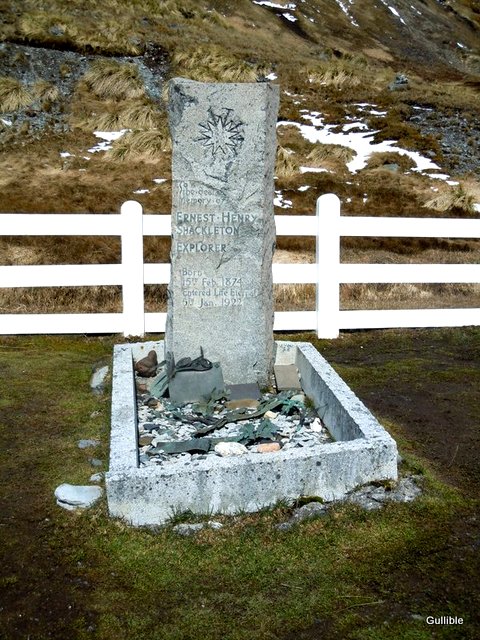
Before me is the final resting place of Ernest Shackleton, explorer, author, and leader extraordinaire of men.  Though most of the graves here are oriented east, Shackleton's is oriented south towards Antarctica.  The remains of Frank Wild, his devoted right hand man in life, are buried at Shackleton’s right.


The Scottish granite marker, topped with the mariner's star.


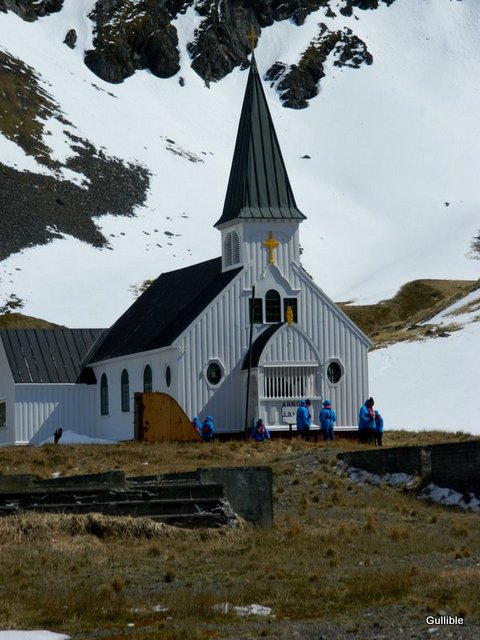
Whaler's church at Grytviken


It is customary for visitors to this remote and stunningly beautiful place to pause here and pay their respects to the man who was arguably the last man of the heroic age of explorers.  It is also customary to dribble a shot of Scotch whisky over Shackleton’s grave, which was his favorite drink.


A few years ago, five cases of Scotch were discovered buried under the hut Shackleton built in Antarctica for his Nimrod expedition.  After great effort by the distiller, the whisky’s flavor  was duplicated and a bottle sold for £100, or about $160 a bottle.  Even the glass maker took pains to make the bottle look as if had been made a century ago.


The whaler's cemetery can be seen to the upper right of the small white building with the red roof.

I turn around and look at Shackleton’s final resting place. Tall mountains, slowly losing their snowy duvets, sparkle in the sunshine of early austral summer.   


Before me, a freshly- painted black and white expedition ship bobs at anchor as little orange boats deliver visitors to the beach.


To my left are the carefully preserved remains of the Grytviken whaling station, a monument to a bygone era.  The seals and whales and penguins that once were slaughtered here for their oil are now protected.  Inside a small museum building is a replica of the James Caird.  


Rising above the vats and conveyors and rusting ruins of whaling boats is the steeple of a white church where a service was held for Shackleton.  After Wild’s grave was located a few years ago, and his remains transported to South Georgia, another service was held in the church for him.


Elephant and fur seals haul out on the beaches and slumber unmolested.   Three King penguins waddle down from a snow patch to peer at the newcomers in blue parkas.


This is a peaceful and lovely place.  It's a fine place for eternal rest.


Tuesday, January 1, 2013

The Antarctic Journals, Chapter Twenty-two, Grytviken


March 23, 1916:  Ernest Shackleton spots land to the west, the first they have seen in more than a year.  Hurley says they could reach land in a day if the pack ice relents and they could find open water.

The ice does not relent, and near the end of the month, Shackleton realizes they have drifted so far north there might not be reachable land ahead.

March: 30:  The last of the dogs are killed, the younger ones eaten.  The men lie in their sleeping bags and feel the swell of the ocean beneath them.  Lees suffers from seasickness.

April 7:  The tall peaks of Elephant Island are seen ahead in the far distance, but the ice shifts again and again, sometimes putting the island out of reach, sometimes making it seem a possibility.


The floe on which they are camped becomes smaller and smaller, until it is a 90 by 100 by 120 yard triangle.   A crack opens in the disintegrating ice and dumps the James Caird into the water.   The next afternoon, after a substantial meal, Shackleton and the men take to the boats.

This photo by Frank Hurley shows the 22.5 foot long James Caird after she was decked over.  However, at this point in our story, she is still an open life boat.

On the James Caird are Shackleton, Wild, and nine men.  The Dudley Decker holds Worsley and eight more men.  And finally, on the smallest boat, there are the remaining  eight men.

The ice moves crazily, constantly threatening to crush the small boats and finding open leads become an ordeal.  Wet, cold, and miserable, the 28 men had been trapped in the ice for fifteen months.

Now comes the hard part.


Shackleton's route now changes to green when the 28 men launch the three life boats as the ice disintegrates.


***


Try pot for rendering seal blubber.
Death has a strong presence here.

It haunts this place, this small bay set in nearly unparalleled, but stark, beauty.  High mountains like sharks’s teeth ring the bay while down below the spectre of death swaggers up the conveyors and swirls in the monstrous cookers and flows to the massive  tanks the color of old blood where the precious whale oil was stored.  Whale bones litter the beach and grounds.


The former whaling station of Grytviken in background.  Administration buildings are on the spit of land in the foreground.


The butchery that was rampant here a century ago and until the not-so-distant past now lingers in the trypots where seals were rendered for their oil.  This place, this place of death, is now a museum but the carnage and slaughter could still be taking place as I walk the beach behind the guide.  


We are in the long-abandoned Norwegian whaling station of Grytviken on South Georgia island, listening to the guide explain the workings of the machinery of death.  The Norwegian ship Fram, a bringer of tourists, bobs gently on her anchor in East Cumberland Bay, while the whaling ship Petrel, a deliverer of death until 1956, rots on shore in front of the museum that once was the station-master’s home.


The whaler Petrel.


“It was a different time, it was a different time,”  I silently repeat again and again, like a mantra that might somehow explain, but not excuse.  I lag behind farther and farther and turn my eyes away when my imagination becomes too vivid until, eventually, I can listen no longer.  I turn my back and wander away.


The pressure cooker where whale blubber was rendered into oil.  Slabs of blubber were loaded into the conveyor buckets  in front, lifted up and deposited into the cookers.


Relics of the whaling industry.  Try pot for rendering seal and penguin blubber in foreground.


Note all the seals on the beach in front of the administration and science buildings.

Former barracks.  Station ledgers show numerous orders of cologne.  Why?  Alcohol was forbidden here and cologne is mostly alcohol.


The white buildings at right are the former station manager's residence now converted into a museum and gift shop.  The church is an iconic landmark in Grytviken.


I look for life, instead. 

Around me, in this small, placid bay, elephant and fur seals were once slaughtered for their precious oil.  They now sleep unmolested but for the clicking of camera shutters, on the beaches, along the walking paths, beneath the bows of small boats.   


The administration buildings are barely visible behind the Fram.


A young male elephant seal offers me what I seek.


When fully mature, this male elephant seal can weigh up to 8800 lbs and measure 15 to 19 feet long.  He will be several times larger than female elephant seals.

The enormous proboscis of a mature bull elephant seal.  I'm still trying to orient what's what in this photo.  I think we are looking at this seal upside down, with the bottom of his head lying on the grass.
   That is his eye on the left of the proboscis and his whiskers and mouth on the right.  That is a cut above (below in the correct orientation)  the eye.


The King penguin with its fins up is trying to cool off.


Penguins in various stages of moult.


When he stops beyond another penguin, he provides a perfect shot of front and back.


Once aboard the Fram, the ship leaves this protected cove and heads east-southeast towards the southern tip of South Georgia, then into the open waters of the Scotia Sea once again.  They meet us with gale force winds, but this time we take the waves bow-on, rather than at the stern.

We have a two-day journey ahead of us before we see land again, all of it into the face of the prevailing westerly winds that whip unimpeded around the globe.

We will return to this place later in these journals (though not on our voyage).  It is here we will find the dénouement of the adventure that is Shackleton’s.


Remnants of skis used by the Norwegian whalers for recreation.