Chapter 27:
In Which I Summon All My Courage and Call a Halt
Haraka haraka haina baraka—Kiswhahili proverb
(Hurry hurry has no blessings)
At o-dark-o'clock the Ferraris are at the starting line and you better be onboard.
And they're off! Racing across the Mara with photographers bouncing ping pong balls in the rear seats.
Yes, I'm exaggerating, but only a wee bit. The guides have heard about a serval cat with three young cubs and they are anxious to get us there before the light becomes too harsh for good photos. It's an hour away, along the bumpy rutted trails of the savannah.
(I interject into the story a note about safari parlance: a "Ferrari safari" is a humorous term for driving much faster than normal. It usually does not allow for photos along the way.)
I'm sitting in the back row and get the worst of the bumps. Think of crack the whip. If you're on the end, you get the most of the generated force. That might not be the best analogy, but you get the idea.
There were no sonic booms, as in the whip, just some "ohs" and "ows." I brace myself as best I can with my feet against the seat legs in front of me and hang onto the window frame or the steel bar above the window. Because the vehicle has no window coverings, my right ear gets so cold in the morning chill that it gives me a headache.
All of which means that by the time we reach the area near the servals, I am beaten to a pulp, cold, and not in a good frame of mind. And I am left to wonder if I would feel differently if I were twenty or thirty years younger.
However, there are so many things to photograph, I put aside my discomfort and concentrate on those animals and birds,
 |
No idea what these vultures are up to.
|
 |
A marabou stork joins them.
|
 |
Griffon vulture.
|
 |
Close up of the marabou stork.
|
We are now in a part of Kenya's Maasai Mara that Marg calls Downtown Mara because of how busy it is with safari vehicles. It is close to many camps and provides easy access to many things the tourists want to see.
Because of that, it is not unusual to see ten or more vehicles on a particularly interesting animal.
Below, while zebra graze in the background, a giraffe with a new calf pause on the side of the road. This particular road is in very good condition, thankfully.
In Alaska, where I live, when you see a moose on the side of the highway, you can bet it will want to be on the other side. This giraffe apparently feels the same.
 |
With her very young calf. Both have red-billed oxpeckers cleaning them of insects.
|
A little farther along, we come upon a cheetah doing her morning yoga.
On the other side of us, a Thompson's gazelle decides he will not hang around for the cheetah to give chase.
Then, a bit farther along, we reach the place where the servals are. There are other vehicles there already so we move into position with them. At first, it is difficult to see the cubs as they are hunkered down in the grass.
Slowly, they emerge and start moving around, giving us opportunities to photograph them They come quite near the vehicles, sometimes going underneath them.


 |
Marg and Laura and a visitor.
|
 |
I began to wonder why the serval cubs were under the vehicles. Was it shade? Or were they trying to hide from all the vehicles surrounding them?
|
Servals are small wild cats native to Africa. The largest weigh about 26 lbs. Their long legs and long necks enable them to see above the grasses of the savannah.
From the African Widlife Association site: Servals eat a great variety of prey, including rodents, birds, reptiles,
frogs, and insects. They catch much of their prey by leaping high into
the air and pouncing. They have also been seen using their long
forelimbs to reach into burrows or to hook fish out of the water. They
are quite successful hunters and seldom eat carrion.
 |
Cub with a mouse.
|
 |
Hiding. No doubt.
|
There are at least eight vehicles in a semi-circle around the serval cubs, with more arriving and some leaving. Whenever the cubs move, the vehicles follow. It is almost a mad house and I am not liking it.
I look directly down and less than three feet from the tire is a cub that has tunneled into the overlying grasses from two clumps. I do not take a photo.
Instead, I put my camera down and tell the guides what I have done. "These cubs are being harassed," I say. "I am not photographing then anymore. I think we should leave them alone."
In moments, our three vehicles leave the scene. Whether it is my words or the fact that it is ten AM and time for breakfast, I don't know, but I am glad we are leaving.
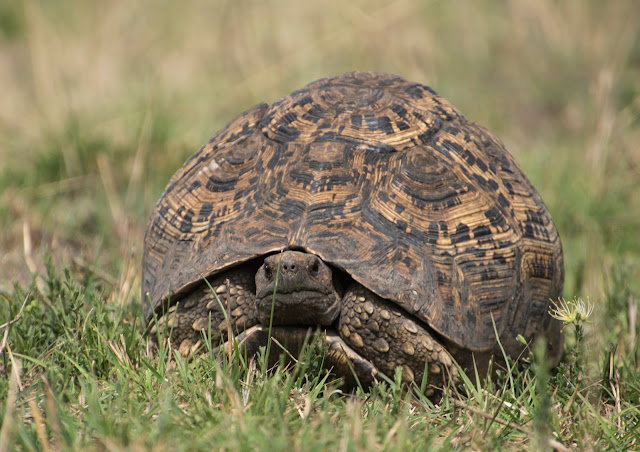
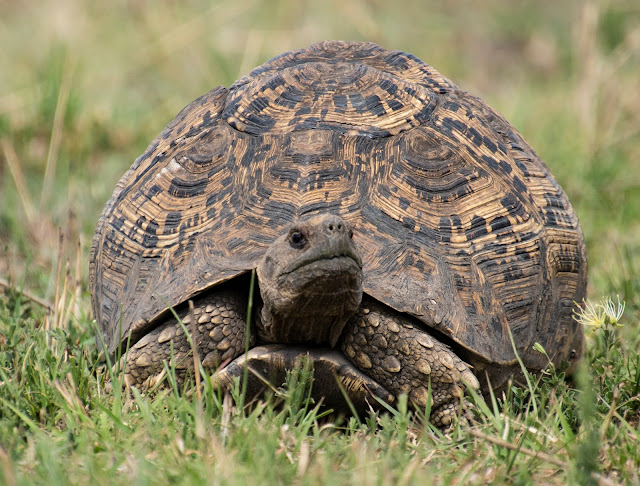
Someone spots a tortoise near our breakfast spot and out come the cameras.
 |
Black-shouldered kite.
|
After eating, it's time for a relatively-leisurely trip back to camp, but our route takes us past the servals again. The mother has returned and only two of the cubs are with her.
She moves from area to area, calling for her missing cubs. Once again, the servals are pursued by safari vehicles. Though the vehicle engines are turned off when they stop (to eliminate vibration in photos), the cats move frequently so it's start and stop, start and stop.
 |
The cubs, now reunited with their mother, go about their fun. This one appears to have caught a rat.
|
 |
| Shade? |

The mother appears stressed. She cannot find nor hear her missing cub.
Finally, I am once again emboldened and tell the guides that I think we should leave. "She's stressed. If she had the third cub, it would be okay to stay. But not like this."
We leave.
 |
Another safari vehicle.
|
We stop for various birds and animals on the way back to camp.
 |
Lilac-breasted roller, the national bird of Kenya.
|
 |
| Superb Starling |
|
 |
Yellow-billed stork
|
These zebra wanted to go down to the water but were not sure about our vehicle.
So, we left.
Later in the day, Enkewa owner Jose talks to us about the servals. The missing cub was located, he says. Apparently it was in a burrow. Jose was under the impression that some of us were afraid the third cub had been run over. We assured him that while we didn't think that, it was certainly a possibility if the number of vehicles increased.
We told Jose that it was the obvious stress of the mother that made us want to leave her alone. Marg, a veterinarian, described the cat's symptoms that indicated stress.
All in all, there were simply too many vehicles there for an enjoyable experience, one of the greatest problems in Downtown Mara. I think we are also spoiled by the remote area our camp is in because we rarely see vehicles from other camps.
Next: I don't know yet what I'll show you next. I am far too caught up in the Russian war against Ukraine and have the TV on all day. Uploading photos with the TV on is exceptionally difficult and takes far longer than I have the patience for.