"I'm going to speak my mind because I have nothing to lose."--S.I. Hayakawa
_______________________________________________________
Showing posts with label Hotel Cabanas. Show all posts

Wednesday, November 15, 2023

The 2023 Brazil Journals, Chapter Eleven

(To see photos full screen, click on one and then scroll through them.)


Chapter Eleven

Monkey Business and Monkey Wrenches


When you’re dealing with monkeys,

 you’ve got to expect some wrenches.—Alva Bessie


Time is short.   We leave tomorrow for our next destination and I haven’t done justice to Hotel Cabanas and the critters that roam its grounds.


Despite the heat, I take my camera and go exploring.   I don’t have to go far to find monkeys creating trouble.


They have found a housekeeper’s cart and are raiding it, tearing open the trash bags and escaping with things edible.   


One monkey has a Fanta soda bottle and sits atop a container to drink the sweet goodness.   Unfortunately for the monkey, the lid is still on the bottle.


Such hopeful expectations.


"Where is it?"


It doesn’t give up, though, but climbs down, runs across to a tree and when last seen was gnawing on the lid with its teeth.


Other monkeys are in trees with drink bottles, doing much the same, while still others continued scavenging through the cart.


This one is chewing on the lid of an orange juice bottle.


And savoring the "fruits" of his labor.


As I leave the monkeys and walk towards my room, I see a monkey climb the wall of a cottage and go in through an open bathroom window.   Suddenly, I realize that it's MY bathroom window.

I shout at it and it comes out immediately and runs away.   From the outside, I am able to close the window which   I couldn't do from the inside.   I check and everything is okay in the bathroom.   Good thing I was right there!


We visit Buraco das Araras, the macaw sinkhole, one last time, this time we saw it from the other side.


Center left you can see the platform where we were twice before?


Face on the cliff with a macaw in its eye.   It reminds me of the face of the volcano in Disney's short called "I Lava You."


Buff-necked ibis with egg in nest


Macaw nest on cliff face.


As we  photograph macaws and bird nests in the sinkhole, Octavio hears a familiar sound and leads us to a Toco Toucan, the largest of the toucan species.   With its vibrant coloring and huge bill, it is a popular bird.


It is grooming when we see it.


I catch it as it turns its head from its back and I catch it in what I call its Disney pose.


It looks like a blue-eyed sweetie, doesn't it?   Though they appear to have blue eyes, this toucan actually has black eyes.  The blue is blue skin with a smaller ring of orange skin.


This fellow doesn't stick to fruit with that soft bill.   Though they eat a lot of figs when available, they prey on lizards, eggs and nestlings of other birds, including parrots, hyacinth macaws, and buff-necked ibises.


That enormous bill is made up of a hollow bony structure and accounts for as much as half  of the toucan's length of 25 inches.    These birds can weigh two pounds and  can live 20 years.


Also near the toucan was another new bird for me--the blue-throated piping guan.


Best shot I could get.  It soon flew away.


Described as being "oddly prehistoric" but "handsome", the piping guan is a medium-sized bird at 23 to 25 inches long and weighing up to three pounds.   Its favorite fruit is the fig, but it also eats leaves.


They are called "piping" guans after the loud-pitched whistles they make at dawn during mating season.


We have, when time permitted, photographed several animals on the grounds that are new to me.


Collared peccary


Collared peccary


Azara's Agouti


Azara's Agouti


Also known as cane rats in Ivory Coast, Africa, Azara's Agouti eat seeds, fruit, and nuts.   They're the only animal known that can open a Brazil nut.


Nick-named the "gardener of the forest," agoutis often find more food than they can eat in one day and bury the rest.   Sometimes they return for it but other times they forget where it is and the buried matter sprouts new vegetation.


These 20-inch-long rodents are hunted for "bushmeat."


We explored the banks of the rivers that make this a favored playground for humans.


And, not to leave out the birds—though they were a bit of trouble to get a clear shot of in decent light.


Bare-faced currasow, female


Bare-faced currasow, female


Bare-faced currasow


The crest of a plush-crested jay.


Plush-crested jay


Red-legged seriema


Blue-crowned trogon


Blue-crowned trogon


Thrush-like wren


At Rio da Prata, where we ate lunch twice, we found cowboys. 


Our last morning.   Sitting on the deck by the hotel's restaurant, we spotted a Capuchin monkey with a very young infant on her back.   She was checking out the tables by the pool to see what she could raid.


She almost had a slice of watermelon but was scared away at the critical moment and dropped it.   Feeding them is frowned upon as they can become quite insistent and possible hurt a guest.


We watch her spy on us though an opening in the rafters.


And now the van is here and we are off on our next adventure—into the Pantanal and the historic Fazenda Barranco Alto Lodge for three nights.


Until, that is, our van is stopped by stern-looking men with assault rifles!!!


***


erato heliconiam


Rhinoceros beetle.   An interesting fact from the National Wildlife Association:  Another name given to some of these insects is the Hercules beetle, because they possess a strength of Herculean proportion. Adults of some species can lift objects 30 times their own weight without sacrificing any speed (that would be equivalent to a human having no problem carrying an adult male white rhinoceros). Some can even lift up to 100 times their own weight, though they have trouble moving at that point. 


Though in the same family as dung beetles, rhinoceros beetles do not eat dung.   They dine of rotten wood, tree sap, nectar and some kinds of fruit.


This is a Blue-crowned Motmot, photographed in extremely shady light.   Note the extension of the tail.

Tuesday, November 7, 2023

The 2023 Brazil Journals, Chapter Nine

(To see photos full screen, click on one and then scroll through them.)


 Chapter Nine

Macaws and Ice Cream


Maybe it’s animalness that will make the world right again: the wisdom of elephants,

the enthusiasm of canines, the grace of snakes, the mildness of anteaters.

Perhaps being human needs some diluting.—Carol Emshwiller


“CAW!” croaks the huge red and green macaw perched on the bush next to the viewing stand at Buraco das Araras.   Actually, the sound is more of a squawk than a caw, but caw is easier to type and fits my storyline better, so CAW it is.


Silence.


Then:   caw caw! Caw! CAW! CAW !  CAW!!!!


I counted 16 macaws in this bush.   Not all are visible here.


From around the giant sinkhole, the raucous sounds of macaws bounce and echo from the sandstone.    One starts it and the rest follow up and soon the whole arena is a “caw-caphony” of  sound.


And there’s always one bird who wants the last CAW!


It’s funny to listen to and apply human characteristics to the birds.  


Then, they fly….in twos and threes and fives they let loose of the sandstone and spread their immense and colorful wings.   


"CAW! CAW! CAW!" says  the peanut gallery.  Everyone's a critic.   Seems they all have to squawk their opinions.


Around and around they swirl, their huge wings making their flights seem effortless.   Some peel off and perch in the rocks or on limbs and branches.  


Later in the morning as the sun warms the day, they circle the sinkhole, gaining elevation with each revolution until they are high enough to clear the cliffs and the trees, off to greet the sun and another day of making a macaw living.


I’m getting a bit better at tracking the birds in flight but I have a long way to go to get the kinds of shots that Octavio is getting.  My friends are absorbed in their own photography so I don’t ask to see their photos.


Nonetheless, I am pleased that I am getting more bird head shots than bird butt shots.


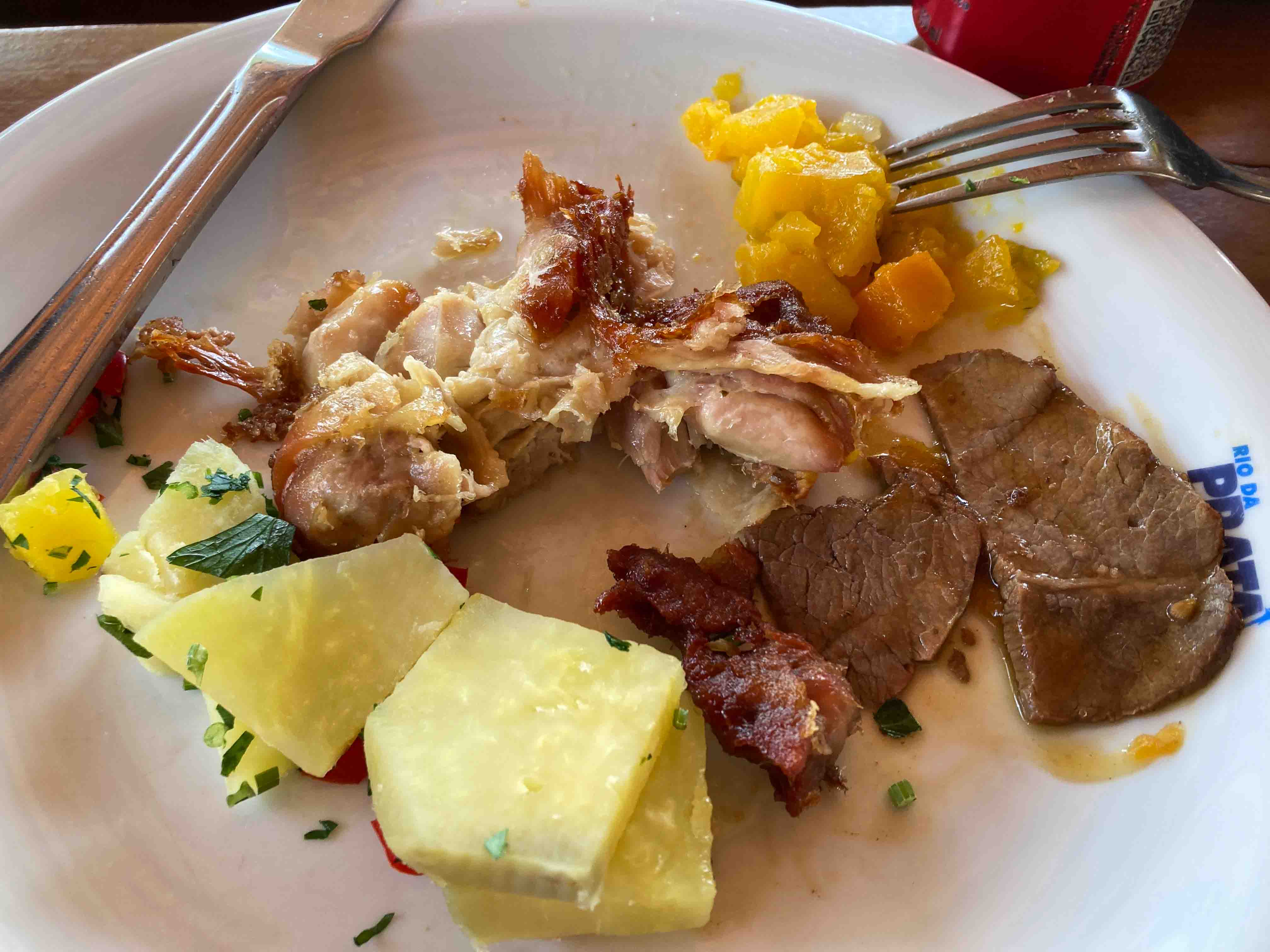
We have lunch at a fazenda (ranch/farm) called Rio da Prada Ecolodge.   It's a popular place for people to snorkel and float in the clear waters of a nearby river.


We are greeted by a flock of noisy Guira cuckoos in a tree by the lodge.


The fried chicken (top left) is fantastic!   Crunchy edges and tender meat.   But, like everywhere I've eaten beef in Brazil, it is tough chewy, and always overcooked.


While the girls are feeding the cats that roam the premises, this parrot waited for the right moment, then swooped down to our table, grabbed a chicken bone,  and flew to a nearby roof to enjoy his lunch.


The fazenda is a working ranch, so we visit a cowboy on what must be a prize bull.


We see several burrowing owls along the dirt road into the lodge.


One afternoon, Octavio asks if we want ice cream and stops at a shop in Bonito.    Want ice cream?    

Oh, my, does this place have ice cream.   Rows of freezer chests line the walls and at the far end is a place with "all the fixings."   Incredibly, it's scoop-your-own!

Someone tells me they have passion fruit ice cream and I put a couple small scoops in a cardboard cup.   At the cashier's station, a lady places my cup on the scale and charges accordingly.    I have no idea how much it is because Octavio pays.

These photos are a sample of the ice cream available and don't represent the whole supply.


The toppings.


Later, while looking for giant anteaters, we come upon a large bird that looks like an emu but is actually a Greater Rhea, and we photograph it in the late afternoon golden light.


Backlit Greater Rhea in the Golden Hour of a setting sun.


The largest native birds in South America, they weight 33 to 60 lbs, and can run 40 mph.   Standing between three and five feet tall, these omnivores are usually found in grasslands where they eat broad-leaf plants and clover, but also small vertebrates such as birds, snakes, and lizards.

From Smithsonian National Zoo:

Males develop a dark collar at the base of their neck during the breeding season. They call females with a booming call and court two to 12 females with an impressive wing display. Once mating has occurred, the males build nests, which are shallow depressions in the ground.

Each of the females lay up to five gold- colored eggs in the male's nest over a period of seven to 10 days. They can lay up to 60 eggs total. The male incubates the eggs for about six weeks and cares for the chicks alone. When male rheas are taking care of their young, they will charge at any creature that comes too close to them, including female rheas and humans.


Though they resemble an ostrich, rheas have three toes whereas an ostrich has only two.