Chapter 15:
Story Telling: Tsavo
“The silence of an African jungle on a dark night needs to be experienced to be realised; it is most impressive, especially when one is absolutely alone and isolated from one's fellow creatures, as I was then.” ― John Henry Patterson, The Man-Eaters of Tsavo
(There’s not much of a story behind most of our game drives in Tsavo, so I’m going to tell you stories instead and intersperse them with photos.)
Tsavo. Tsavo. Tsavo.
Does that name sound familiar? Is your Random Access Memory (RAM) furiously flipping through your hippocampus in search of something you KNOW you know but can’t quite access, which I think is why it’s called ‘random?” (Mine gets more random every year.)
Here are some hints:
A railroad in Kenya.
Val Kilmer and Michael Douglas.
“The Ghost and the Darkness.”
Nothing yet?
Okay, here is the answer: The Man-Eating Lions of Tsavo!
 |
| Chandelier in the dining room made from Coke Zero bottles. |
 |
| The chandelier at night. |
 |
Ice cream with a thin slice of broiled pineapple. Note the china. Fancy, fancy.
|
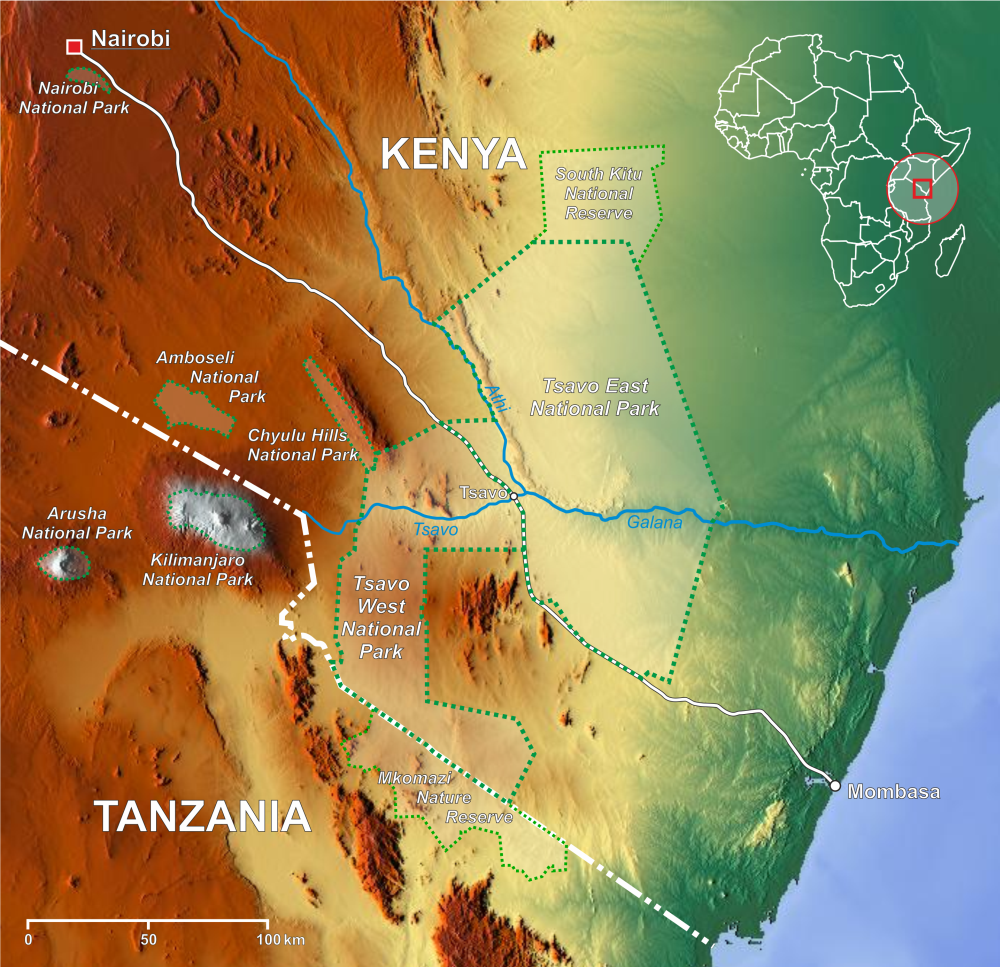
Here’s the story: In 1898, British military engineer Col. John H. Patterson was assigned to oversee the building of a railway bridge over the Tsavo River in southeastern Kenya for the Uganda-Mombasa Railroad
Soon after his arrival, two lions began killing and consuming railroad workers and local inhabitants.
 |
| Lions killed these two Cape buffalo recently. The buffalo were weakened by the drought that prevails across southern Kenya. |
 |
| A Drongo, also called "The Thief" because it watches where other birds cache their food and steals it. |
As the number of victims rose, Patterson faced losing all the workers to desertion, as well as his own safety. The workers’ tents were enclosed within a boma (a large barricade built of thorny trees and branches. Fires were burned all night long and guards kept watch.
Still, the lions got through to the men. Their cunning was uncanny. Patterson waited at night in trees to shoot the lions and often realized he was being watched by the lions but he could not see them.
Superstition took over and men deserted in droves, calling the lions The Ghost and The Darkness.
 |
| We abandoned the dining table when someone spotted sunbirds in a nearby bush. This is a Hunter's sunbird. |
Finally, Patterson was able to kill one of the lions. Three weeks later, he killed the second lion as it charged him.
 |
| From Wikipedia. |
The workers returned, the bridge was completed, and Patterson received world-wide acclaim.
The lions of Tsavo are larger than lions elsewhere. The two that Patterson killed measured nine feet long from nose to tip of the tail, and was almost four feet high at the shoulder. Accounts say it took six or eight men to carry one back to camp.
So, imagine a sheet of plywood that is 4'x8'. Imagine a lion superimposed on that sheet of plywood. Its tail would stick out beyond the panel.
 |
| From Wikipedia |
 |
| White-bellied go-away bird, so-called because their "gwaaa" call sounds like "go-away." |
The taxidermized mounts of the skulls and hides of the lions are on display at the Field Museum in Chicago.
If you go to see them, you’ll see that these lions look different than your notion of lions. They have no manes, only scraggly hair around their necks where gorgeous manes usually grow. Why don’t they grow manes?
Theories range from evolutionary changes due to the manes constantly being caught in the thick brush of the region to a lower testosterone level. Even today, the lions of Tsavo have no big, bushy manes. They are large cats, though, and they carry the genes of the man-eaters.
 |
| Baboon in late light |
There are a few reasons asserted as to why the lions turned to hunting men. There was a cattle plague in the area and food supply was low. Poor burial practices (if any men were buried to begin with) accounted for the lions realizing humans were an easy food source.
Caravans that passed through the area often lost members to illness and their bodies were not buried. So, too, the Arab slave traders failed to bury any lost captives.
The lions began to see humans as a food source.
 |
| More table abandonment. Hunter's sunbird |
 |
| Hunter's sunbird. I hope the staff didn't think we were barbarians with no table manners. |
Accounts differ on the number of humans taken by the lions from 35 to 140. Most likely the only accurate count was that kept by Patterson of the loss of railway workers only.
Which brings me to the movie with Kilmer and Douglas, “The Ghost and the Darkness.” First, they used smaller and less aggressive lions in the movie and these lions had gorgeous manes. Kilmer portrayed Patterson.
Douglas plays the part of a great white hunter Charles Remington, sent to Tsavo to kill the lions. The Remington character is pure fiction.
 |
| Helmeted guineafowl |
 |
| Von Der Deckens Hornbill |
At one point in the movie, Remington and a number of Maasai warriors have surrounded one lion in a large thicket of saplings and thorn brush. The warriors are armed with spears and are wearing the traditional red shukas (something like a toga) and massive headdresses or face ruffs. These appear to be two to three feet long and made from ostrich feathers. Others have parts of a lion’s mane attached.
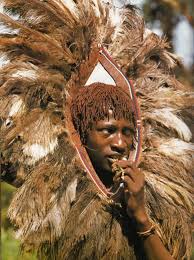 |
| Maasai face ruff made from ostrich feathers. Not my photo. |
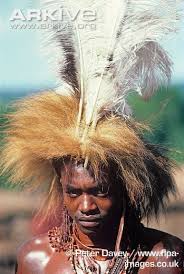 |
| Ostrich feathers and lion's mane headdress. Not my photo |
So, they have the lion surrounded. The signal is given to enter the thicket. My two thoughts are, 1), how are they going to get through all those thorns with those face ruffs, and 2), no way would I go into a thicket, where visibility is severely limited, wearing a lion’s mane on my head when everybody is looking to kill a lion.
 |
| Relaxing around the fire that evening. |
For a more complete telling of the man eating Lions of Tsavo, see:
https://en.wikipedia.org/wiki/John_Henry_Patterson_(author)
His book, "Man Eaters of Tsavo" is available on Amazon as an e-book for $0.95. I read it last night and it is intriguing. Which is why I was reading the last page at 4 A.M.
 |
| See the red airplane routes from Nairobi into Tsavo park? I think our camp is located quite near there. |