"I'm going to speak my mind because I have nothing to lose."--S.I. Hayakawa
_______________________________________________________

Saturday, February 4, 2023

The 2022 Africa Journals, Chapter 20: Some Miscellany about the Guides and Camps

 Chapter 20:

Some Miscellany about the Guides and Camps


Life's a journey, not a destination.


(NOTE:   There is no story attached to the evening game drive, so I'll write about other stuff and insert some photos.)


We landed at the busy Keekorok airstrip in southeastern Maasai Mara.   Though there is a long line of Land Rovers waiting, they were not all for us.   This airstrip services many camps in the area.   That said, one would expect to be overwhelmed with safari-goers near our camp.


The truth is we rarely see other vehicles at this camp.   The exception being, of course, when leopards or cheetahs are spotted, then every Land Rover in Africa swarms to the sighting.   Farther north into the Mara, that is a daily occurrence.   Where we are, we can go days and only see vehicles from our camp.    That is safari-going at its best.


Common area tent on the left, and dining tent on the right.   Enkewa Camp


The guides share information among themselves and with some guides from other camps.   During their down times, guides will go out seeking animals for us to photograph.   That is what earns them tips of $10 USD to $15 USD or more, per day per person, with $10 being the norm.  Sometimes a photographer will tip a guide extra.


Depending on their configuration, the vehicles have two seats abreast with two or three rows.  Sometimes the “shotgun” seat next to the driver is available.  Regular safaris try to fill all those seats, or fill them with members from the same group.


By the way, these Land Rovers are driven from the right front seat as Kenya, once a British colony, adheres to the British system.


Totally cool bridge to my tent.


One of the tents at Enkewa


Tent I shared with Marg.


Photographers like to have a whole row for themselves and their gear.   That enables them to switch from side to side depending on where the photo subject is and not have to shoot over someone’s shoulder.  They pay extra for that whole row.   Likewise, the photographers in a group buy an extra seat in a plane to accommodate the extra weight of our gear.  The airline can still sell that seat, but there is no charge for our excess baggage.


When it comes to tipping guides, the discrepancy is apparent.  The more people, the larger the guide’s tips.   That is why photographers pay larger tips.   Also figured into the tip are the guide’s knowledge and his ability to place photographers in the ideal spot for photo composition.


This addition on our tent could be another bedroom.   We put our luggage in there to keep it out of the way.


Guide Dominick was able to arrange for another desk for our room.


I had a tent to myself for the first three nights at Enkewa and then moved to Marg's tent to make room for an arriving guest.


The extra room in my private tent.


King sized bed that can be separated into two twins.


Bathroom with show open right.


Front deck of tent.


As for the camp staff, they pool their tips and divide them at intervals.   The average tip we pay is $10 USD per day, per person.  This figure, of course, is subject to change, depending upon the experience and service.


Dining tent:


You might have noticed that there are two spellings of Maasai/Masai.   The name of the semi-nomadic people is correctly spelled Maasai.    Their language is Maa.   Most also speak Swahili.


It is theorized that the English anglicized Maasai to Masai, to conform with English spellings.   


For this, and other reasons, I prefer to keep the original spelling of Maasai, whose land this is.


 And every morning, at o-dark-fifteen, tea and cookies delivered to our tent.   Or coffee.


 Some shots from the afternoon game drive:


Immature martial eagle, the largest eagle in Kenya.


Immature martial eagle.


Auger buzzard.


 These lions are from the Black Rock pride.


Juvenile lion and lioness.


Abdim's stork


Abdim's stork and catch.


Southern ground hornbill.


Look at the long eyelashes.


A juvenile male.


Note the faint rainbow.


No, no, no!    A). That's your sister.    B).  You're too young.   C).  You shouldn't have to cover her eyes.


Marg and Shelly in Dominick's truck.


A serval.   Though a cat, it is not considered when speaking of the Big Cats of the Maasai Mara--the leopard, lions, and cheetahs.   They are slender, long-limbed cats up to 40 inches long with tail, and can weigh 33 lbs.


Tuesday, January 31, 2023

The 2022 Africa Journals, Chapter 19: There are Game Drives and then there are GAME DRIVES!

 Chapter 19:

There are Game Drives and then there are GAME DRIVES!


"But African time was not the same as American time…As African time passed, I surmised that the pace of Western countries was insane, that the speed of modern technology accomplished nothing, and that because Africa was going its own way at its own pace for its own reasons, it was a refuge and a resting place.”-Paul Theroux


We landed at Keekorok airstrip around 11 A.M. and walked into the welcoming arms of our African guides.   It felt like we were being welcomed home, even this is only my second time lodging at Enkewa camp.


Map of the Masai Mara
Keekorok is located near where all the roads come together in the lower right.    Enkewa camp is in the area southwest of the airstrip.


The guys load all our luggage  except cameras into one vehicle and it heads immediately to camp.   

The camp Land Rovers appear to be brand new and I recall the owner, Jose, telling us he had ordered new vehicles just before the COVID pandemic hit and closed down so many camps in Kenya.

I climb into a three-row truck with Peter driving and I expect he will follow the luggage truck.  Pretty soon I realize we aren't passing any familiar landmarks.   We are also on a Ferrari Safari, which is what we call driving far too fast for scanning the landscape for animals


Peter has the two-way radio on high volume.   This is unusual because almost all the guides are now using cell phones for communicating privately with each other.

I lean back, hold on, and imagine that Peter is a young man with his first hot car and loud radio blasting across the savannah.   I'm not far off.


We come upon a herd of zebras and wildebeest and Peter slows down to let the animals cross the track.


First stop:   some beautiful Coke's hartebeest, so-called because the shape of their horns resembles a heart.


A large antelope at  46 inches at the shoulder, these animals weigh a little over 300  lbs.    They prefer dry savannah and forested woodlands, and will often move to more arid regions after rainfalls.    They have been spotted at the 13,000 ft. elevation on Mt. Kenya.

Hartebeest share similar traits with wildebeest, topi, and blesbok in that they have elongated heads with forequarter sloping to hind quarters.    There are several varieties of hartebeest, with a couple having become extinct.

Next, I ask Peter to stop ("Oh, look! A calf!") so we can photograph two eland with a calf.    Can't miss calves, no matter what species.


The common eland is the largest antelope at up to 6 ft. at the shoulder and males weighing up to 2200 lbs.   While they are the slowest antelope at 25 mph, they can jump 10 feet from a standing start.   Males have a large dewlap and are really impressive animals.


This is an interesting item from Seaword.com:   When walking, tendon or joints in the eland's foreleg produce a sharp clicking sound, the cause of which has not been widely investigated. The sound carries some distance and is a good indication of an approaching herd. Some scientists believe it may be a form of communication; if a male is walking through his territory, the clicking which can be heard for up to a mile away, may alert another eland about this territory.


We leave the elands and soon slow again for a herd of zebra and wildebeest.   The zebra are blocking the track, so Peter moves forward slowly.


Then, the reason for the rush appears.   A leopard was spotted earlier and the guides are taking us to see it.   

I laugh to myself at something Marg said a few years ago:  "These guys are hard-wired to find leopards."    She and I were once lined up to take photos of elephants against the horizon at sunset.   Suddenly the guide yelled at us to get back in the truck.  

Then they raced down into a gully--and there was a famous female leopard known as Fig, who was walking through a scrum of safari vehicles.    It was too dark for photos.

We missed the elephants on the horizon.


Our first look at this leopard.


She moves into a ditch where she is partially concealed and carefully scans for game.    Then she moves back into the depression and walks along it, closer to the main herd.


Leopards are beautiful and impressive cats.


Leopards are about 6 feet in length and females weigh up to 88 lbs, with males weighing 130 lbs.   They are powerfully built cats that can carry their prey up a tree to protect ion from other animals that might steal it.


Leopards are primarily nocturnal so seeing one out in the daylight at noon is exceptional.   No wonder we were in such a rush.


It is remarkable how close the herd animals are as the leopard watches for the right one--a calf, or a sick or wounded animal.   Some even wander closer to her, apparently unaware of her presence.


Apparently she doesn't see a likely catch, so she lies down in the grass.   That's where we leave her to continue our drive.


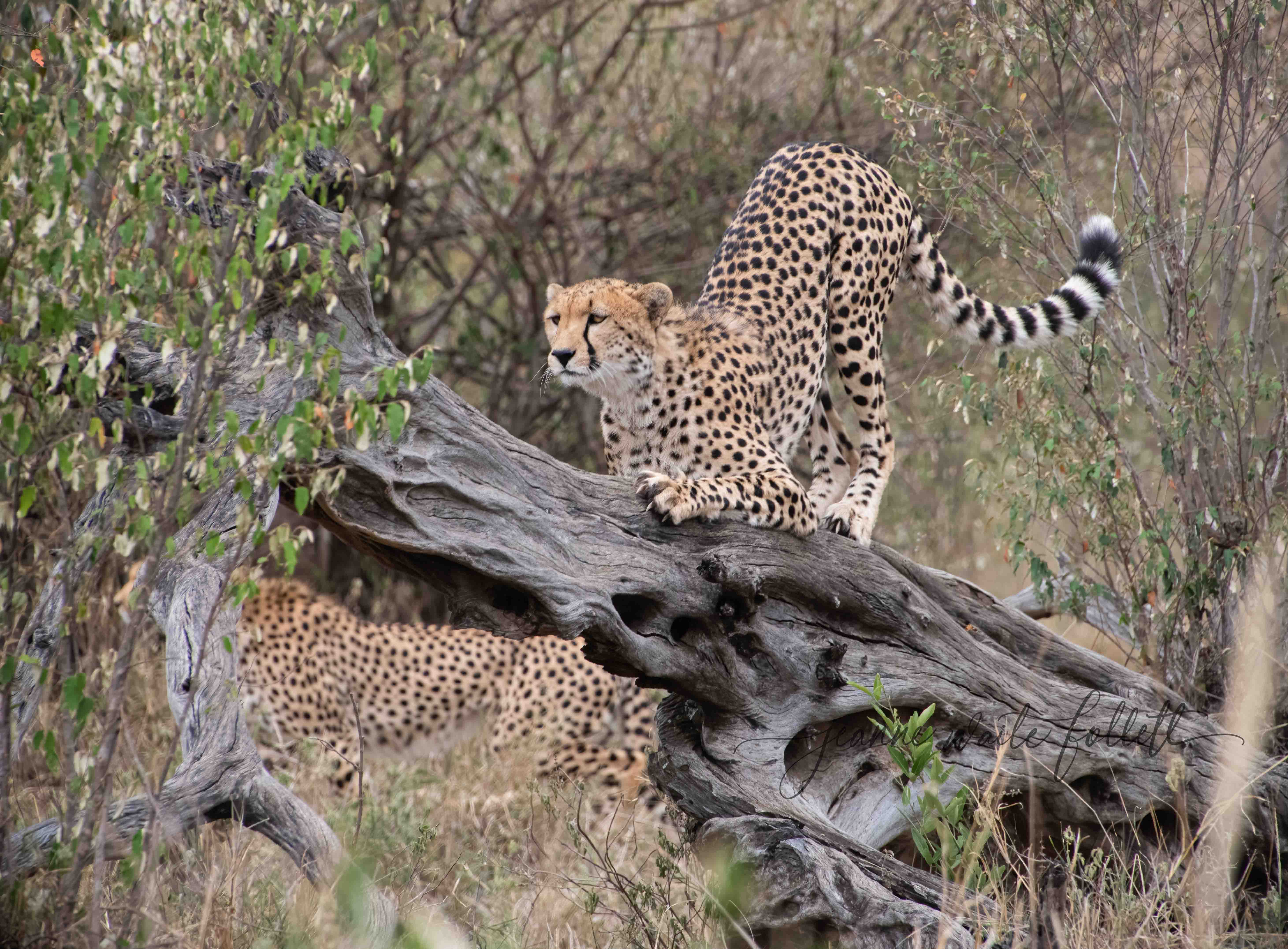
Fifteen minutes later, the guides find two female cheetahs roaming through the grasslands and brush.   They are sisters, out one their own though they still have mantles on the back of their necks.   A mantle is a long patch of hair that helps camouflage cheetah cubs.


Cheetahs have long bodies--four feet plus another two or three feet of tail.   They weigh from 75 to 120 lbs.


Their sprint speed has been measured at 71 mph, though they can exceed that when pursuing game.


When big cats are spoken of, cheetahs are generally included.   Some internet sites claim that they aren't true cats because they can't roar.


A video for you.   Our guide, Dominick, suggested the names Napi (Brave) and Nanyorri (Beloved).   The names were adopted.   This was a first sighting of these two out on their own.


It's a video!   Play it!


Some information from Britannica on what makes cheetahs are so special:


Cheetahs have evolved many adaptations that enhance their ability to sprint. Their legs are proportionally longer than those of other big cats; an elongated spine increases stride length at high speeds; they have unretractable claws, special paw pads for extra traction, and a long tail for balance. Internally, the liver, adrenal glands, lungs, bronchi, nasal passages, and heart are all large to allow intense physiological activity. During a chase, cheetahs take about 31/2 strides per second and 60 to 150 breaths per minute. 


Like most cats, cheetahs are very affectionate with each other and will often groom each other, as this one is doing to her sister.


Do you see the longish hair on the back of the neck and shoulder?   That is called a mantle and is a form of camouflage for young cubs.   Note the long tail.   That acts like a rudder and also stabilizes the cat at high speed.


We spend a lot of time with the cheetah sisters and leave when they seem to be ready for a nap.


We are heading in the direction of camp now and come across some elephants with very young calves.


This calf is so young you wonder how it can reach high enough to suckle.


Finally I recognize the scenery and realize we are close to "home."


But, before we get there, we see the third and last members of the Big Cats of Africa-- lioness with her two cubs.


All three of the Big Cats in one drive--leopard, cheetahs, and lions!    And we haven't even reached camp from the airstrip.. Phenomenal!


KUDOS to our guides!!!


Can't forget the jackal pup we see.


And then, we roll into camp.   Happy with the drive, happy with the camp and happy, happy with lunch that featured broiled chicken and salad, topped off my personal favorite--the Chocolate Amarula Mug.


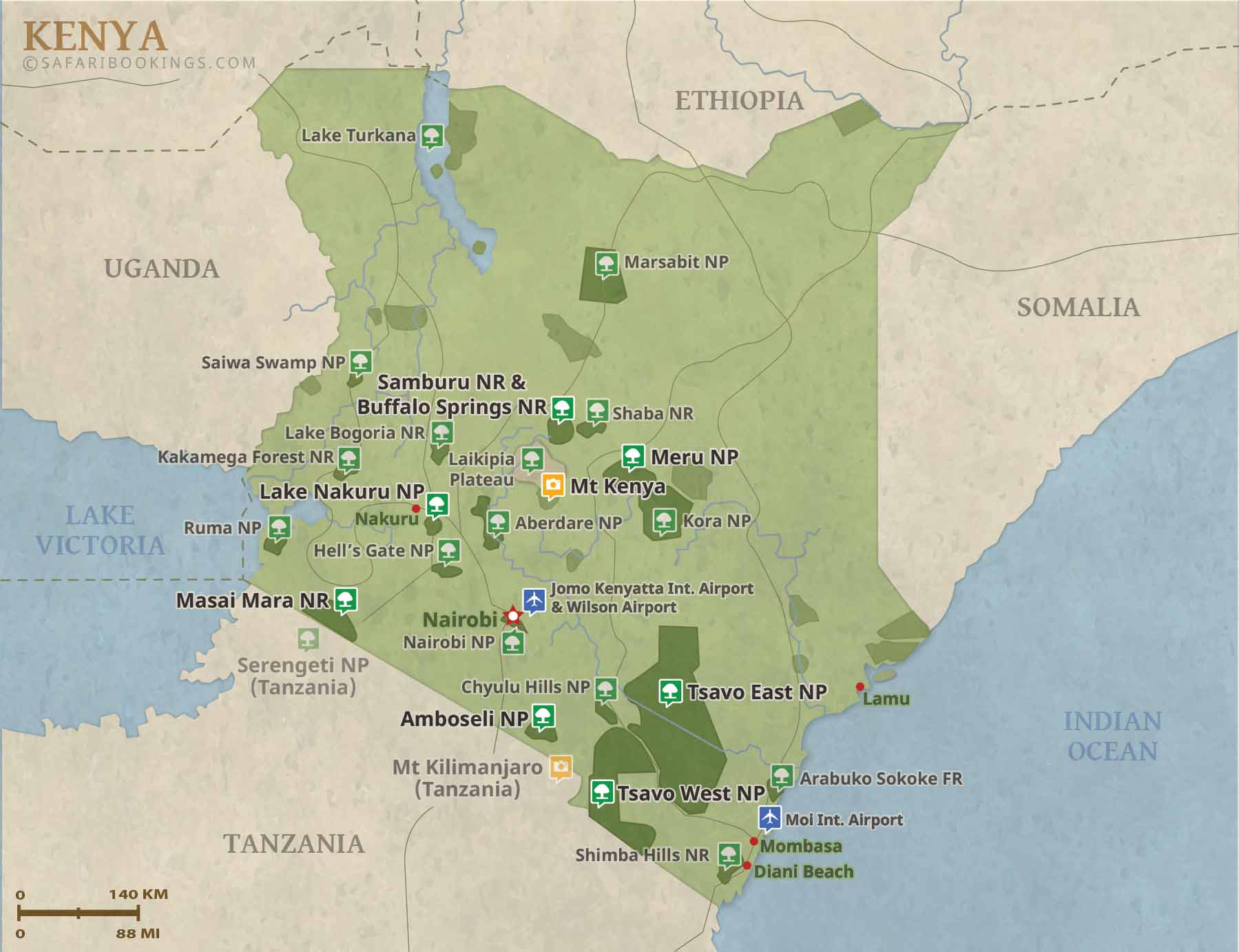
Detailed Map of Kenya National Parks
The Maasai Mara National Reserve, where we are now, is the tiny dark green spot at left, on the border with Tanzania.   It covers 580 square miles.   It is unfenced and conservancies along its upper borders increase the habitat for animals.


Map of Africa
This map shows Kenya on the east coast of the continent at the equator.


Saturday, January 28, 2023

Dear Clyde, I am so sorry about your favorite dining room set....

 NOTE:   Hours after I woke this morning from a strange dream, I remained so affected by the look in the ape's eyes that I wrote the story down, trying to get some control over my feelings.    Once it was down on the computer, I figured I'd inflict it upon you.   Enjoy


I walk into the Dimond Mall (correct spelling) near the zoo and see a sign asking for the donation of foam cushions and other flammable material.   I look into the sunken zoo and see hippos, lions, and various other creatures wandering around on the tiled floor in what looks to me like a swimming pool with no water in it.


A woman had fallen into the Olympic-sized swimming pool/zoo and was fatally bitten by a hippopotamus a couple days ago.   She had fallen from the open balcony of a fine-dining venue that overlooked the zoo.  (There IS a Dimond Mall in Anchorage.   It does not have a zoo or even a swimming pool.   It does have a skating rink.)


The zoo has decided to euthanize the hippo, named Hugo, and relieve the carcass of its head for examination.  The cushions are needed to provide space under the fallen hippo so straps can be installed to hoist the beast onto a table for autopsy and then for fuel to cremate the carcass.   All in view of the public, which has now crowded around the sunken zoo.


By coincidence, a girlfriend’s favorite dining set is nearby as is an old couch of mine.   I strip the furniture of the cushions and throw them into the zoo.  Each piece lands perfectly next to the others.   The animals, by this time, have been removed.   Only Hugo the Hippo is in the pit.  As luck would have it, that furniture is enough to cover the entire bottom of this large arena.


That done, I go in search of my girlfirend to explain what I’ve done and why.   I find her and her three children sitting in another part of the vast mall.   As I’m explaining, a large, sedated ape is asleep on some nearby foam bolsters.   She stirs, rolls over, and holds out her left hand to me. 


The look in her eyes is one of pleading for empathy and help so I reach out and touch the heel of her hand. This ape, named Joy, is the mother of Hugo (who is a hippo, mind you) and she is frantic with worry about him.


She stands and offers her arm to me.   I take her elbow and she leads me down the mall to the security entrance of the zoo.   She holds her hand to a scanner, then holds her eye to the optical scanner.   She passes the check, but we walk around that entrance and go to a wide-open public entrance, manned only by a receptionist.


Joy and I walk past her and descend part-way into the zoo/pool by a staircase.  One of the biologists stops her and tells her she should not be here.  The deceased Hugo, whose head now resembles a rhinocerus, is already on the autopsy table.


I leave Joy with the keepers, ascend the stairs, and ask the receptionist if an animal behaviorist is available to talk with.  I’m asked to leave my name and number, which of course I can’t remember.   I think the behaviorist would be quite interested in learning of my inter-action with Joy, but I am dismissed.


I return to my friend, whose favorite dining set I destroyed and will be used to fuel a fire to cremate Hugo’s remains (all in full view of the public).   Shortly, a medical tech appears and asks me if I am the one who walked with Joy, and when I respond in the affirmative, she tells me that I must come with her to be put into quarantine because I might have been exposed to some (twenty-letter) bacteria.


I will have to spend the night until staff has an opportunity to test me for the (twenty-letter) bacteria and get the results.


I’m escorted to Room #4.   When the door opens, the room is no wider than a regular elevator car, with doors on each end like some elevators cars.   A handsome young man occupies one bed.   There is a short, half-length curtain meant to provide privacy, with maybe two feet in between the cots.   I am told to change into the hospital garment.


I decide that if I’m going to spend the night here, I am going to get something to eat first, so I wander off into the mall again.   I wind up in an area where several other people are waiting for the zoo medical team to see them.  I tell staff I’d like something to eat and shortly someone arrives with a huge hamburger piled high with fries and with more fries on the side.   


There are also a Coke in an 8-oz. glass, a six-pack of Heineken beer, and a large bottle of red wine.   I devour the burger, the Coke, a bottle of beer, and a third of the wine.   (That should be enough to put me in a coma for a week, if not kill me outright.)


Suddenly I’m in a wheelchair.   I start offering beer and wine to the other patients.  My “roommate” Bob is there, but he declines.   I pass out the remaining five bottles of Heineken and open them with a tiny bottle opener hanging from my backpack. (Yes, a backpack.   I also have a duffle bag, and another satchel.)


I learn Bob’s story.   He is a safety guard on a new extensive toll road/bridge that crosses Westchester valley in Anchorage, from 15th Ave to Fireweed Lane.   (This completely imagined road/bridge has figured into several other of my dreams.)


One night a few days ago, Bob spotted a man trying to sneak under the bridge without paying the toll.  The man jumped from the bridge.   Bob also jumped off the bridge, after reading all the Miranda, safety warnings, of course, and landed on the man.   The 50-foot drop almost kills both of them.   Instead of going to a hospital, Bob has come to the zoo medical staff for assistance.   He is in tough shape.


Still overwhelmed by the interaction with Joy the ape, I go in search of a notebook so I can spend the time in my cell writing it all down.   I find a bookstore that sells notebooks.   One that had about four pages sells for $17.95.   I keep looking.   A used notebook, with all the pages written on, is $.80 and I decided to buy that one.    (This notebook thing is another recurring theme in my dreams.)


Before I get to the cashier, though, I spot a red, leather-bound notebook with Margaret R Wood printed on its cover.   I look inside and there is a small woolen scarf carefully folded inside a pocket.  I remove it, intending to send it to my friend Marg.   I buy the notebook for $.90, and return to my “cell.”   Down in the sunken zoo, staff is cremating Hugo.


My gear is on a trolley that I’m pushing in front of my wheelchair.   When I open the door to my cell, the rear door opens also and my gear trolley, along with Marg’s notebook, go sailing through and into the zoo pit, which, unaccountably, is filling with water even as Hugo is being cremated.


I look around my cell as staff rush to snag my gear from the water, overlooking Marg’s bright red notebook.   Bob, in his agony, has peed his bed, the walls (including mine), and the floor clear out into the mall aisle.


I wheel my chair to the zoo receptionist and tell her of Bob’s mishap.   “You’re supposed to be in quarantine,” she scolds.   I don’t tell her about my foray to get lunch or passing out beer and wine to the other patients, who now are contaminated also  if I’m contaminated.


A couple guys arrive with a mop bucket and start cleaning up Bob’s pee mess.   That’s when the dream ends.


 ***


 No wonder I woke up tired.