Today is our final full day at Tawi Lodge and Amboseli National Park. We ask to go back to the lake by the airstrip. After all the death we've seen because of this horrid drought, we need to be with the teeming wildlife at the lake.
The day is packed full of animals and adventures, so I will have to split the fun into two or three posts. So, let's get on with it.
We have a little trouble getting there. There are a few traffic jams and a couple roadblocks slowing us down.
We are roughly a mile into the park when we come upon a crowned lapwing screaming at us from the berm alongside the dirt road. I am pretty sure this is the same lapwing whose chick we rescued from the middle of the road on our first day and I wonder why it's still screaming.
I look around and see four tiny things scurrying around and decide our little one survived. As we watch, our driver Benjamin spots five cheetahs farther off the road under a bush.
They have a kill there and have eaten. Now, bellies full, some are resting. The four cubs are within months of independence, when the males will strike out of their own. The females tend to stay with their mother longer. Mum cheetah has done an excellent job raising her cubs this long. Cheetahs are exceptionally vulnerable to being killed by other animals.
When we stopped, it was only our three vehicles. I look around and we are now in a scrum of safari vehicles, their drivers jockeying for the best positions.
Behind us.
In front of us. Where did they all come from?
We watch a few minutes longer and it's apparent the cheetahs are down for a rest, so I suggest we move on and let others have a front row view. That means we have to get out of three-deep vehicles, but Benjamin manages very well and we drive on.
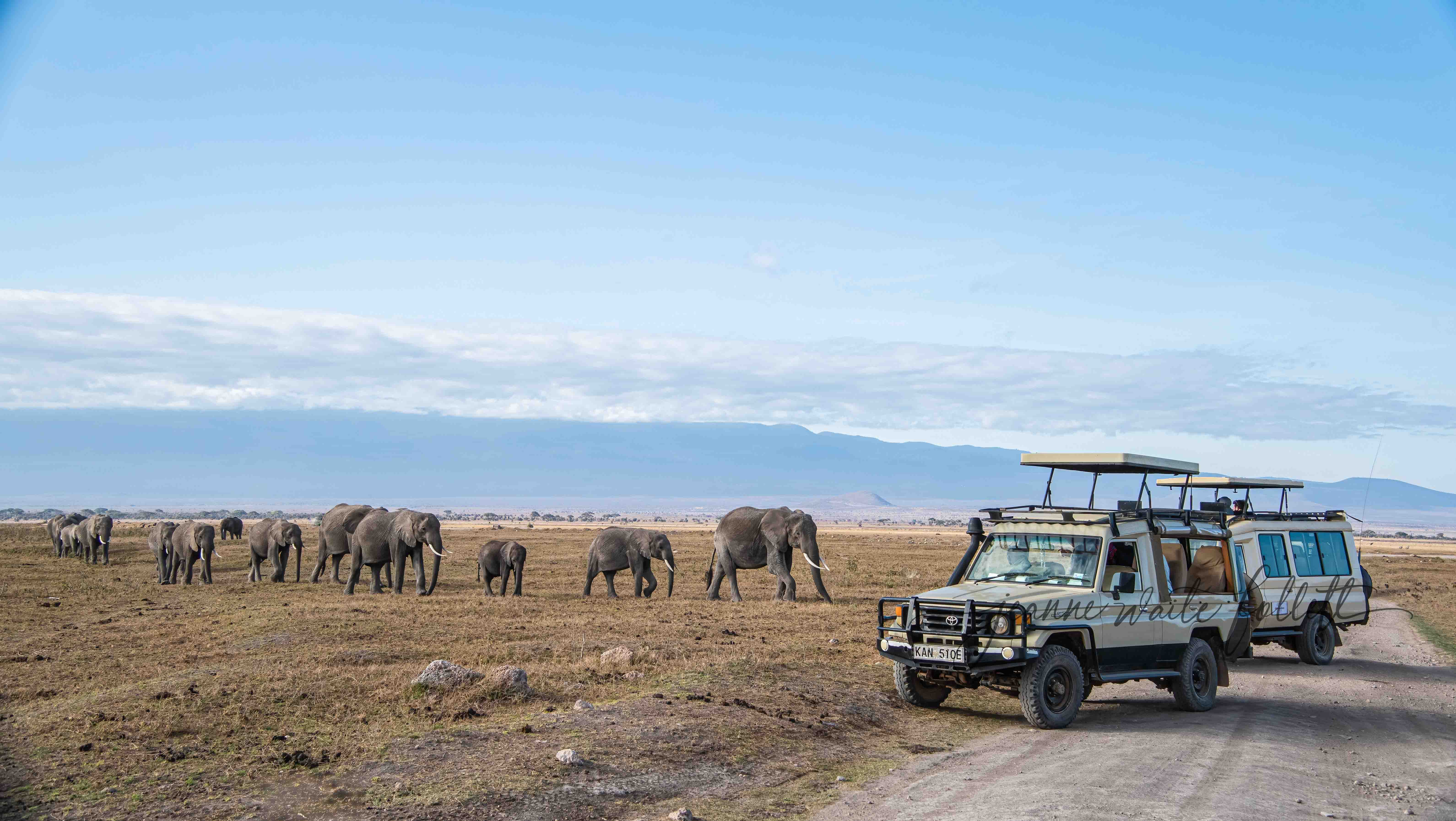
A short time later, a herd of elephants on the move against a vast panorama gets our attention. Benjamin pulls over and angles the vehicle so we can get photos of the elephants coming toward us.
Other vehicles arrive and park a distance behind us, perhaps leaving room for the elephants to cross the road between us. The elephants decide otherwise, and cross between them and other vehicles behind them.
The leader of the herd stops and lifts its trunk to smell the vehicles. It decides they are not a danger and continues on.
Then, just before the lake area we run into a traffic jam. The place is full of private cars, ranger trucks, and safari vehicles. It takes a while to maneuver through them. In the midst of all that is a mob of bicyclists, most wearing identical jerseys. Some event is about to get underway.
These people are participating in a fund-raising event called Ride Africa. They will journey from Amboseli, through Tsavo West and Tsavo East national parks, and reach the of coast of the Indian Ocean at Mombasa. Six days, 500 kms. All while protected from the wild critters by rangers of Kenya Wildlife Service.
Funds raised for to Child.Org., which helps deliver care and information to women, both pre-and post natal. Valuable health assistance and information, as well as educational and employment assistance is offered.
We pass them and continue up the narrow road along the water. Soon, the cyclists start going past us and I suggest we stop and let them go by. They travel a lot faster than we do because they aren't stopping to take photos.
Eventually, they are front of us.
Marabou storks watching the cyclists go by.
All is well, and we are left to drive as slowly as we want and to enjoy the wildlife in and around the lake.
We do, however, have one final road block when we begin the journey out of the park:
You hate to make these poor wildebeest move off the road. So, you stop and let them move at their speed.
The effects of starvation.
Although, a herd of giraffe could have caused another road block on the way home, we turned off before our paths intersected.
And it was clear driving back to the park entrance.
As usual, it is dark when we move from our tents to the main lodge, where tea, coffee, and fruit are laid out for us. We are escorted by security guards with flashlights.
By 6 o’clock, we are driving through the Tawi Conservancy on our way to the entrance of Amboseli National Park. But James surprises me and turns off on a dirt road that parallels the boundary of the park.
We bounce along for what seems like endless hours (on the return trip, I realize it’s actually not far at all.) There are villagers and school kids along this route, adults heading somewhere, as well as entrances to private lodges.
We spotted Craig last evening near this boundary road and this morning he was located again by Maasai who let our guides know his location. At the Maasai’s signal, James turns off the road (thank goodness) onto the smooth sand of the adjacent bush veld.
And shortly, there he is. Much closer than last night Much, much closer. Because we are not on park land, we can drive off-road and get nearer to the elephant.
Make no mistake. This is not irresponsible behavior. Our guides and several others make sure Craig is not molested or bothered in any way. They also watch out for us, reminding us to mind our elephant manners, which is hard to do when we are gobsmacked! But, one does not one’s expensive camera gear trampled even though Craig might trample us in the process. (Yes, I say that in jest.)
Twice Craig approached so close that I could have touched him. When he is this close, the drivers no not move the vehicles. They let Craig go wherever he wants and sometimes, it seems, Craig is being a little naughty and teasing us.
Full frontal, ears spread!
Watch this short video.
So, we heed their advice.As Craig moves, we frequently get back in the vehicles to be repositioned.“We cannot walk in front of the elephant,” one guide says to me, “but we can drive in front of him.”
They do not drive close. Rather, they move far away and then circle back, trying to get us in position for full frontal photos of this magnificent creature, one of the last “super tuskers.”
Even the guides are in awe, even if they have seen him many times. They pull out their cell phones and take quick photos at the same time they keep an eye on us.
Many photographers prefer to get down on the ground—kneeling, sitting, or lying down—in order to get a low perspective. This is ideal when shooting massive creatures, something like getting the horizon and sky under a giraffe’s belly to emphasize its height.
L to R: Shelly, Sylvia, Virginia, and a guide.
At far right, a guide reaches for the photographers to have him pull back as Craig approaches.
All around, people are lying in the sand. I kneel. I sit. And I instantly get help standing again, whether I need it or not. (Which I usually do.)
The second time I could have reached out and touched him as he moved beside my vehicle and another.
I see Marg and Shelly and a guide by one of our vehicles. Shelly is kneeling and Marg is stretched flat out. Craig is approaching.
I’m in our vehicle and I whip out my cell phone to video what happens. Watch Marg, the consummate photographer.
Watch this amazing video!!!!
All is well. The guide moves in to help Marg, but she is well aware of the elephant and what she must do. They crouch by the truck, becoming part of it and keeping their low vantage point.
Craig stops to sniff the air twice. I think I would have fainted, but Marg keeps her camera ready and continues to shoot.
We move away and the guides break out the breakfast tins. Craig, however, ambles over and stays nearby. I think he likes our company.
Sylvia and Cory waiting for breakfast. Craig is to the right of the open truck door.
They always send too much for us to eat. A BLT with cucumber sandwich, pastries, sausage, fruit, yoghurt, mints, and juice. There is also coffee and tea.
Breakfast with Craig!
He continues to hang with us. He even moves closer.
He is such a presence!
There is always a Maasai Warrior with Craig and the few other big tuskers. Twenty-four hours a day, they guard him at a distance. Perhaps this is why Craig is so gentle and comfortable with humans. That, and the fact that people have been staring at him for 50 years.
I doubt that Randy will ever forget being so close to a legendary elephant.
I watch this magnificent animal (sometimes with tears in my eyes) as he tears branches from trees or uses a front foot to uproot a small bush.
From an online site:
Elephants grow two tusks. These are their incisors. There aren’t incisors in their lower jaw.
Tusks keep on growing throughout the elephant’s life.
All African elephants, male and female, have tusks but only male Asian elephants have tusks that grow longer than their lip.
Tusks are a useful tool for ripping bark, digging up roots and moving things that are in the way. Elephants can favour one tusk over the other, just as people are either right or left handed.
The part of the tusk that shows is made of dentine covered by enamel.
There is also a third more tusk concealed in the elephant’s head.
Craig, like all elephants, will have five or six sets of molars to last his life span.
More from the same site as above:
Elephants are herbivores. As they spend 22 hours a day chewing vegetation, they need their really big, strong, ridged, back teeth.
Apart from two tusks (if present), elephants have only four other teeth in a set. While people’s teeth grow either up or down from the jawbone, an elephant’s molars grow in from the back of the jaw. There is one tooth for each quadrant that moves towards the front and is replaced when worn down.
An elephant will have six sets of four molars in its lifetime. Occasionally an elephant may be lucky and have seven sets.
Each time the teeth change, the new set is bigger. An elephant molar can be about 20cm long, and weigh 4kg.
If an elephant lives so long it has used up its life supply of teeth, then it may die from malnutrition.
Craig scratching an itch with his trunk.
I show Marg the cell phone video of Craig approaching when she was lying on the ground.
She pulls out her phone and shows me a photo that she took of Craig last February. The difference is astonishing and even my untrained eye can see that he has lost weight. Whether this is because of his age and worn molars, I can't say. But it is worrisome.
What kind of nutrition can there be in eating dry, dead sticks?
Amboseli had another super tusker named Tim. He died two years ago of "natural causes." A twisted gut, they said. Earth Touch News Network had this to say about Tim:
"The only marks on his body were the imprints left by other elephants. Perhaps it was his companions, trying to lift him back on his feet. Push the life back into him."
It's time to head back to camp for the mid-day break. I watch Craig as he saunters away and wonder if I will ever see him again. Not on this trip, to be sure. And probably never if this drought doesn't end.