
The Africa Journals
Chapter 51
The Huguenots to the Rescue
The Huguenots to the Rescue
When a woman is told that her husband
drowned in a vat of wine, she laments, ‘I hope he
went quickly.' ‘Well,
actually, he didn’t,’ responds the messenger. ‘He got out to pee three times.’
—Our esteemed tour guide Brian Heywood.
—Our esteemed tour guide Brian Heywood.
Brian holds out his arm to bar my way and says, “You can’t
get on the bus yet.”
Wondering what I could have done now, I ask, “I haven’t
spent enough money yet?” I did buy some paltry trinkets worth only a few Rand.
“No, come with me,” and he walks across the shaded gravel
parking area. “I though you would appreciate
this.” He points up into a tree.

It takes a moment, and then I see it—a spotted eagle owl (yes,
eagle owl) in the crook of a eucalyptus tree.
He’s right. I do appreciate it
and am pleased that he thought of me, but then he stays there to point it out to everyone who wanders over.
We are parked in a gravel lot next to a Dutch Reformed Church, and I have just finished a quick exploration of this town known as Fraanschhoek.


 |
| "Dutch Reformed Church The oldest portion of this church was erected in 1846-1847 and inaugurated on 18 April 1847. The northern and southern wings were added in 1883. National Monument Council 1978" |
When the Dutch East India
Company established a mid-way supply station in the mid-1600s at what is now Cape Town, the
Dutch farmers (Boers) were able to provide the company's ships hauling lucrative spices from India to Europe with produce, meat,
and fresh water, but the wine left much to be desired.
French Huguenots, escaping religious persecution, were subsidized by the Cape government to emigrate to Cape Town. Their knowledge of viticulture and
wine-making vastly improved the quality of South African wines. Today South African wines are among the best in the world.

Because of the conditions imposed upon their
immigration, it did not take long for the Huguenots to become assimilated into
the Dutch population. Those conditions
included that all schools be taught in Dutch, that official correspondence be
done in Dutch, and that all assemblies be tightly restricted. The crafty Dutch also made certain that land
allotments to the Huguenots were spaced between Dutch farms.
Eventually, a valley in the beautiful mountains became known as Franschhoek, or "French corner." Today it is a bustling tourist town, streets lined with shops catering to tourists and abundant wineries offering tasting rooms.


 |
| I think everyone in our group found this shop. |
In fascinating gift shop, I found these porcupine quills, which really put our Alaska porcupines to shame.
 |
| Guessing these to be 14 to 16 inches long. |
 |
| This bundle of quills I brought home are 8 inches long. |
 |
| South African porcupine |
 |
| Alaskan porcupine |
At one end of town, there is a large monument to the contributions the Huguenots made to South Africa.


 |
| "Erected on this dedicated ground in 1943 by a grateful South African people in honour of the Huguenots at the Cape (1688) and their invaluable contribution to our nationhood. The three arches symbolize the Holy Trinity; the Sun and the Cross form the emblem of the Huguenots. Design by d. C Dongens. The central figure represents the freedom of conscience. Sculptor: Coert Steynberg." |


And then, it was time for lunch and for that we drove to a winery in Franschhoek.


 |
| The view from my dining room seat. The wall was floor to ceiling glass. |


 |
| Found this book on a fireplace mantle. |
 | |
| Published in 1912 |
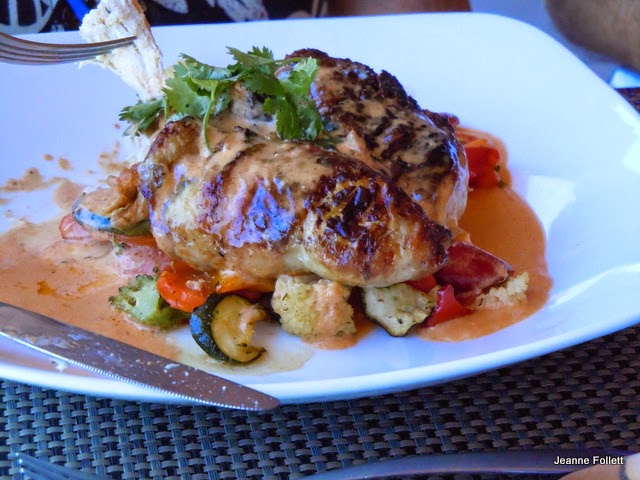 |
| The lady next to me had Wood-Roasted Mozambique Chicken. |
 |
| I opted for a luscious ostrich steak. Mild, tender, incredible. |
 |
| Creme brulee. |
 |
| Fossils in the steps and walk outside the restaurant. |


Oh, goodness. On to the wine-tasting room.

 |
| Restio, the thatching grass, make a fine ornamental plant. |
 |
| Chandelier in the tasting room. |


 |
| Tony, Carol, and me. |

Then it was back to the Spier hotel and ..... yes, more wine. This time, paired with chocolate. For some reason, I don't have any photos of this event. Curious. Maybe too much wine.