Ch. 15, Tomb of the Last King of Bengal and the
Dog that Lives There
India conquered and dominated China culturally for 20
centuries without ever having to send a single soldier across her border!~~~ Hu
Shih ( former Ambassador of China to USA)
We
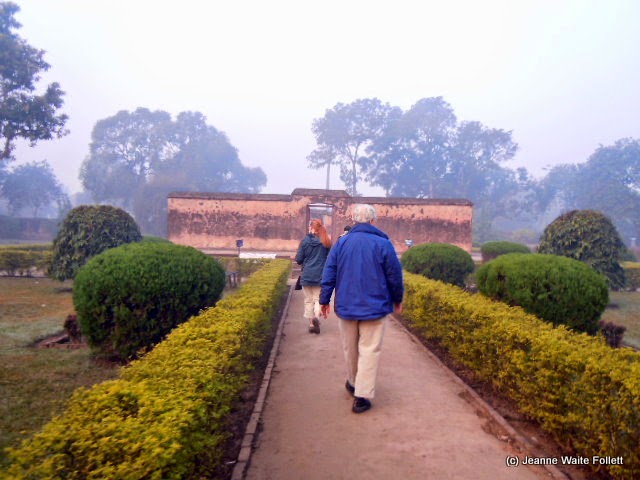
walk past dark green eggplant bushes, mango trees, and yellow mustard blossoms. Tomato vines sprawl on the dark earth and lime-green
rice grass is almost fluorescent in the early morning mist.
 |
| Eggplant |
 |
| Eggplant |
 |
| Mango grove |
We are on way to visit the
village of Khushbagh and the burial tomb of the last independent Mughal Nawab
of Bengal.
 |
| Banana |
 |
| Tomato |
 |
| Rice |
The villagers are up
and going about their morning chores, dressed warmly against the chill. Once we pass the fields, I see jaggery being
made from date palm. Jaggery, a
sweetener that looks a lot like brown sugar when boiled down to its essence,
usually is made from sugar cane juice, but date palm is substituted where there
is no sugar cane.
 |
| Date palm juice being boiled down to make jaggery. |
 |
| Making jaggery. |
 |
| A little shy. |
Two shops are open at
the junction of our path with a dirt road running through the village. Men
are sipping hot drinks from tiny plastic cup and eating boiled eggs and
pastries. There is no doubt in my mind
that they have come to see us.
 |
| Isn't he a handsome fellow? Some of the jars contain cookies and biscuits. |
We reach the Ali Vardi
Khan mosque complex and pass through its gate.
India’s history over the millennia is far too complex for this casual
traveler to comprehend, but as China had its Silk Road that opened that kingdom
to the Western world, India had its renowned spices that opened it to traders
and invaders, conquerors and kings.
Ali Vardi Khan was one
of those conquerors, and as events played out, he was the last independent
Mughal king of Bengal. He was the Nawab (ruler) of the vast Bengal territory
from 1740 to 1756. He was buried in this
quiet complex after his death from dropsy in 1756. A few years later, the nawabs ruled on behalf
of and at the pleasure of the British Empire.
 |
| The Nawab's tomb |
 |
| Perhaps his wife's tomb. |
 |
| The Nawab's mosque. |
|
 |
| I don't know what this is or what it means, but it was embossed on the stone. |
 |
| The Nawab's mosque. |
We wander around the
complex, seeing the tombs of relatives and body guards, and I wonder if they
all died at the same time, or were buried here after their natural deaths. I don’t have an answer.
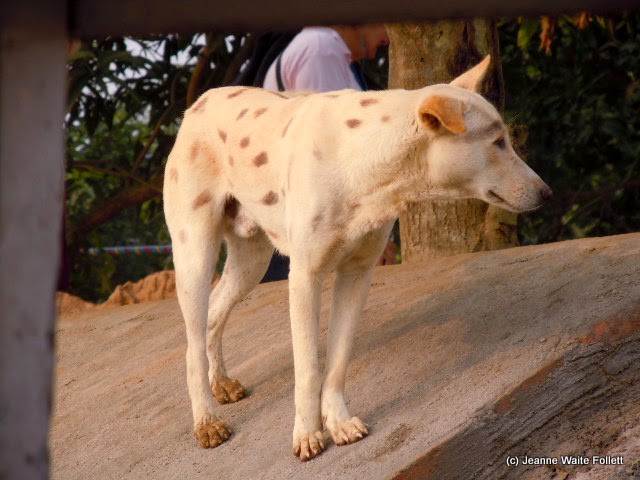
A whitish dog with tan
spots on one side and tan ovals on its other, approaches one of our group and
she pets it for a long time. It relishes
the contact. The dog lives in this
complex, we’re told. It follows our
group as we walk back to the river, passes with impunity a barking dog
defending its territory, and chases off an interloping dog that appears to
have acceded to its lowly lot in life.
Sumit, the expert on
the Ganges area who gives our nightly port briefings and answers questions
galore, is delighted with this landing spot.
A month before when they were finalizing this itinerary, he explains, this
was nothing but a dirt bank. Now it
boasts stairs-in-progress, a mark of how pleased the villagers are to host our
visits, he says.
 |
| Our guide Asif stops at this table and buys a bottle of this caustic-looking liquid, in obviously re-purposed plastic bottles. |
I am one of the first
to board the country boat and move to the back where something
catches my eye. The tiller is made of
two pieces of plumbing pipe, and I am more in thrall with this humble boat than
ever.
 |
| The tiller |
The dog waits as the tourists board and watches are the country boat pulls away. It's difficult to watch so I anthropomorphize and give the dog honorary guide dog duties, hoping the tourists to come will stop long enough to pet him.
 |
| When in Khushbagh, please pet this dog. |