Ch. 12, Kalna and the Missed Mulligan
We
live in a wonderful world that is full of beauty, charm and adventure. There is
no end to the adventures we can have if only we seek them with our eyes open. – Jawaharial Nehru
This is the day I
want back, the only one in the entire three-week trip that I’d like a do-over,
a mulligan. I don’t even need the whole
day, just the few minutes when opportunity presented and then was lost. But first….
Morning
on the Ganga and the ever-present pall of smoke from coal, wood, and dung fires
colors the sunrise with a deep rosy filter. Along the river banks, people are bathing
and washing clothing. Children run to
the edge and shout to get our attention, then wave with enthusiasm.
 |
| These small boats are called naukas. |
Nearby,
a team of oxen drag a plow through a field, preparing the soil for a new
crop. A group of villagers waits at the
top of concrete stairs for the tourists to arrive.
 |
| Oxen plowing a field between the mustard crop |
 |
| We Westerners are shocked at the litter, but the villagers think nothing of it. They've always lived like that, we're told. Perhaps their trash eventually rotted away, but with the invention of durable plastic items and foam plates, it's there to stay. |
 |
| A fisherman tending his traps while women and children bathe in the river. |
The
intrepid country boat delivers those tourists who then climb aboard
bicycle-drawn rickshaws for a ride through town to the Nabakailas Temples,
built in 1809.
 |
| Bob sits beside me in the rickshaw. Note I am carrying the purple bag that's been with me on travels around the world. I bought it at the Ali'i Kula Lavender Farm near Kula, Maui. Since then, I've sent them photos of me with the bag from wild and weird places. |
 |
| A rickshaw ride through Kalna. |
These temples consist of an outer ring of 74 temples, an inner ring
of 34 temples, separated by gardens. The total number of 108 temples represents beads in a Hindu mala (rosary).
This holy man is as surprised at our presence as I am at his walking into the photo, and stops to look.
 |
| I nod at him but receive no recognition. |
After
passing through the gate in the wall that surrounds the complex, we come first
to the Pratapeshwar Temple built in 1849.
Its many terracotta plaques depict themes of Hindu stories and myths,
and day to day life in the region.
 |
| There he is again. I am NOT stalking this man, but we make eye contact often. He never responds to my nods. |
Just a few of the terracotta tiles on the temple.
 |
| I could have spent hours photographing these tiles. |
 |
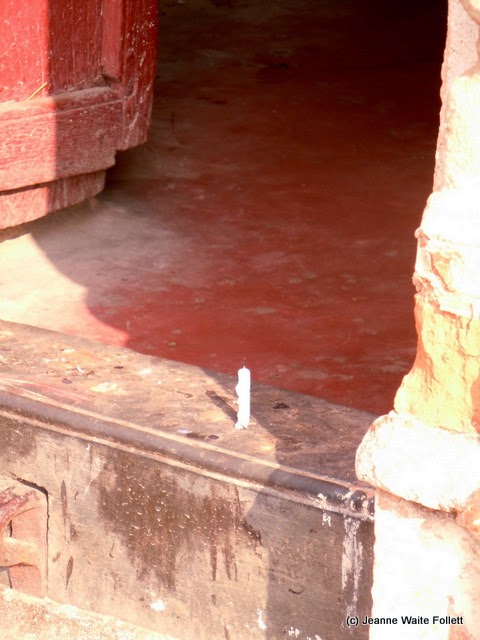
| A black marble linga with marigold and devotional candles burning at right. |
Next
is the Lalji Temple, built in 1739. I turn to walk down the path towards this temple, and see this:
 |
| Note the modern communications tower amid the antiquity. |
 |
| Lalji temple was built in 1739 AD. It has 25 pinnacles. |
Then
we arrive at the Krishnachandra Temple, built in 1751
Asif
and most of the group stop here as Asif talks about many things. I have trouble hearing him so, as usual, I wander off a ways and find a set
of stone steps with several pairs of shoes at the bottom.
 |
| Asif answering questions. |
The shoes identify it as a temple as it is customary to remove one's shoes before entering. Something is
going on in there, and I walk around to the front to see what it is.
 |
| Yes, I asked if I could take her photo and she is posing for me. |
A
woman sees me and beckons for me to enter.
I am soooo tempted, but I give her the “one second” hand sign and
retreat to Asif. He and Joanne try to
talk me out of what I want to do. Asif
says they are serving “blessed food” and Joanne says my stomach might not be
used to it. I am well aware of the dangers in eating "street food" but at this point I think that they are serving tea, which has been boiled, and I'm willing to chance it.
I ask if I would be offending
any mores and Asif diplomatically says the custom of serving “blessed food” is
usually reserved for Hindus, a tradition begun when food was offered to lure
people to the temples. That’s enough
for me and I return to the site and decline the woman’s offer. I motion to ask permission to take her photo and she willingly obliges.
And
those are the few minutes I would like to have back. As for offending their religion, she invited
me to participate and I wish I had.
According to a Hindu website, “Hindus believe that serving food to the
poor and needy, to the pious and the religious, and to birds, insects, and
animals is a very good karma.” I will admit, however, that not knowing the proper ceremonial moves also kept me back.
Very
soon they finish their duties and start to leave. I am back with the group where Asif is answering questions. The woman sees me, and stops nearby, making eye contact. She seems to want to connect with
me, but apparently does not speak English. Nonetheless, she seems to search me out and I am moved by this.
 |
| This appears to be fruit and cucumber. |
An
opportunity presented; an opportunity lost.
If one invites you and your heart is in the right place, is it offensive
to accept?
A
few minutes later, we go through the gardens to the rickshaws for our return to the
boat. And just then, camera tucked away, the man in the lavender robes pauses by the gate. We make eye contact for about the fourth time and this time he RETURNS MY NOD!
Some photos of Kalna. I apologize for the length of this post, but it was necessary to do justice to Kalna.
 |
| I think this is a goat. |
 |
| Asif and Joanne |
 |
| The first cat I saw in India. Altogether, I saw fewer than six. |
 |
| A bicycle shop and a man hauling many goods for sale on his head. |
 |
| An elderly woman walks past bicycles, a rickshaw, and a motorcycle. How many changes has she seen come to India? |
 |
| INDIA! |
 |
| These men are loading 180 lbs. bags of rice onto a truck. |
 |
| Man feeding his goat. He gave me a big smile after I took this photo. |
| |  |
| Schoolgirls |
 |
| India in one photo. The rickshaws drop us off at the river. I got off on the left, right next to this cow. You can see how steep the bank is where, down below, women are bathing their children. The RV Ganges Voyager is anchored in the river. The guides saw me standing on the edge, photographing the cow, and freaked out. They hustled me away quickly. I'm not sure if they thought I would fall into the river or if the cow would attack. |
 |
| The guides "rescued" me from the cow/river/whatever but not before I got this photo of women drying their just-bathed children. |