"I'm going to speak my mind because I have nothing to lose."--S.I. Hayakawa
_______________________________________________________
Showing posts with label Tern Lake. Show all posts

Saturday, August 30, 2025

JUST SAY NO !!!!

May be a black-and-white image of text that says 'August IS almost over. September is next week. Time to pick out a Halloween costume and start your Christmas shopping, Happy New Year, everybody. SaltySarcastic Salty Sarcastic'


On the other hand, the golden hour at Tern Lake was exquisite last evening.   I found this Ring-necked juvenile enjoying its bath.


\


The golden hour is that time just after sunrise and just before sunset when the light is infused with red and golden hues.  It's the favorite time of day for photographers.


And another juvenile, a Red-necked grebe.


From these ducklings, I learned two things.   One is that the ring-necked are nesting at Tern Lake, which I love.   And two, that a pair of grebes somewhere on the lake had a successful hatch.  You can still see its "prison stripes" that the young grebes have as camo.


The pair that nest near the highway, and that I watch, had two nest failures this year for unknown reasons.

Saturday, July 26, 2025

The Babies


Some more scauip photos because they are so darned cute.


And we conclude with a photo of the Common Loons, taken from a distance and edited with a significant crop.


Sunday, July 20, 2025

A Kayak, a Camera, and an 83-Year-Old Woman:

What could Go Wrong?


Down the road a mile is Tern Lake, named after the Arctic Terns that nest there and raise their offspring before migrating to Antarctica, where they enjoy the Antarctic summers.   That migration route, round trip, is about 25,000 miles!


Because they are so lightweight, the birds are able to sleep while gliding and never flapping their wings.

But, I digress.   Decades ago, Tern Lake was called Mud Lake, and that name fit it exactly.  It was swampy, dotted with grassy islands, and hosted many, many terns during the summer.

Things changed over time and the marsh began to have a reliable water content stretching over three-quarters of a mile.   Road construction, the 1964 Great Alaska Earthquake, and a changing water table may all account for this.

After I moved to the area with my husband, I always thought I’d like to have a small boat to row around the lake and see what was there.  We never did.


Then, after I was widowed, I bought small kayak—about 9-1/2 feet long, bright blue plastic.   It’s a Swifty model called Perception, and weighs about 44 lbs.  It’s meant for the casual kayaker who paddles around on ponds and calm lakes.   It is most definitely NOT a white-water kayak.


I never considered how easy or difficult it would be to get into the kayak and then get out, and therein lies the ongoing problem.


It wasn’t too bad when I was in my late 60s.   I’d find a way to beach the kayak until it was steady and then find a way to stand up, even though my butt was lower than my feet.   Then I began asking tourists at the pullout to drag me onshore.  


That could not continue.   Finally, I devised the method I use today.

I found the perfect spot near the area I like to explore first.  Its behind a guardrail along the highway where there’s a small opening in the trees where I position the kayak.  My cameras and other gear are in a waterproof bag that I put next to the water, a place where I can reach it once I’ve launched.


Once in the kayak, I scooch down the gentle slope until I’m floating.   Then I retrieve the camera bag and off I go.

Getting out was a bit more of a problem.   Again, there’s the problem of standing when my butt is lower than my feet.   The solution was a rope tied to a birch tree.  


I ram the kayak onto shore until it’s stabilized, then grab the rope and pull myself into a standing position with the aid of large knots.   


By the way, the camera and gear are once again in the waterproof bag and already onshore.

Most of the time this method goes well.   If my trigger finger locks up, that’s another thing to deal with.

Just recently, after a pleasant float around the lake, I decided to use my phone to document my ingenious method.


I steady the kayak even more by putting the paddle from shore to the kayak and I can push down to help me stand.


Everything went according to plan until I stood and took my first step on the ground.  Backwards I went.  I wound up on my back, my legs draped over the kayak, and only my PFD (life vest) held my head above the water.


I am not unconscious.


I am not distressed and only a little bit in trouble.


Now, this was a fix.  I couldn’t roll to the right, the obvious direction, because I’d be in the lake.

I couldn’t roll to the left because that was not only uphill, but my left shoulder is almost useless.


I still had hold of the rope but was above any knots.

I managed, reaching over my torso until I had hold of a small willow stump.   Then, I was able to grab a branch farther away and pull myself around.

Finally, I was standing.  For a moment.  I’d walked around to pull the kayak farther onshore, and suddenly I was sitting on my butt.


I blame all this on the rubber shoes I wear.   No support and not much of a heel.


But all's well that ends well, right? 


Saturday, June 28, 2025

All in Good Time

What can I say? It's summer in Alaska, and I've been busy both photographing birds, animals, and wildflowers, as well as engaging in my usual practice of picking up litter for 40 miles along the Seward highway. 

Over the next few days, I'll post a few photos along with some explanations. Short and quick because I have to get out on the road. The vegetation is way ahead of me.

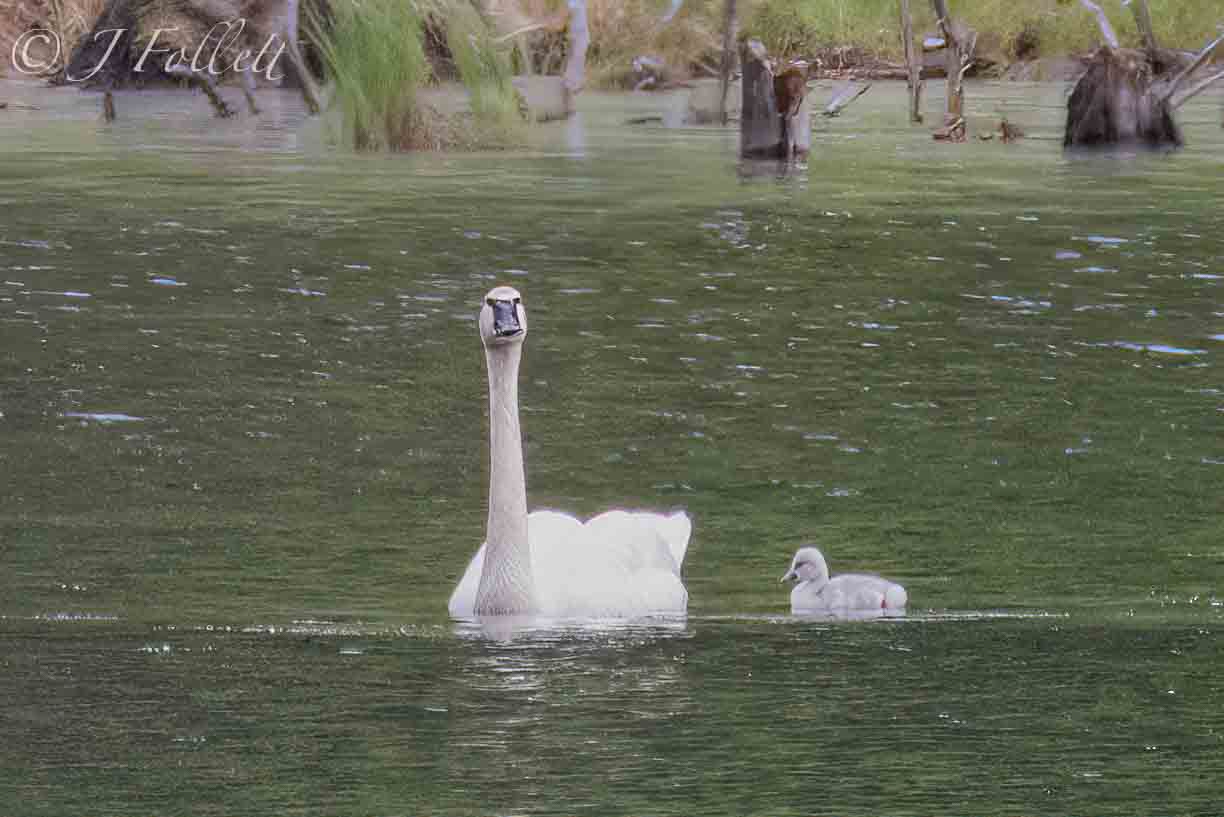
First off, the Tern Lake trumpeter swans hatched six cygnets and then took them into seclusion on the far side of the lake.   This is their usual behavior.


The American Dippers, formerly called water ouzels, which is a much cooler name, had three eggs hatch.


So many mouths to feed!


Sometimes the parents weren't fast enough with the grub, so the fledgling foraged on its own.


The Common Loons appear to have one chick.   It 's riding on an adult's back.   They were way too far away for my lens.


This photo needs an explanation.   One parent is behind the loon carrying the chick, and feeding it.   All you can see is the adult's head.


The two photos below show one red-necked grebe parent leaving the nest and the other ready to take its turn incubating what appear to be four eggs.   This is the second nest the red-necked grebes made this season.   

The first nest they made did not yield any chicks.   The reason could be many--something like a gull, eagle, or otter got the eggs.   The eggs may not have been fertile.  Anything.

They promptly built another nest some distance away and, by my reckoning, are close to the 23-day incubation period.   I hope to watch baby grebes soon.


What these greater and lesser scaup are up to is anyone's guess.   Hoping to see their chicks as I consider them the cutest baby ducks of all.


Hanging out with the scaup was a pair of ring-neck ducks.

Note the white markings on their bills.


As for litter, I am currently working in Turnagain Pass, having walked--little by little-- the 30 miles from home.   My current count of bags filled with litter is around 200.


And off I go.


Thursday, October 24, 2024

The Terribly Sad and Lamentable Tale of a Vision Unrealized.

The Terribly Sad Tale of a Vision Unrealized


Photographers are told to visualize the photo they want, imagine it in all its colors, and lines, and background. Then go for it!
Today, I had two tips. Each by itself would make a cool photo but combining the two would result in a masterpiece!!
Tip #1: the resident Trumpeter swans are still at Tern Lake, despite the ice covering most of the lake.
Tip #2: people are skating on the thin ice of Tern Lake.
I grabbed my camera and drove to the lake, all while visualizing the photo I wanted. Subjects: skaters and swans. Light: pewter gray day, so that was decided for me
Background: the leafless trees on the far side of the lake.
Composition: to be determined but hopefully skaters in front of, beside, or behind the swans.
IMAGINE!!!
When I arrived, the skaters were gone, as were the swans. No where to be seen.
All I got was this crappy shot of skate marks on the frosted ice of Tern Lake.
Well, I told you it was a sad tale.


Wednesday, April 24, 2024

Revealing the Truth

 Will the real boss of Tern Lake please stand up?


And there you have it, Ladies and Gentlemen.   The real boss of tern lake is not the river otter, nor the red-necked grebes, though they try.  


It is none other than the Trumpeter swan cob (male).   The female is called a pen.

Tuesday, June 20, 2023

The Self-Appointed Sheriff of Tern Lake

I live quite near Tern Lake and spend many hours there during the summer, watching the varied bird life and kayaking in its little coves and around its many islands.


SATURDAY EVENING:

This time of year, I watch a pair of trumpeter swans who moved onto Tern Lake and made it their home. I am expecting their eggs to hatch at any time, and pay close attention to them when I'm on my way to and from picking up litter farther up the Seward highway.


On this day, I was on my way home from cleaning up litter and was horrified to see three kayaks very near the swan's nest.


They ignored my yelling at them to move away from the swan. I started taking photos, not to shame them, but to report them in case something awful happened with the swans. With the nest abandoned, every bald eagle and gull on the lake could have cygnets for dinner.


I stopped and yelled at them to move away from the swan. No reaction, but the swan was already frightened and swimming away from the kayaks, dipping her head and honking all the time--a sign of high stress.


I kept yelling. Two kayaks went right behind the nest and the third passed in front of it, then stopped. And took selfies!!!


The poor swan is trying to get back to her nest and this girl is sitting there taking selfies! I didn't cuss at her, but I might have said a few choice words sotto voce.


She is very nervous, moving about the nest, checking everything to make sure it's safe to go back to it.   The nest is the brown pile to the left behind her.


When I was sure the women weren't going to return to the nest, and when the swan was--nervously--back on the nest--I drove around the lake to explain to the women why I was yelling at them.
I introduced myself, explained that I have become very protective of the swans.
"We weren't that close," said one.
"The swan thought you were. She abandoned the nest at a time when her eggs might have hatched and there are cygnets in the nest. I am surprised that every gull on the lake wasn't over there taking the eggs or cygnets."
I asked her to please explain to her friends why I yelled and to please stay far away from swans when you see them.


SUNDAY:

I drove to the lake to check on the swans and was delighted to see tiny cygnets.


Note the tiny fuzzy head under her belly.   Plus, there appears to be another right under her head.


Oh, right.   NOW the cob acts like he's defending them.    When the kayakers were near, he was hiding in some bushes.


MONDAY:

Dad takes one of th ecygnets for a paddle and introduces it to their neighbors, the scaup. This is even more evidence that at least one cygnet had hatched Saturday.


Lest you think I over-reacted, take a look at the two photos below. The first one is a repeat of a photo above. I show it because I wasn't you to note the two clumps of grass near the kayak.


In this photo, the swan is on her nest. Note the proximity ofd the two clumps of grass.


TUESDAY:

All the swans are away front the nest. They usually hide them in the far reaches of the lake for a spell before making their grand debut.


I hope I can keep the kayakers away from them until they are old enough to be safe.