"I'm going to speak my mind because I have nothing to lose."--S.I. Hayakawa
_______________________________________________________
Showing posts with label macaws. Show all posts

Tuesday, November 7, 2023

The 2023 Brazil Journals, Chapter Nine

(To see photos full screen, click on one and then scroll through them.)


 Chapter Nine

Macaws and Ice Cream


Maybe it’s animalness that will make the world right again: the wisdom of elephants,

the enthusiasm of canines, the grace of snakes, the mildness of anteaters.

Perhaps being human needs some diluting.—Carol Emshwiller


CAW!” croaks the huge red and green macaw perched on the bush next to the viewing stand at Buraco das Araras.   Actually, the sound is more of a squawk than a caw, but caw is easier to type and fits my storyline better, so CAW it is.


Silence.


Then:   caw caw! Caw! CAW! CAW !  CAW!!!!


I counted 16 macaws in this bush.   Not all are visible here.


From around the giant sinkhole, the raucous sounds of macaws bounce and echo from the sandstone.    One starts it and the rest follow up and soon the whole arena is a “caw-caphony” of  sound.


And there’s always one bird who wants the last CAW!


It’s funny to listen to and apply human characteristics to the birds.  


Then, they fly….in twos and threes and fives they let loose of the sandstone and spread their immense and colorful wings.   


"CAW! CAW! CAW!" says  the peanut gallery.  Everyone's a critic.   Seems they all have to squawk their opinions.


Around and around they swirl, their huge wings making their flights seem effortless.   Some peel off and perch in the rocks or on limbs and branches.  


Later in the morning as the sun warms the day, they circle the sinkhole, gaining elevation with each revolution until they are high enough to clear the cliffs and the trees, off to greet the sun and another day of making a macaw living.


I’m getting a bit better at tracking the birds in flight but I have a long way to go to get the kinds of shots that Octavio is getting.  My friends are absorbed in their own photography so I don’t ask to see their photos.


Nonetheless, I am pleased that I am getting more bird head shots than bird butt shots.


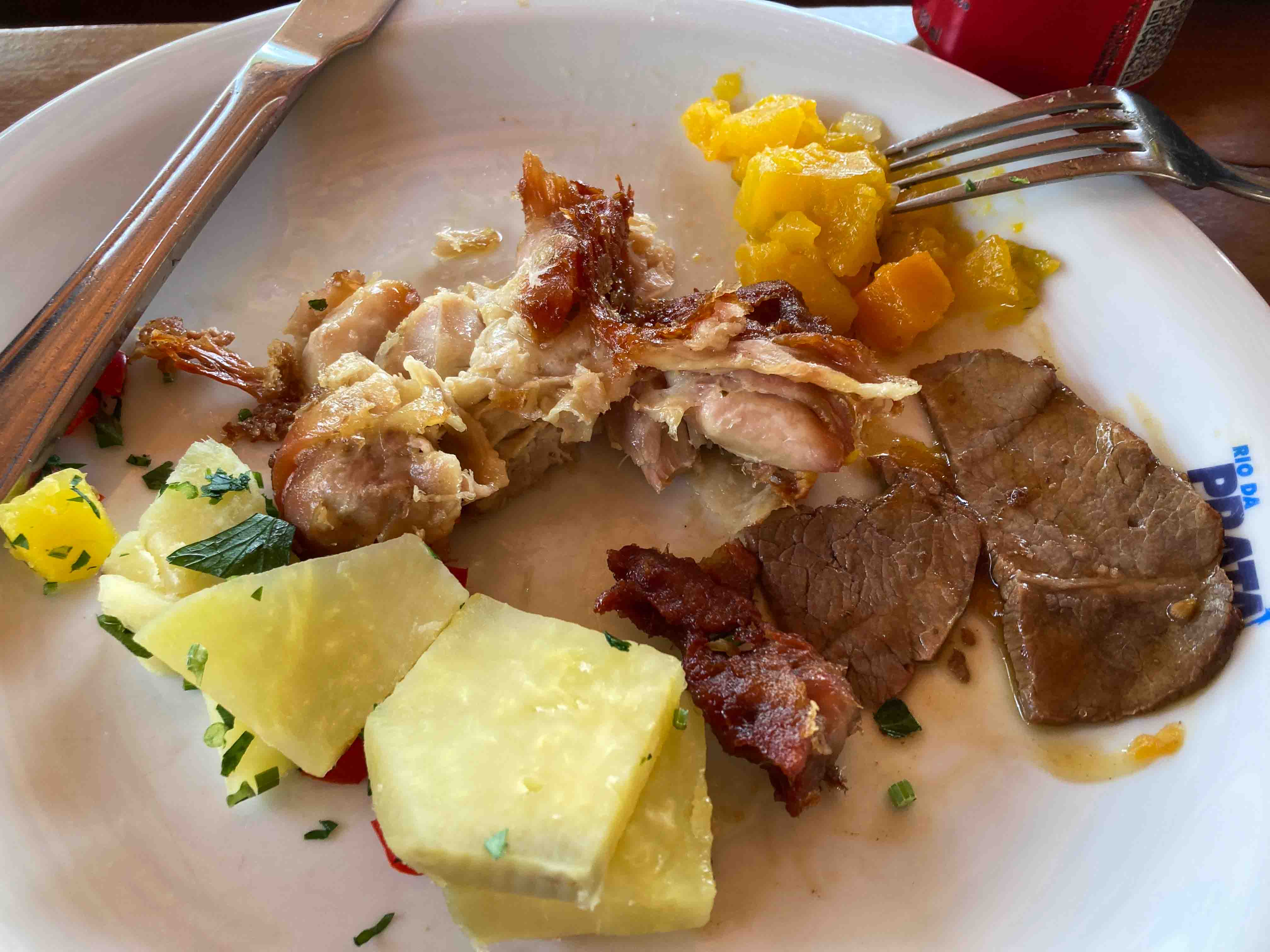
We have lunch at a fazenda (ranch/farm) called Rio da Prada Ecolodge.   It's a popular place for people to snorkel and float in the clear waters of a nearby river.


We are greeted by a flock of noisy Guira cuckoos in a tree by the lodge.


The fried chicken (top left) is fantastic!   Crunchy edges and tender meat.   But, like everywhere I've eaten beef in Brazil, it is tough chewy, and always overcooked.


While the girls are feeding the cats that roam the premises, this parrot waited for the right moment, then swooped down to our table, grabbed a chicken bone,  and flew to a nearby roof to enjoy his lunch.


The fazenda is a working ranch, so we visit a cowboy on what must be a prize bull.


We see several burrowing owls along the dirt road into the lodge.


One afternoon, Octavio asks if we want ice cream and stops at a shop in Bonito.    Want ice cream?    

Oh, my, does this place have ice cream.   Rows of freezer chests line the walls and at the far end is a place with "all the fixings."   Incredibly, it's scoop-your-own!

Someone tells me they have passion fruit ice cream and I put a couple small scoops in a cardboard cup.   At the cashier's station, a lady places my cup on the scale and charges accordingly.    I have no idea how much it is because Octavio pays.

These photos are a sample of the ice cream available and don't represent the whole supply.


The toppings.


Later, while looking for giant anteaters, we come upon a large bird that looks like an emu but is actually a Greater Rhea, and we photograph it in the late afternoon golden light.


Backlit Greater Rhea in the Golden Hour of a setting sun.


The largest native birds in South America, they weight 33 to 60 lbs, and can run 40 mph.   Standing between three and five feet tall, these omnivores are usually found in grasslands where they eat broad-leaf plants and clover, but also small vertebrates such as birds, snakes, and lizards.

From Smithsonian National Zoo:

Males develop a dark collar at the base of their neck during the breeding season. They call females with a booming call and court two to 12 females with an impressive wing display. Once mating has occurred, the males build nests, which are shallow depressions in the ground.

Each of the females lay up to five gold- colored eggs in the male's nest over a period of seven to 10 days. They can lay up to 60 eggs total. The male incubates the eggs for about six weeks and cares for the chicks alone. When male rheas are taking care of their young, they will charge at any creature that comes too close to them, including female rheas and humans.


Though they resemble an ostrich, rheas have three toes whereas an ostrich has only two.


Sunday, November 5, 2023

The 2023 Brazil Journals, Chapter Eight


(To see photos full screen, click on one and then scroll through them.)


Chapter Eight

The Sinkhole


I hope you love birds too.   It is economical.

It saves going to heaven.

—Emily Dickinson


 The ladies who run the kitchen at Hotel Cabanas come to work early just so we can have breakfast at 5-ish and be on our way to a special place.   It’s about a 30-minute drive and we leave in darkness.


Just a small part of the large buffet for breakfast.


Buraco das Araras is the name of this private property that has been turned into an attraction so that thousands of people can marvel over the birds that live there.   Rediscovered in 1912, the sinkhole is now part of the 29-hectares Buraco das Araras Private Natural Heritage Reserve.


Buraco das Araras means, literally, Hole of the Macaws.


We register at the greeting center (I guess if we don't return, they'll assume we fell in the sinkhole) and begin a ten-minute walk through the woods. I'm lagging behind and suddenly red and green macaws are flying over my head so closely  I feel the movement of air and duck.


Local legend has it that cattle thieves and other miscreants that the locals wanted rid of would be blindfolded and driven to this area.   They would be untied, blindfolds still in place, and told they were free—run!   Of course they would run in the opposite direction of the lawmen and right into the sinkhole.


We come to a two-story platform with high railings overlooking a 330-foot deep sandstone crater that is 1640-feet in circumference, and more than 522 feet in diameter.   


Photo taken after the tourists arrived.   Hence the arm in the photo.


A short video of the sinkhole.


At the bottom is a small green pond that is the natural water table in this area.

Broad-snouted caimans live at the bottom and their survival is thought to be because they eat their young, there being no other food in the crater.


And so begins the most challenging photography I have ever encountered.   Half in sunlight, half in shadow, my camera's auto-ISO is all over the place and mostly way too high.  Bird in light with darkness in the background, or the other way around.   


I take photos of perched birds first, then try my luck at flying birds.


To do that, I have to lift my camera above the top guard rail and lean it out.   Now I’m afraid I’ll drop the camera into the abyss.


This railing is way too high for me to lean my camera over, as you can see by this photographer who is a bit taller than me.   I had to stand on a step stool.


The day heats up quickly and soon I’m taking frequent breaks on a bench and gulping water.


I should have done what Shelly did—ask Octavio questions right off the bat.   

At length he comes over to see how I’m doing and when I tell him “not very well” he takes my camera and changes the auto-focus settings.    That helps a lot and long after this trip is over, those settings remain on my camera.   


 Rather than a tiny rectangle to try to place on a flying bird, I now have a larger rectangle and need only get part of the bird within that rectangle.   It gives me a fighting chance and enables me to get bird-in-flight photos throughout the trip.


There’s still the flying bird thing.   They might look like they’re just drifting along, but try to track them with your long lens and they might as well be Secretariat at Churchill Downs, except that famous horse wasn’t constantly in and out of  changing light.


Eventually, I get something approximating a decent, though not great, image but by then I am exhausted from the heat.


These photos are not all from this first day.


A bunch of non-photographers arrive and we leave.  It's almost lunch time anyway.


Last evening, we drove the backroads around pastures, looking for giant anteaters.   Octavio spotted brown shapes that were barely visible above the dried grasses.


I took a couple shots.   I thought they were boulders but after down-loading and looking at them on a computer screen, I can see the long brown hair of anteaters.


Are they or aren't they giant anteaters?


A mated pair:   red and green macaw and blue and yellow macaw.


Making baby macaws.


The same mated pair.


Red and green macaws


Buff-necked ibis

Plumbeous ibis.


Black vulture