
If the men of the Endurance
though they had it rough when they had to abandon their dying ship and spend
months on the pack ice of the Weddell Sea, they must have revised their
definition of “rough” after their first day at sea in the life boats. The small boats are less than 23 feet long, with
no enclosure to escape the wind and waves and spray and blizzards common to
this area.
All afternoon they dodge floes of ice meant to crush their
tiny boats until finally, as darkness approaches, they tie up to a seemingly
stable floe and drag themselves onto the
ice to rest. They go to their wet and freezing sleeping
bags after a hot meal cooked over the blubber stove.
Ernest Shackleton is exhausted also, but he gets out of his
bed and walks about the encampment. “Some
intangible feeling of uneasiness made me leave my tent about 11 p.m. that night
and glance around the quiet camp. I
started to walk across the floes in order to warn the watchman to look
carefully for cracks, and as I was passing the men’s tent the floe lifted on
the crest of a swell and cracked right under my feet.”
The crack quickly runs under a tent and dumps two men in the
water. One pulls himself from the
icy water. Shackleton grabs the other
man, still in his sleeping bag, and yanks him onto the ice before it slams
together again. There is no more sleep
that night.
Men huddle around the blubber stove for warmth and listen to
the killer whales prowling and blowing around their small floe. They have spent months worrying about leopard
seals attacking them on the ice. Now
they wonder if killer whales will prey on them.
They make progress.
Then a gale blows up and drives them back 30 miles east and 11 miles
south. Shackleton worries that the drift
will force them between the islands of the Antarctic Peninsula into the open
southern Pacific.
There is no more camping on the ice because they cannot find stable ice. Instead, the men suffer all night long in the
boats, cold, wet, exhausted, and hungry. Many are
sick with dysentery. Blisters from
rowing break and are irritated by the salt water. Their mouths are swollen and lips bloody, and
painful boils erupt on their skin.
The Stancomb Wills
is in danger of sinking from gale force winds that blow wave after wave into
the boat, drenching the stores and men. It
is too much for some of the men. Some
cry, some sit in silence.
Finally, dawn reveals Elephant Island ahead of them, but it
is dusk when they near and Shackleton decides to delay landing until first
light. The Dudley Docker disappears during the night during a heavy snow
squall, and Shackleton despairs. The
small boat reappears in the morning.
 |
| This Frank Hurley photo taken with a Kodak Vest Pocket camera shows men of the Endurance landing on Elephant Island, the first ground they have set foot on in 497 days. |
They make a treacherous landing across a reef in the
morning. Shackleton decides to give
Perce Blackborow, the young stowaway who has acquitted himself well, the honor of
setting foot on land first, but he does not move. Shackleton helps Blackborow over the side only
to see the young man sit down in the surf.
Then he remembers the boy’s feet are frostbitten badly.
Eventually, all the men get to shore. Many suffer temporary aberrations from their
torments, reeling about the rocky beach, shaking with palsy, or stumbling out
of control. One man writes in his diary that half the men are insane.
The island is uninhabited, but penguins and seals are
plentiful.
“They had spent seven frightful days at sea in open boats…at
the beginning of an Antarctic winter; 170 days drifting on a floe of ice with
inadequate food and shelter, and not since Dec. 5, 1914—497 days before—had they
set foot on land.”*
It is April 15, 1916.
They are alone and no one in the outside world knows where they are or
even if they are alive.
 |
| The green line ends at Elephant Island. Now what, Shackleton asks himself. |

* As quoted in "The Endurance" by Caroline Alexander
***
 As we leave the former whaling station of Grytviken on South
Georgia Island and sail south-southeast, I think about the reindeer that are to
be eradicated from the island to preserve plant species. At least the meat will be salvaged and given
to residents of the Falklands, where fresh meat is difficult to obtain.
As we leave the former whaling station of Grytviken on South
Georgia Island and sail south-southeast, I think about the reindeer that are to
be eradicated from the island to preserve plant species. At least the meat will be salvaged and given
to residents of the Falklands, where fresh meat is difficult to obtain.
The rodent elimination also begins this year. Helicopters will spread poison bait, with the
rodents expected to perish in their dens after consuming it. The South Georgia Heritage Trust believes
that many bird species will return to nest on the island after the rodents are
destroyed, and eggs and chicks no longer preyed upon by the rats.
 |
| Ice bergs along South Georgia. |
With 900 miles to go, we leave the protection of Cumberland Bay and, still in the
lee of the high mountains, encounter massive icebergs. The Fram sails close-but-not-too-close
between them. It is a taste of what is
to come.
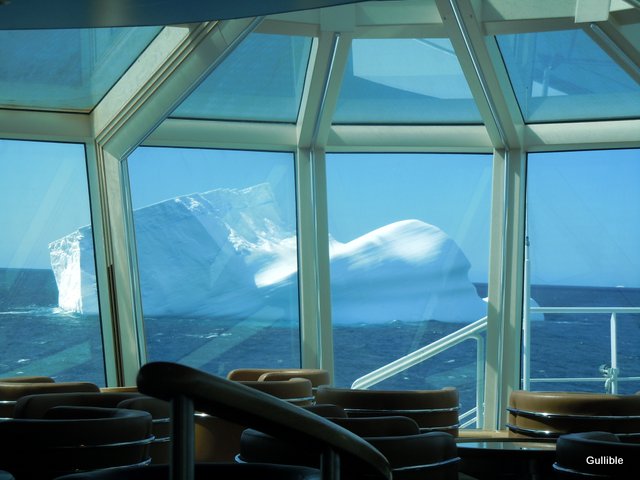
The weather is glorious,warm and sunny with little wind. Passengers go out on the decks to photograph
the bergs in the bright sunlight.

 |
| A berg off South Georgia island. |
 |
| Note the tiny sailboat the bottom left of this berg. |

 |
| Our route from the Falklands to South Gerogia, the hard right turn south to South Georgia during the storm, and now on the way to King George Island in the Antarctic Peninsula. |
Rounding the southern tip of the island that evening, we run
into near gale force winds, and our newly-educated sea legs become necessary
again. Though the winds and waves are
nowhere near what we experienced on our northern approach to South Georgia, one
elevator car is taken out of service and access to open decks is restricted.
 |
| Cape petrels following the Fram. |
I see wave spray as high as Deck Five and sea birds return
and surf the air currents just off the water.
The winds and waves increase in strength as we push westward. By the second day at sea, the winds are near gale force at 30 km per hour with waves near 15 feet.
 |
| Photo taken from Deck Six. |
We wake to snow. For some of the Filipino crew, it is the first
time they have seen this frozen white rain.


There are lectures and information about Antarctica to
attend, meals to enjoy, and temptation all along the dessert aisle at lunch and
dinner.
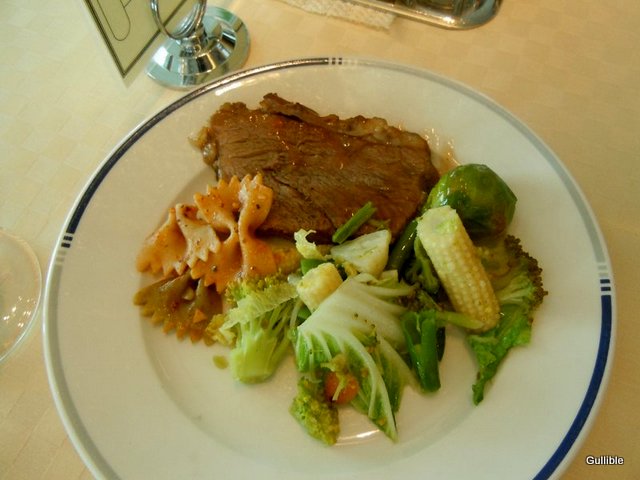 |
| Beef steak, pasta and veggies. |
 |
| Baked apples. |


I see the ship’s officer in the companionway outside my
cabin. He is laughing.
“I have never seen a ship full of passengers like this
before,” he says. How’s that, I ask
him.
“After all you have been through, you’re still smiling.” I tell him I think we’re just happy to be
alive still.
 |
| Attending a briefing. |
 |
| This woman was pitched into the cabinets at right when she stood up from her chair. |
And then, half way to the Antarctic Continent, the long arm
of Argentine politics reaches out and grabs us, and the proverbial monkey
wrench arrives. In a show of power, the
transportation minister declares a 24-hour strike for Tuesday, Nov. 20.
What this means to us at this time is unknown. Our program managers are busy with e-mails
and calls trying to determine how this strike might mess up our carefully
planned itinerary. Our reservations call
for us to fly out of Ushuaia, Argentina, to Buenos Aires on the 20th
and overnight there.
Many of us signed up for various shore excursions, and Kathy
and I chose a trip to the southernmost national park in the world, Tierra del
Fuego National Park, but the strike involves bus drivers. Everything’s up in the air.
Meanwhile, back on the ocean, Capt. Hårvik has three engines pushing the Fram against near
gale force 30 knot winds and 15 foot waves.
Fram’s speed is only 9 to 11 knots, and we are a half day behind
schedule as a result.
Word goes around the ship that we will miss our first scheduled
landing in Antarctica. This is not good
news. We have come a long way just for
this part of the trip.
Three and a half days at sea, we approach our first landing
in Antarctica. Fram drops anchor in a
quiet bay on King George Island and within a few minutes, the Polarcirkle boats
are buzzing around the ship like mosquitoes.


