"I'm going to speak my mind because I have nothing to lose."--S.I. Hayakawa
_______________________________________________________
Showing posts with label Falklands. Show all posts

Friday, December 21, 2012

The Antarctic Journals, Chapter Sixteen, We Shall See What the Sea Serves


Stanley, East Falkland Island.  

 Kathy and I walk through the streets of this charming and tidy town, the largest settlement.  Of the 2500 people who call these islands home, 2300 live in Stanley.  Traditionally, they are called "kelpers," because at one time they harvested kelp to turn into fertilizer.

The other 200 are scattered around the many islands.  That means that there are more passengers and crew aboard the Fram than live outside of Stanley.  Not included are the 1000 British military personnel garrisoned at Mount Pleasant.


The older part of the Government House, built in 1865.


Since the end of the 1982 war, living conditions have improved in the Falklands as Great Britain has committed more resources. 

The Government House


In days past, the Falklands were the last stop for provisions and repairs for ships sailing westward towards Cape Horn at the bottom of South America.  And, it was a place of refuge for ships battered by the notorious winds and ferocious seas at Cape Horn.  They used the prevailing westerly winds to limp into Port Stanley.


Not all ships reaching Stanley were repaired.  The town acquired a reputation when unscrupulous operators charged more for repairs than the ships and cargoes were worth.  As a result, many ships were deliberately abandoned or scuttled and their rotting hulks lie today in Stanley harbor.


Once an important area of commerce for whaling, sealing, and penguin oil, as well as sheep farming, today Stanley has a new deep sea fishing industry.


And, there are the tourists.  Gift shops are springing up in town for the estimated 66,000 visitors a year, and Kathy and I hit several of them on our windy walking tour.  We now find our third foreign currency—the British pound sterling.  Argentina uses the Argentine peso, and the Fram, the Norwegian krone.


Standing in line at the last gift shop, the one that sells “all things penguin,” I overhear one cashier say, “I hear there’s a storm coming.  I hope it doesn’t get too bad for you.”


Sign in Harbour View Gift Shop
 
A storm?  The wind is blowing 40 knots—gale force winds blowing 39 -46 mpg, force 8 on the Beaufort scale—and the lady says there’s a storm coming?  These folks would do well in Alaska.


Typical cottage.


Did I mention there are a lot of Land Rovers in the Falklands?
In every color.


Our time in this charming town with its friendly people comes to a close.  Back aboard the ship, we hear many tales of kindnesses extended to passengers, including one who accidentally splashed some tourists as she drove past.  She turned around, apologized profusely, and then drove them on a scenic tour of the town, waited for them at stores they wanted to visit, and then brought them to the ship.


We must have our photos taken under the whale bone arch.


No blue sky the day we were there.


When everyone’s aboard that late afternoon, those gale force winds pin the Fram to the pier as if trying to keep us in Stanley.    We’d like to stay longer, we really would, but South Georgia Island is on our itinerary and we are anxious to see it.  It is the reason  Kathy and I chose this particular trip to Antarctica.


While waiting for the shuttle to take us back to the ship, Kathy laments that she hasn't found a mail box to mail some postcards.  I suggest she turn around.  I'm helpful that way.


Powerful 1000 kw electric bow thrusters push back against the wind and the Fram inches away from the pier.  High waves crash against shores as we sail out of the harbor and into the open water of the Scotia Sea.   


It’s a two-day sail to South Georgia, almost 900 nautical miles east.

We shall see what that forecasted storm brings.  


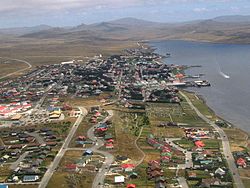
Aerial view of Stanley.  Photo from Wikipedia Commons.


Thursday, December 20, 2012

The Antarctic Journals, Chaper Fifteen, War Made Personal


January-February, 1915.   

The Great War against the Imperial German army is going poorly for Britain and her allies.

At the same time the Endurance is battling gale force winds and thick ice, German Zeppelin airships fly over the east coast of Great Britain and bomb two towns.

In early February, Germany declares a submarine blockade of Britain, and warns that all ships approaching that country are considered targets.

Ernest Shackleton and the men of the Endurance have no way of knowing how the war is progressing.  They have lost radio contact with the whaling station on South Georgia Island. 

The plan was for the Endurance to reach Vahsel Bay, drop off the excursion party and a mountain of supplies, build a winter hut, then return to Argentina.  With no radio contact, no one knows the ship is struck fast in the slowly revolving ice of the Weddell Sea.  No rescue operation will be mounted.


Black and white photographs by Frank Hurley.

      South with Endurance: Shackleton's Antarctic Expedition 1914-1917
      The Photographs of Frank Hurley
      Book Creation Services, Ltd., London, 2001
      ISBN 1-932302-04-2


***


Falklands flag
Michael brings the war to us. 

Bouncing across the Falkland moors, grinding through the mud and tracks of four-wheel drive vehicles, gale force winds plaster rain against the windows as we pass through an area that is now cleared of land mines buried by the Argentine forces in 1982, and Michael brings the war to us. 

He’s too young to be a veteran.  The war was thirty years ago, and he’s less than that.  But he’s an islander, born and raised here.  His speech is British-accented and there are many colloquialisms.

“My father has a farm near here,” he begins.   "British soldiers would go there and target practice on their time off.  The ground was littered with brass.

“After the invasion, an Argentine military helicopter landed in the yard one day.   An officer stepped out and looked around the property.  He saw the brass.

“My father was taken away on the helicopter, accused of being a spy, of communicating with the British Forces.  All communications equipment in the house was confiscated—telephones, everything.  They flew to a remote area and landed.  The officer ordered my father to get out and bury the radios and things.

“My father refused.  He said they would shoot him in the back if he got out.  Again he was ordered and again he refused.

“A voice came from the back of the helicopter, a voice with an American accent.  It was another Argentine officer, one who had been educated in America.  He told my father that he would walk behind him, stand between him and the helicopter while he buried the equipment, then walk in front of him on the way back.

“And he did.  Then they took my father home.”

He speaks of a military craft full of soldiers who were told to go ashore without their kits.  The heavy equipment would be off-loaded the next day, they were told.  The soldiers refused because they did not want to be separated from their kits.

That night the ship was attacked by Argentine planes.  The loss of life on the ship that night was the single-most loss in any conflict of the war for the British.

“Since the war,” he continues, “there have been more British soldiers lost by suicide than died during the war.  They thought they were going to fight soldiers.  They found themselves fighting boys.”  

That rings a bell.  Back in Argentina, we were told that young boys from the poorer parts of towns being were sent to war believing they were going to liberate their countrymen from the hated yoke of British colonialism.

I’ve been all over the internet since I got home, trying to verify these and another of Michael’s stories.   Obviously, I cannot verify what happened to Michael’s father unless I could talk with him.

I found enough information about the attack on the boat to think it might be true.* 

As for the loss of life since the war, that is true.   

Two hundred and fifty-five British died during the war.  In a 2002 report, 264 veterans were known to have committed suicide.  The toll for the Argentine military is worse.   They lost 649 in the war, and 464 veterans since.  As for the residents of the Falklands, three women were killed in the British bombardment of Stanley when the Argentines occupied it.

The Argentines have refused to take their dead home.  They are buried in the Falklands because Argentina continues to claim sovereignty here.

I know that tour guides sometimes make up stories to regale the tourists.  I know they exaggerate.  As to whether or not Michael was telling us the truth as he knew it, or telling us whoppers, only he knows.

What I do know is that Michael brought the war to us in the cab of the Land Rover that afternoon as we drove towards Stanley.  It wasn’t our war.  It wasn’t our country.  It wasn’t us.  It was a cover on Newsweek, a mention in the newspaper, sparse coverage on TV.   And it was so very far away.


 But somehow, in the cab of that Land Rover, the war became personal.


*http//en.wikipedia.org/wiki/Falklands_War


Tuesday, December 18, 2012

The Antarctic Journals, Chapter Thirteen, Penguins and Provisions


After a month at the Norwegian whaling station of Grytviken on South Georgia Island, Shackleton re-provisions the Endurance.  Two live pigs, destined to be food,  are aboard.  The month-long rest has rejuvenated the crew and all are ready for the upcoming adventure.

The stowaway with Mrs. Chippy.  Frank Hurley photo.
The ship’s carpenter, grouchy Harry McNish from Scotland, known by the traditional shipwright's nickname of “Chippy,” has brought along his tabby cat named “Mrs. Chippy,” though it is a male cat.  The crew is quite fond of the personable cat, whose chief delight is to walk across the top of the kennels of the half-wild sledge dogs, knowing the chained dogs cannot reach it.

Frank Hurley photo of sledge dogs aboard Endurance


Whalers report the ice conditions are still bad but Shackleton fears waiting longer would mean a complete end to the expedition and he decides to proceed.  The Endurance leaves Cumberland Bay on Dec. 5, 1914,  turns south by southeast to sail around the bottom of the island, into the Scotia Sea and thence south to the Weddell Sea of Antarctica and some of the worst ice conditions in memory.


(Frank Hurley photographs courtesy of:  South with Endurance: Shackleton's Antarctic Expedition 1914-1917
The Photographs of Frank Hurley
Book Creation Services, Ltd., London, 2001
ISBN 1-932302-04-2


*** 


I leave the Napier’s farmstead with mixed feelings.  I live in an area that many consider “out in the sticks,” yet I am nowhere near as isolated as these folks on West Point Island.  I have many questions, but with a couple hundred inquisitive blue-parka-ed tourists waiting for tea and pastries, I drink my tea, extend my thanks, and leave for the Cirkle boat.

As I walk down to the water, a few sheep top a rise and watch.  

Once we’re all back on board—remember, they check our ID barcodes as we leave and return, so they know if there’s a straggler—it’s lunch time, so we leave our shore parkas and rain pants in our cabins and head for the dining room and a buffet lunch.


Breakfast and lunch on the ship is always buffet style, with several hot entrée choices, various salads, soup, cold cuts, breads, and far too many desserts than should be placed before one fallible human.  Dinner, on the other hand, is in two seatings with assigned tables, as the number of passengers and crew is greater than the dining room’s capacity.

There are two entrée choices, a main choice and an alternative.  We must notify the dining room attendants before 3 PM if we prefer the alternative.

Only when there are late afternoon landings is there a dinner buffet. 

While we have lunch, Captain Arild HÃ¥rvik repositions the ship to Saunders Island, only 18 miles away from West Point Island.  This is the last island we will visit in the West Falklands.


Aerial view of  the Saunders Island isthmus.  The Fram drops anchor near the cove on the left side.

We wait on the ship while the program managers, lecturers, and ship’s crew leave in the Cirkle boats to find a safe landing.  I start calling them the Orange People for their red-orange parkas that make them readily recognizable for questions and assistance.


Gentoo penguins swimming ashore after feeding at sea.


Coming ashore.


Our rocky ledge landing on Saunders Island.   The orange people are stationed in various places to assist.


This landing is exciting as we step from the front of the bouncing boat onto the rock shelf, carefully walk over slippery rocks, and climb a hill to access a sandy isthmus.  There are Gentoo penguins EVERYWHERE, and, as usual, once comes to see what’s going on.


Apparently the nosiest Gentoo on the island.  Or perhaps it's his turn at guard duty.


And there he goes, back to tell his buds what's going on with those blue-backed boobies.


I walk along the beach to the low grass on the far side, then cross the isthmus to another sandy beach.  I encounter my first King Penguins on this crossing.  There aren’t many of them, but I am enthralled with their colorful plumage.


Crossing the isthmus to the far side.  Those dark areas inland are sites of Gentoo colonies.


Whale skeleton.


Adult King penguin.  They eat fish and squid, diving to depths around 300 ft.  Scientists have recorded dives to 1000 ft.


Gully and furry brown King Penguin chicks.  King penguins do not build nests, but carry a single egg on their feet, keeping it warm with a pouch of skin that folds down over the egg.


King penguin chicks in their brown woolly fur.   The chicks moult this fur at about two years of age.  Until then, they cannot go to sea and must be fed by their parents.


King penguin parent feeding chick.  King penguins are the second largest penguin.  Only the Emperor penguin is larger.  Kings are three feet tall and weigh between 24 and 35 lbs.   The plumage of an adult King penguin has four layers of feathers, for warmth or water-proofing.  There are 70 feathers per square inch on the outer plumage.


Each piece of high ground is covered with Gentoo penguins.  Penguins come and go, usually in groups, but I found this lone Gentoo running from the beach back to its colony.


I include this video because walking penguins are so much fun to watch .

The wind is blowing, whipping up sand on the exposed beach.  I head back to the landing site as my allotted time onshore is closing.


 A Magellanic penguin among Gentoos on the beach. 


Magellanic penguin.


King penguins and sea cabbage, which blooms with  bright yellow flowers.   Young King penguins have yellow ear patches that become orange when they reach adulthood.

We go ashore by boat numbers.  Kathy and I are in boat group 3, and our group is first ashore at Saunders Island because this is the third landing.  Next landing, group 4 will go first, and so on.  There are 8 boat groups with thirty-some tourists in each group.  This means the Cirkle boats are constantly shuttling people ashore and back to the ship, thus the allotted time on shore.


Falklands Steamer duck.


Once we’re all back on board, the Fram leaves for the capital city of Stanley in the East Falklands, 132 miles from here.  It’s an overnight journey, and the wind has picked up.  We’ll be in the open waters of the South Atlantic Ocean.