"I'm going to speak my mind because I have nothing to lose."--S.I. Hayakawa
_______________________________________________________
Showing posts with label buffalo. Show all posts

Monday, March 6, 2023

The 2022 Africa Journals, Chapter 26: Sleepless on the Mara

 Chapter 26:

Sleepless on the Mara


(Note:   If you want to view the photos in a larger format, click on one.   A film strip will open at the bottom of the page and you can click through it.)


It’s funny, but you never really think much about breathing. Until it’s all you ever think about. – Tim Winton


I can't sleep.

I can't sleep because I can't breathe.

I can't breathe because when I lie down, I'm short of breath.

And thus it goes, awake and concentrating on breathing.   The longer I'm awake, the more anxious I become which serves only to exacerbate the problem.  I'm trying not to toss and turn so that I don't disturb Marg in the next bed, who may or may not be sleeping.

I notice, however, that my persistent cough has disappeared now that we are in the less dry area of Kenya.

I must have finally drifted off because I wake up and Marg has already gone to the dining tent for coffee.   (How does she unzip and zip the tent flap without waking me?)


My bed is left, Marg's is right.   At night, mosquito netting shrouds both beds.


I lie in bed for a while, thinking and worrying.  I finally decide what to do near wake-upon call time and it's a tough decision because this is our last full day at Enkewa camp.   Tomorrow we head for our fourth and final camp.

I get up, get dressed, and wave a flashlight out the tent flap to summon a security guard to escort me in the dark to the dining tent.   Marg is the only one there and I sit down beside her and tell her I am going to stay in camp this morning because I din't sleep much and am exhausted.

She wants to know why I didn't sleep well.    I hesitate because Marg is a veterinarian and reluctant to say too much, but she dismisses my initial middle-of-the-night delusional self-diagnosis.   


Virginia walks into the dining room.   Virginia is a surgeon (people, not animals) and can ethically advise medical info.  She immediately wants to know what's wrong.   She checks my (nice, steady, and not too rapid) pulse and pokes a finger at my shin.   A dimple remains:  I'm retaining water.

I look at my leg and think that it doesn't look like my legs usually look.   It's bigger.  And puffy.

This gives me another avenue to research for my self-diagnosis and I return to the tent. I dig into my tea and cookies, then take my morning prescription meds which includes a pill that lowers blood pressure and reduces the risk of strokes, and a diuretic.

Then I go back to bed.

Two hours later, I wake up and feel fine.   I'm no longer short of breath.   I turn on the computer and Google "elevation of the Maasai Mara National Reserve" and there's my answer--it's 4900 to 7000 feet above sea level.   I am having a bit of a high altitude problem.   After all, I've lived within 700 feet of sea level almost all my life.

I should have recognized the symptoms as they have plagued me in the past in high elevations--in Tibet and in Wyoming.    They are the reason I can't go to Machu Picchu

This is the first time I'm in camp during the morning, so I wander around to see what I can see, hoping for birds.   I strike out on that, but I finally get a decent photo of the dining room.


In the next couple hours, two different people (Solomon the dining room waiter and Jason our tour organizer) come to check on me.   They assure me they can get me to a hospital if I need.   I'm embarrassed for all the attention, but assure them I'm fine.

Later, Dominick, the head guide, also checks on me.  


I'm ready for the late afternoon game drive.   This time, I'm with Marg and Dominick is driving.   He has a spotter also.

First off, we find a black-backed jackal den in a huge termite mound.   A pup is curious about the vehicles with people pointing those huge black circles at him.

These charming little canids are among the bravest animals I've seen in Africa.   They think nothing of getting close to and barking at lions, trying to make the big cats move away from a carcass so they can eat their share.

This is from Go Africa, a tourist web site written as a blog:

"...(N)ow lack-backed jackals are one of the most ancient canids of all –the ancestors of modern wolves and dogs. They have not survived the past two million years by only getting in the ring at their own bantam-fighting weight. In fact, these little fellows – literally the smallest of all jackals - are considered the most aggressive. I’ve seen an individual jackal hunt and kill a young impala – an antelope larger than itself - with clinical efficiency."


Monogamous, cunning, and shy around humans, they are always a favorite sighting.


A Cape buffalo with a headdress of two yellow-billed oxpeckers.


A black-bellied bustard, displaying for a lady bustard.


Little bee-eater

Little bee-eater


On the way back to camp, I request a short stop to take a scenic photo.   It's raining slightly and it's slightly hazy, but I love this terrain.


Then, one last stop for an immature martial eagle.   This is Africa's largest eagle.   As you can see, it's crop is full and it causes a large lump on the breast.

Adult martial eagles are incredible strong, enough to carry off small antelope, baby warthogs, etc., but their favorite prey are poisonous snakes, chickens and the wild species of francolins, grouse, young bustards, and young goats and lambs, which makes them the enemy of pastoralists.

They are considered endangered.


Maybe.   Maybe it's something else.   With immature birds, it's often hard to tell.


I go to bed this night and sleep much better, even with the itching termite bites.

Wednesday, March 1, 2023

The 2022 African Journals, Chapter 25: Rethinking my 'Do No Harm"' Ethos after the Termite Swarm


Chapter 25:

Rethinking My ‘Do No Harm” Ethos


Some primal termite knocked on wood;

And tasted it , and found it good.

That is why your Cousin May 

Fell through the parlor door today.

--Ogden Nash


“Do termites get wet when rain falls down their chimneys?”   I‘m lying in bed, gazing absently at the mosquito netting that enshrouds my bed and thinking about termites when I ask the question.


This abandoned termite mound at Great Plains  Selinda Explorer camp win Botswana
is 12 to 15 feet high.

   At least.


Termite mound.   The chimneys are for ventilation.


I was remembering a photo I’d seen many years ago that depicted a fantastic “sculpture” after someone poured molten aluminum into a termite nest.   I looked at all the tunnels and connectors and chambers filled with aluminum and wondered, “But what about the termites?”


Marg is across the tent getting ready to find her way through the mosquito netting and climb into her bed.    She doesn’t answer.   I wonder if she’s thinking about my question, didn’t hear me, or if she’s wondering, “Where the hell did that come from?”


A cheetah is sitting on an old termite mound.


Another view of the Great Plains Selinda Explorer camp mound.


I find out a few days later that, yes, termites do get wet when it rains because I photographed some black-backed jackals gobbling up the insects as they came out of the ground during a hard rain.


Soaking wet black-basked jackal gobbling termites that come out of their nests in a hard rain.


After today, I no longer care about the fate of termites.   You can pour all the molten aluminum on them you want.   This is what happened:


We are off on another Ferrari Safari with Peter driving.   Our tour organizer Jason Fernandes is  riding shotgun, and Virginia and are I in the back seats hanging on to all our camera gear to keep it from bouncing around or flying out of the truck.  We are heading to “Downtown Mara,” which is where the majority of safari vehicles swarm around an animal sighting, especially if the sighting involves big cats.


Peter is anxious to get us to a sighting that he knows we will like.


Flower of Oxkiller (Boophone disticha)


I feel bugs biting me but I can’t see them.  How are they catching up with us as we speed along the road?  Pretty soon, I can make out some small winged insects on me, my gear, the seats, blankets, all over.   And I see little red spots erupting on my exposed forearms, little red cones.  As if I didn't already have enough big bites.


Peter turns around and says, “Termites.”   Aha!   We must have driven through a swarm and scooped them all up.  Termites swarm when one nest becomes overcrowded and some break away to build a new nest.   Well, with all my swatting, this swarm has far fewer flyers than when it started.  


With that, "Do No Harm" ethos is out the open window of the safari vehicle.


Virginia, in the back row, isn’t affected by the termites.    Of course not.  It wasn't until late in the trip that someone other than me was bitten by an insect.


We finally stop and I recognize the spot.  This is where we saw the leopard known as Luluka crawl into her den a couple days ago.   The word is that she will move her cubs today, so we settle in for the long wait.


Luluka entering her den a few days ago.


We don’t have to wait long .   Across the gully from us, Luluka appears, carrying a cub in her mouth.


For photographers, this is an exciting moment.   She is partially obscured by grass and bushes, but I don't care.    I have never seen this before.


We watch for a while, hoping she will return for the second cub, but she doesn't    She probably had already moved it.   And, we don't follow her to her new den.


So, off we go around the Mara.


Immature bateleur eagle, probably the most colorful of the eagles I've seen.


Immature bateleur eagle


Its backside so you can see some of the colors.


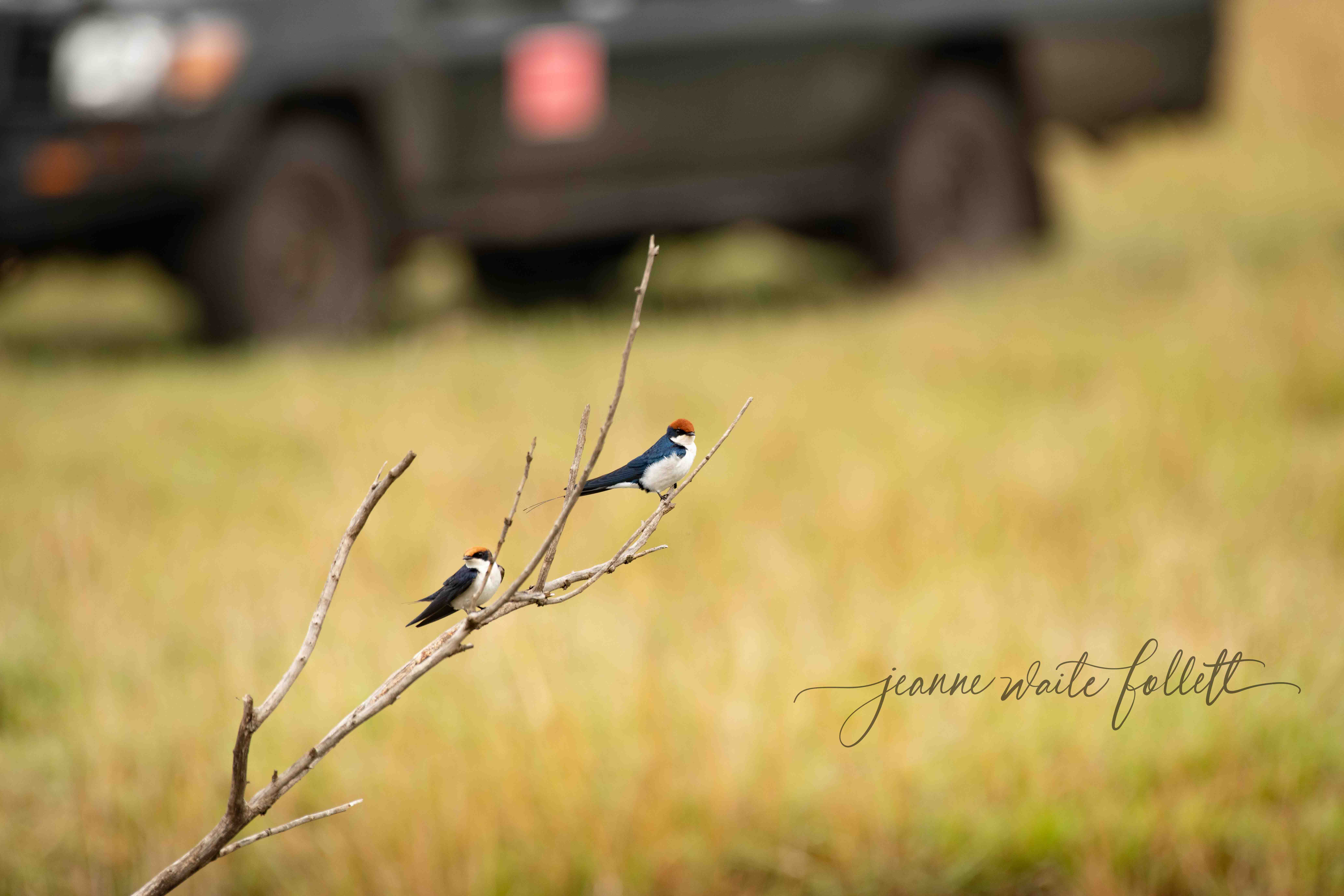
Pretty little wire-tailed swallow.


Wire-tailed swallows.


The photo below shows something that is so common in the Downtown Mara.   Whenever a vehicle stops to look at something, other vehicles also stop.   This one drove on when they realized we were photographing birds.


You can frequently find lions sleeping on the dirt tracks.   The dirt is warmer and drier than the grass.


The safari vehicles swarming like termites.


My favorite African bird, the hamerkop, the Afrikaans word for hammerhead.   With their long, flat bill and the feathers on the back of their head raised, they resemble a hammer.


Hamerkop build the largest nests of any African birds and can support the weight of a grown man.   One researcher estimated 8000 twigs were used in the building of one nest.   It can take 10 to 14 weeks to complete a nest and some claim if the female doesn't like it, the male builds her a new nest.


Rather than perching on top of the nest, a mud-plastered tunnel about 24 inches long is constructed into the bottom of the nest.   It leads up to a nesting chamber.


There has been a long scientific discussion as to whether hamerkop are storks, herons, or ibises.    Currently they are considered related to pelicans and cormorants, but check in a month or so and see where they are then.


They are so prehistoric-looking.   Their calls are hysterical, particularly if you're in a hide and one is wading in front of you, shuffling its feet to stir up pray.   I thought I'd choke trying to stay quiet.


Stopping for breakfast.


Setting out the goodies.   Johnson, Peter, Dominick.


The next two photos are the Lilac-breasted roller, the national bird of Kenya.


You must look closely to see the tiny black bug this southern ground hornbill has tossed in the air to catch before swallowing.


There is a  unique and particularly recognizable tree not far from camp.   Sylvia, whose name we changed to Slyvia because of a typo on a pre-printed hotel registration form,  said she knew we were close to camp when she saw that tree.

Today, a pair of brown parrots were tending their nest in the Slyvia Tree.


The parrot is in the fork  in the tree and the nest is in the knot below the fork.


The hard-working, proud parents.


A topi and her nursing calf.   There is a second calf lying down behind her.


This evening, Johnson takes Randy and I out to find the black rhino that mock-charged Randy the evening before.   We didn't find any rhinos, but we saw lots of other stuff in some delightful lighting.    Dark rain clouds and a setting sun were responsible.


Little bee-eater


Bare-faced go-away bird, so called because their "gwaaaa" call sounds like go-away.


The bare-faced go-away bird is in the Turaco family and might be related to the cuckoo.


Black-backed jackal pups.   The pup heading away from me is carrying a bone.


European roller.   Not as vivid as the Lilac-breasted roller, but beautiful with its pastels.


Same roller


Magpie shrikes.


White-crowned shrike.   Shrikes are often very pretty but they are also known as "butcher birds" because they are known to pin their kills on thorns, barbed wire, etc., to stash them until they are ready to consume them.


Cape buffalo are one of the most feared animals in Africa, killing a few hundred people every year.   They are highly unpredictable and very tempermental..   The bird in its nostril is a yellow-billed oxpecker.   These birds and the bovine have a symbiotic relationship in that the birds clean the buffalo's hide of ticks and other insects.

In return, the bird finds a lot to eat and it obtains moisture from the mucus of the beasts.   If the buffalo has an open scratch or wound, the birds drink the blood and peck at it to keep the source open.


The oxpecker has found some mucous for moisture.


I don't know, Mr Buffalo.   You don't scare me with two oxpeckers in your nostril and another in your ear.


I'll finish today with one more photo.

The photo below is my favorite of the day.   We caught this Lilac-breasted roller on a nice perch as the sun slipped between the overlaying clouds and illuminated it.   Light in the eye, to boot!


Damn the termites! Full speed ahead!