"I'm going to speak my mind because I have nothing to lose."--S.I. Hayakawa
_______________________________________________________
Showing posts with label Kathy. Show all posts

Sunday, April 28, 2013

The Chilkoot Trail Journals, Ch. 2, Getting There


During the winter of 1972-73, my friend Kathy decided it was time to get serious about a career, one with benefits like health insurance and retirement.   She gave notice to her employer at the Alyeska Ski Resort in Girdwood, Alaska, and loaded her belongings into her Toyotal Corolla  station wagon.   

In mid-June, she headed north, because  if you are in Alaska and yu want to get to southern California, you had to drive north a few hundred miles and then turn south on the Alcan Highway through Canada. When she passed through Canadian customs at Beaver Creek, she was in Canada’s Yukon Territory.   Not even a full-blown Canadian province, but a territory.

The Yukon, as it’s called for short, evokes its own colorful images—the Royal Canadian Mounted Police, a town on the Yukon River called Whitehorse, and a gold rush that brought a hundred thousand hopeful, gold-rush-crazed people to a little spot called the Klondike.

At the same time Kathy was preparing to drive north/south, I decided my life needed new horizons.   Unlike Kathy, I couldn’t load all my possessions in my 1965 Ford Mustang, though I gave it a sporting try.
 
My lead dog, Kolega.
I boxed up most of my extensive collection of books in beer boxes because those boxes were the most readily-attainable cardboard storage containers available in a ski town, and hauled them to Anchorage to store at my parents’ house, along with a dozen boxes of things I couldn’t part with. 

I became the owner of a dubious  surplus military trailer and hired a local fellow to build a “camping box” on it.   It had a bed and two plywood cabinets on either side.  A couple boxes of books and boxes of clothing and supplies went under the bed.

And then I loaded six huskies—no, make that five because the lead dog rode shotgun with me in the Mustang—in the trailer.   But that’s not all I took with me.


Leaving Girdwood on a rainy day in 1973.  The Mustang is loaded, my lead dog is in the passenger seat, the trunk is loaded, and there are a couple 50-lb. sacks of Purina dog show in the back seat..  There are five huskies in the trailer, plus a bunch of supplies and stuff.  Tied on top of the Mustang is a dog sled, two spare tires, and a pair of snowshoes.  On top of the trailer is the base of a 3-wheeled cart for summer dog training, and a spare for the trailer.  I figured if it fit, the Mustang could handle it.

I’ll say this in my defense:  Had I known any better, I never would have had the adventures I had in the next two years, and I’m really glad they are part of my life.  I made it back to Alaska alive two years later, this time with seven huskies, because dogs kept in close quarters have a way of multiplying their numbers.

But in the meantime, Kathy and I were taking the scenic route to Whitehorse where we would meet seven friends.  We had two weeks to get there, so we included visits to Denali National Park and Fairbanks.   We also stopped in Anchorage long enough to say goodbye to my folks.  My mother almost fainted, while my dad just shook his head and turned away with a smile.

Our destination?  The Chilkoot Trail—a 35-mile hike from the gold rush town of Skagway to Lake Bennett, which straddles the boundary of the Yukon Territory and British Columbia.


I left behind my beloved cabin in Girdwood.

Tuesday, December 4, 2012

The Antarctic Journals, Chapter Four

Leaving Your Mark, or Not


 To say that Shackleton’s second expedition to Antarctica sailed from New Zealand in 1908 would be both correct and incorrect.  Shackleton is the leader for this expedition and he chooses to have his ship, the Nimrod, towed 1650 miles by a steamer ship in order to save coal.

Before leaving England, Shackleton promises Robert Scott that he will not use the McMurdo base camp set up by Scott on their previous expedition. 

 This promise will be broken, of necessity.
Therefore, Shackleton heads for the eastern sector of the Great Ice Barrier (now called the Ross Ice Shelf), but finds ice conditions completely unsuitable and unsafe for landing or establishing a base.  He sails for McMurdo Sound and establishes a base hut about 24 miles from Scott’s former base.  Stores are off-loaded and the Nimrod sails back to New Zealand.

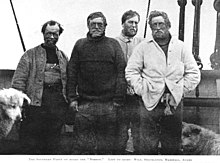
Frank Wild, left, Shackleton, Marshall and Adams
Shackleton and his men wait out the Antarctic winter in a pre-fabricated hut and in January 1908, a four-man party consisting of Shackleton, Petty Officers Frank Wild, surgeon Eric Marshall, and Jameson Adams reach a point only 112 miles (97 nautical miles) from the South Pole.  They also establish the approximate location of the magnetic pole.  For this journey, Shackleton uses Mongolian ponies to carry their supplies.  The cold and conditions are far too difficult for the equines and many die during the long Antarctic winter from eating volcanic sand for its salt content, and more perish on the trek inland.

The trip is arduous and food is rationed as the men trudge southward.  One of the ponies falls into a cravasse, taking with it some of the food supplies. Though they travel farther south than any other expedition and are so close, Shackleton decides to return to the ship, knowing that further travel would most likely cause the death of his teammates and himself.  

Marshall, Adams, Shackleton at their farthest point south.  There is some discrepancy as to the identity of the men in this photo, with some sources claiming Shackleton took the photo and that Adams, Wild, and Marshall are in the picture.

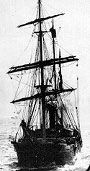
Nimrod

The return trip is plagued with starvation and half rations.  Frank Wild writes in his diary that Shackleton gave him (Wild) his allotted biscuit for the day and adds, “All the money that was ever minted would not have bought that biscuit and the remembrance of that sacrifice will never leave me.”

It is but one measure of Shackleton’s character.

 On arriving back at the base camp, the men find the Nimrod had sailed two days previous.  In desperation, they burn the camp.   It works and the Nimrod returns for the men.

Back in England, Shackleton is knighted and receives many awards but only a grant from the government saves him from defaulting on his loans.


The red line shows the route of  Shackleton's Nimrod Expedition trek to within a hundred miles of the South Pole.  Ignore the green line, because Shackleton did not fly from South America to Antarctica.  This was the only map I could find that showed the route of the Nimrod Expedition.  The red line denotes the air route used by a  group that recently duplicated Shackleton's expedition.


***


Surprisingly, we land in Buenos Aires just about on time.  I say surprisingly because there was some kind of delay in Dallas, one of those things the ticket agents won’t disclose the reason for, but leave your imagination to run wild instead.  

We get off the plane and walk down a long hallway, ride down as escalator, pile up at the bottom, and fall down in a heap. 

Really.  Well, some did.  The escalator continues to deliver more bodies to the heap.

Gold glass-fronted building across from the hotel in Buenos Aires.
Some of us see the heap in time to avoid the escalator.  Turns out, about fifty feet beyond the bottom of the escalator is where we line up in double lines to pay our bribe to get into Argentina. 

They call it “reciprocity,” kind of a turn-about-is-fair-play.  Seems the U.S., Canada, and Australia charge Argentinians a visa fee, so even though Argentina doesn’t require a visa for US citizens, they charge us the fee anyway. 

As I said, a bribe to get into the country.  However, when a 777 full of foreigners de-planes, it requires more than fifty feet to accommodate all those passengers at passport control.  When a herd of sheep is blindly following the sheep in front, it can be difficult to see what happens at the bottom of the escalator, hence the heap.  


Close-up of the reflections in that glass (see above photo).

Someone had the wherewithal to hit the stop control on the escalator, which allowed the poor lady at the bottom to get her feet under her and stand up.  The rest of us take the stairs, not wanting to be part of another heap.


This photo is actually of Kathy trying to get back into the US without fingerprints.
My friend Kathy finally reaches passport control, where an agent inspects her passport, takes her photo, and a digital fingerprint of her right thumb.  It won’t take, so they give her an alcohol swab to clean her thumb.  Still nothing.  They try the left thumb and it, too, won’t print.

Eventually they try a number of fingers, again without success.  A supervisor is called and after a discussion, Kathy is allowed into Argentina without leaving her prints behind.

She thinks the reason for the failure is that she has psoriasis on her hands.  Though she treats it daily, the skin condition has all but eliminated her fingerprints.

And then we encounter the chaos of the terminal where guides holding Vantage signs hope to corral us.
 

Sunday, July 8, 2012

The Yosemite Journals, Chapter Eight


My friend Beth at Memoir on the Fly titled one of her recent posts:  Sit Still Long Enough and Maybe Something Wondrous Will Find You.

As she sat still, a black bear came into view just off the porch of the cabin  where they were vacationing in North Carolina.

Nothing so spectacular here, but wondrous things come in all sizes.

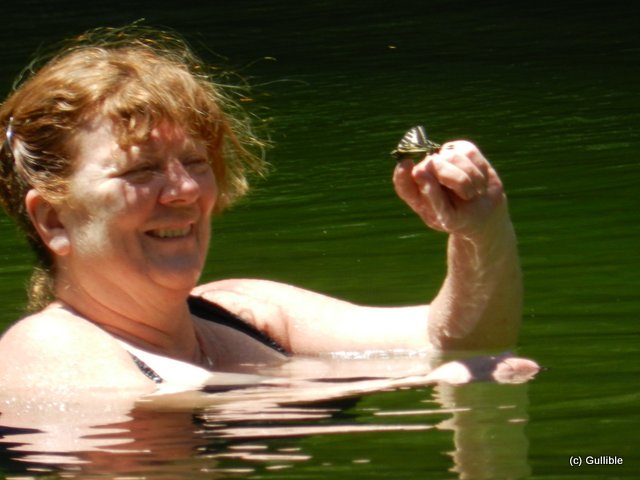
One hot afternoon in Yosemite Park, the group drove to Devil's Elbow, a beautiful bend in the Merced River that they favor.  Kathy and Sally waded out neck deep in the clear snow melt water.

Suddenly Kathy said, "There's a butterfly on my nose."  There was indeed but by the time I got the camera turned on, it had moved to her eyebrow.


I'm absolutely sure that Kathy had been holding very still because that water is so cold it paralyzes your muscles and you are unable to move.  Well, actually, it paralyzed this Alaskan.  The Californians thought it a delightful temperature, but I think they've lived with the sun baking their brains for far too long.

Soon the Swallowtail butterfly moved to Sally.  This time the camera was ready.


She walked ashore and the butterfly stayed with her.


As I said, nothing as flamboyant as a black bear at your knees, but when one is receiving wonders, one cannot be choosy.