"I'm going to speak my mind because I have nothing to lose."--S.I. Hayakawa
_______________________________________________________
Showing posts with label waterfowl. Show all posts

Friday, July 25, 2025

'Night, Y'all


As Mum Scaup stood watch nearby, these babies anchored themselves in the flowers for a nap.


Saturday, June 28, 2025

All in Good Time

What can I say? It's summer in Alaska, and I've been busy both photographing birds, animals, and wildflowers, as well as engaging in my usual practice of picking up litter for 40 miles along the Seward highway. 

Over the next few days, I'll post a few photos along with some explanations. Short and quick because I have to get out on the road. The vegetation is way ahead of me.

First off, the Tern Lake trumpeter swans hatched six cygnets and then took them into seclusion on the far side of the lake.   This is their usual behavior.


The American Dippers, formerly called water ouzels, which is a much cooler name, had three eggs hatch.


So many mouths to feed!


Sometimes the parents weren't fast enough with the grub, so the fledgling foraged on its own.


The Common Loons appear to have one chick.   It 's riding on an adult's back.   They were way too far away for my lens.


This photo needs an explanation.   One parent is behind the loon carrying the chick, and feeding it.   All you can see is the adult's head.


The two photos below show one red-necked grebe parent leaving the nest and the other ready to take its turn incubating what appear to be four eggs.   This is the second nest the red-necked grebes made this season.   

The first nest they made did not yield any chicks.   The reason could be many--something like a gull, eagle, or otter got the eggs.   The eggs may not have been fertile.  Anything.

They promptly built another nest some distance away and, by my reckoning, are close to the 23-day incubation period.   I hope to watch baby grebes soon.


What these greater and lesser scaup are up to is anyone's guess.   Hoping to see their chicks as I consider them the cutest baby ducks of all.


Hanging out with the scaup was a pair of ring-neck ducks.

Note the white markings on their bills.


As for litter, I am currently working in Turnagain Pass, having walked--little by little-- the 30 miles from home.   My current count of bags filled with litter is around 200.


And off I go.


Tuesday, May 14, 2019

Black and White

Something a little different:


This female American wigeon was in silhouette in the evening light.  I monkeyed with the camera to bring out some details and that led to the white background.


At the opposite side of the spectrum, I intentionally went for a dark background for this greater scaup drake

Monday, March 25, 2019

And Suddenly, It's Spring!

March, usually the snowiest month of winter, was unusually warm and rainy.  Except for one blizzard that dumped more than a foot of wet, heavy snow, the temperatures have been in the forties and a persistent rain with warm breezes attacked what little snow we had.

I can't remember a year when the snow left so quickly and the ground was bare so early.   Well, not quite bare yet, especially where the snow was piled, but bare enough that I'm setting a record for the earliest date I've started picking up litter.

As soon as I finish this post, I'm heading out with grab stick, yellow bags, and safety vest to start cleaning up around Tern Lake.

Which brings me to the thawing ice around Tern Lake.   Waterfowl are returning to the patches of open water.   I suspect these are birds that stayed all winter rather than migrating.   Mostly likely, they were on the Kenai River in Cooper Landing, which stays unfrozen.

While scouting for areas to start the clean up, I found pairs of  common mergansers, the flashy Barrow's goldeneyes, and the ever colorful mallards.

So, here are the ph

otos as proof...and then I'm off!


A drake goldeneye


The hen


And the pretty mallards:


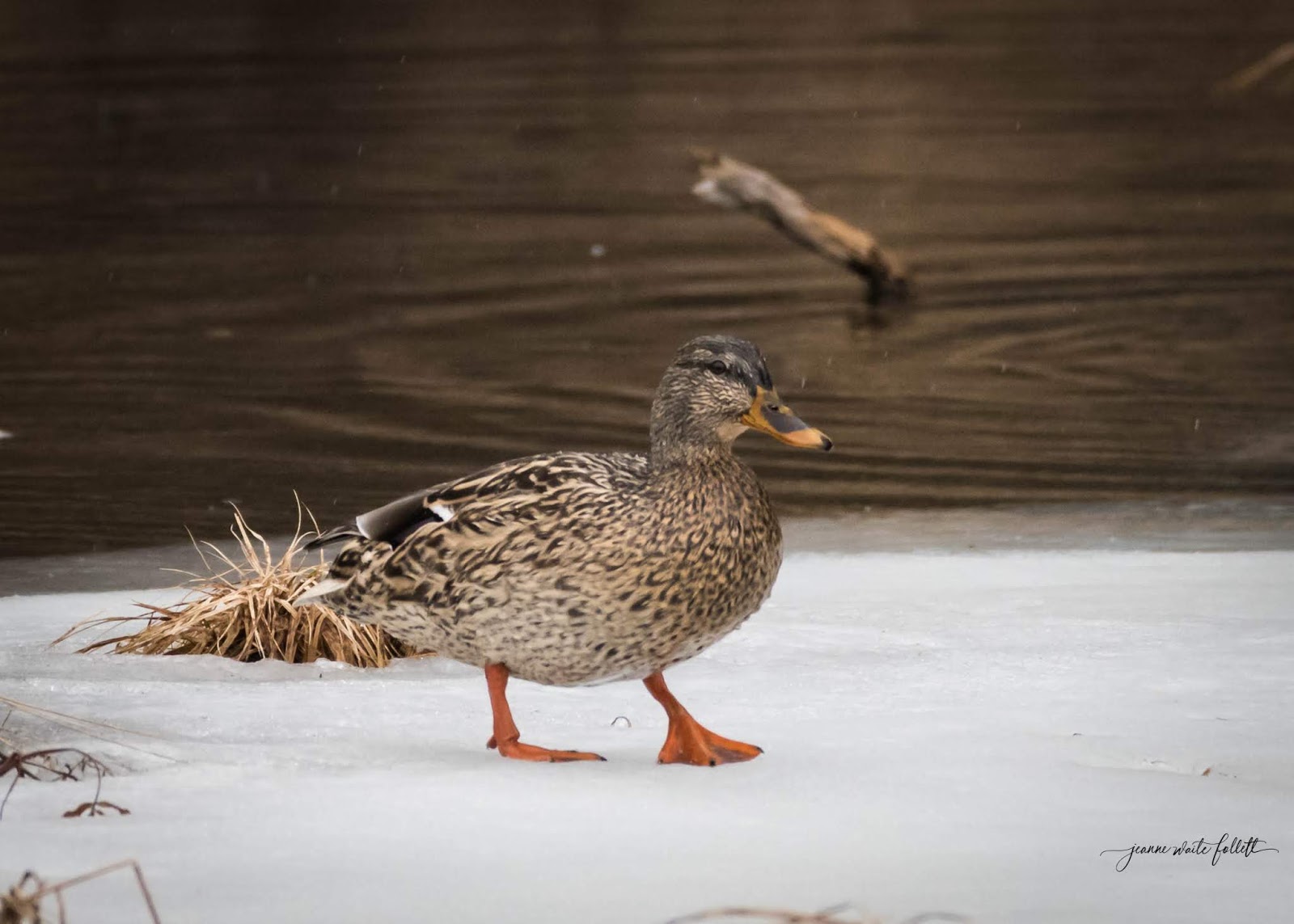
A hen mallard

The hen and the drake


And the common mergansers:


 Right now, these look like females, but as juvenile males often look like females, it's hard for me to tell.


Tuesday, May 8, 2018

Present...... sometimes

I'm here, just not too often.

It's litter clean up season and I'm on the road every day.   Cleaned up twenty miles of highway so far and have 22 to go.


Meanwhile....


On a rare sunny day at Tern Lake.

Rogue's gallery of two American wigeons and a female common merganser.


Squirrel found her has his very own sunflower seed buffet.   He is very happy.

Mallard drake

The wigeons

Two mallards and a bunch of green-winged teals at Lower Summit Lake.

A pair of common mergansers

A very chatty red-necked grebe.

Wednesday, March 28, 2018

A Primer on Birds in Flight Photography


A Primer on Birds in Flight Photography
—presented by Tongue-in-Cheek Publishing


You see them everywhere, those sharp, crisp, colorful and perfect photos of birds in flight (BIF).   It is something every photographer tries, but which is accomplished only by the very expert.

Or sometimes by the lucky who accidentally get a good shot of a feathered missile flying past, which would be me.   The lucky, not the missile.  Which was a long time ago, and DISCLAIMER!!!  does not include any of the included photos.


A gorgeous male mallard in its breeding colors.   Look at the cute little curls on its tail.


Having tried my luck and found it wanting, I have a few suggestions and tips for BIF photography:

1.      Birds are under no obligation, either by their own choice or under union contracts, to notify you when they choose to fly.  However, many birds unintentionally clue you in with body language:   they poop.


2.      Therefore, you must constantly be aware of pooping birds, or, lacking that important clue, have expert hand and eye coordination.  I do not.   I think I am so entranced with the miracle of flying birds that by the time I realize what a great photo that would make, it’s too late.


So much wrong with this photo, but I really like that all three mallards had their wings in the same position.


3.     I recently had occasion to be in the right spot to observe BIF, that being water and many mallards in front of me, while behind me was another flock of mallards that wanted to be on the this side of the pond.   The sun was in the right position, being at my nine o’clock, so when the ducks took flight the first thing I saw were their shadows cast on the snow in front of me.   You would think that would be sufficient warning, right?


4.     Sometimes it was; sometimes not.  The shadows did give me time to raise the camera, but zooming in on an individual duck was near impossible.   Instead, a lot of cropping of the photos was necessary to detect what it was that I was trying to photograph.   Oh, and that cropping results in loss of quality and that's why these photos are so poor.  Yes, that's why.

5.     Sparkle.   A bit of light reflecting in the bird’s eye is essential in any photo or birds, animals, or humans, flying or not.   Otherwise, the bird’s eye is a dead dull black.  Ducks know that.   They go to great lengths to avoid eye sparkle when photographers are near.


You can see this female intentionally hid her eye so as not to have that little spark of life in her eye.

6.     You would think that with the sun over my left shoulder and the mallards flying from that angle to my one or two o’clock, all the duck eyes would sparkle.   Not so.


What would otherwise have been a nice photo is ruined by the top bird being in the frame.


7.     Instead, the ducks concentrate more on their shadows rather than their sparkles.  I witnessed this bit of duck behavior and can attest to its veracity:   the duck’s shadow on the snow marks its landing spot.  


8.     Next time you’re out watching birds, watch and see if it isn’t true.   The bird lands where the shadow marks the spot.

9.     Spot on!


10.  Uh, this mallard, perhaps blinded by the sun on snow, used water-landing techniques instead of solid surface techniques, which result in abrupt stops instead of waterskiing across the surface.  You can almost hear it saying, “OOF!”    Can’t you?


11.  It is essential, in this instance, that the mallard act as if it intended this landing, especially when a bunch of its buddies are there to critique the landing.


"Why, yes.   This IS where I intended to land."


12.  For some reason I haven’t discerned, female mallards are more cooperative than the males.


Look at that!   Nice attitude, sparkle in the eye, unobstructed background, all attention drawn to the subject.   Perfect.   Too bad it isn't in focus. 


You will find that when  a male seems to be cooperating, it will make sure the background is exceptionally cluttered, thus ruining the photo.


There's that cluttered background again, but the female's eye is visible.


Or, it hides in a group of other ducks, again ruining the shot.   Faces hidden, no eye sparkle: boo.


What a mess.


Technique, mallards.  Technique.   Our mallard that made the poor landing is just right of center.   Just remember, pal, any landing you walk away from is a successful landing.