"I'm going to speak my mind because I have nothing to lose."--S.I. Hayakawa
_______________________________________________________
Showing posts with label Vantage Travel. Show all posts

Tuesday, December 11, 2012

The Antarctic Journals, Chapter Eight


 Let's Float This Boat


The main ship for the 1914 Imperial Trans-Antarctic Expedition has been found and  Ernest Shackleton purchases it for £11,600. 

Originally built for tourism in the Arctic, the Norwegian-built Polaris becomes available when the tourism plan fails.  She is arguably the toughest wooden ship every built for polar conditions.  At 144 feet long, with a 25 foot beam, her keel is four pieces of solid oak, providing a thickness of 85 inches.

Her hull varies between 30 inches and 18 inches thick.  Extra-special attention was paid in forming her bow, which when completed was 52 inches thick, with each timber selected from oak trees with natural shapes that followed the curve of her design.

She carries three masts and a coal-fired steam engine with 350 horsepower.  The engine alone can propel her at speeds up to 10.2 knots (11.6 mph).

Opinion of the day holds that the strength of the ship equals if not surpasses the Fram, which Roald Amundsen used in his successful expedition to reach the South Pole.  There is a notable difference, however, one that would become significant.

The Fram’s hull was bowl-shaped, allowing it to ride up when ice formed around it.  The Polaris is designed to operate in loose pack ice, and will not rise when compressed by ice.

Shackleton is now set to sail.  He renames the ship Endurance, after his family’s motto, Fortitudine vincimus.   Translated from the Latin, it means “By endurance we conquer.”

Manned and loaded with supplies, provisions for men and dogs, and crew, Endurance departs Plymouth, England, August 6, 1914.  Captain Frank Worsley sets a course for Buenos Aires.   It will take two months to get there.

Shackleton remains in England, wrapping up last minute chores.  He will travel to Argentina on a regular mail/passenger ship to meet the Endurance and finish supplying her.

The Endurance.  Photo by Frank Hurley


 ***


Finally, finally, the day for boarding the Fram arrives.   The six buses depart the hotel in Buenos Aires in fifteen minute intervals and soon arrive at the very busy commercial dock.  The intervals are an attempt to avoid long lines.  It doesn’t work.
We enter the port building and line up behind those who arrived earlier.  We pass through passport control and security, police and security dogs watching.  Then we line up to wait for the port shuttle buses to take us through rows of cranes and connex shipping containers, where we line up to board our ship.
Waiting to board.

Waiting for our ID cards.
The staircases on the ship.
Up the gangplank we go, line up to pass through metal detectors, and pack the lobby to wait until someone at the desk is available to take our photo and give us another lanyard with a plastic card.  This card is our room key and credit card to use on the ship.  It will be scanned each time we get off and back on the ship.

Our first assignment is to go up a deck to the lounge on the port side where we will be issued our parkas.  They turn out to be exceptionally well-made, beautiful blue water-resistant windbreakers with hoods.   I love them immediately, not only for their color and quality, but for the words printed on the back:  Greenland, Antarctica, Spitsbergen, Norway. 
In my lovely blue parka.
These are the areas where the Fram operates.

I stop by the main desk and register my credit card (not the ship card).  All of my on-board purchases will be charged to this card before I leave the ship at the end of the trip.


Our cabin, number 614
Kathy is caught in a long line downstairs so I go to Deck Six where I find all four of our bags in front of our cabin door.  I drag them inside and try to unpack before Kathy arrives.  There really isn’t room for two unpacking at the same time.  I almost succeed, needing only a minute or so to complete my unpacking after she gets there.

I grab cameras and head for an outside deck.  Unfortunately we aren’t allowed out until we receive lifeboat drill, so we gather in the lobby on Deck Five and wait until the crew is ready.  And wait.  
The only departure shot of the city I could get.

The ship departs Buenos Aires, heading down the long estuary of the Rio de la Plata to the Atlantic Ocean.  No photos of the departure because the adamant lady at the door won’t let me out.  I snap one picture out a window.

Life boat drill consists of being shown how to don life-saving gear, though both the young lad following the lead of another out of my sight do it in the wrong order.  I keep my mouth shut, but I am aware that in Antarctic waters, that thin little nylon suit won’t be of much help.


Then, it’s time for lunch and ship-exploring before a late-afternoon Captain’s welcome.


Kathy checking her bed for its nap-worthiness.  The cabin is cozy and comfortable and perfectly adequate for two.  It has an  attribute that will prove very special in a few days when we approach South Georgia Island.  You'll have to wait to find out.


In between there’s an orientation lecture and time for a nap.


The other end of our cabin.
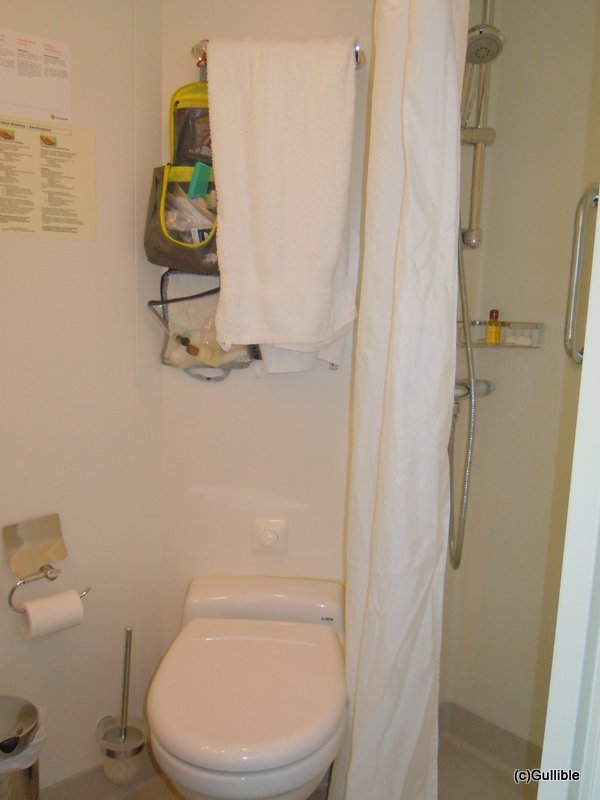
Part of the bathroom.

Toilet and shower.

The modern-day Fram flies the flag of Norway.  She is about 350 feet long, 62 feet wide, and has a service speed of 13 knots.  There are 128 cabins with a passenger capacity of 318.  On this special trip, there are 231 Vantage Travel passengers.


There are eight decks, with the waterline at Deck One.  Deck Two is a service deck, where the landing craft are located and other facilities for the operation of the ship.

Front row of seats in the observation lounge.

Deck Six, rear observation deck.
Sitting area and front desk.

Framheim lecture hall.

The 24-hour snack bar.
Arcade where we line up for the dining room.

The bridge.

The Captain and the crew.


Deck Three:  mostly passenger cabins.
Deck Four:  Front desk, dining call, café, sitting areas, and two lecture halls.
Deck Five: Cabins and a Promenade deck with access to the bow for viewing.
Deck Six:  Cabins and access to the bridge
Deck Seven:  Observation lounge, fitness room, hot tubs, rear exterior deck.
Deck Eight:  Half-length deck with saunas and exterior observations areas.

Our intended route.

Saturday, December 8, 2012

The Antarctic Journals, Chapter Six

Getting It All Together


Not only did Norwegian explorer Roald Amundsen out-fox British explorer Robert Falcon Scott, but with superior equipment, planning, and implementation of those plans, he beat Scott to the South Pole by several weeks.  That devastated Scott when he arrived at the pole after an arduous journey to find evidence of Amundsen’s feat.

Scott’s expedition was already in trouble, and he and his party perished on the way back to base camp.

News of Scott’s demise overwhelms Amundsen’s accomplishment.  Now, biding his time in England, Ernest Shackleton decides that the last great polar accomplishment would be to transverse the Antarctic continent.  He calls this expedition the Imperial Trans-Antarctic Expedition. 

His plan calls for two landing parties.


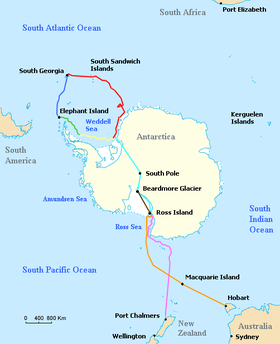
The red line is Shackleton's intended route to the Weddell sea and the aqua route is his plan to journey across the continent.  The pink line is for the additional supply ship which to to land on the Ross Ice Shelf and establish a line of supply caches (brown line) to the Beardmore Glacier.)

Shackleton.  The leather traces on his chest were to pull supply sledges.
Shackleton will sail south from South Georgia Island to the continent at the Weddell Sea.  Another ship will head south of New Zealand to McMurdo Sound at the Ross Ice Shelf.  That second group will travel inland, laying chaches of supplies at regular distances as far as the Beardmore Glacier.  Thus, when Shackleton and his party make their push, those caches will see them across the rest of the continent.

And this time, Shackleton decides, he will use dog teams, not Mongolian ponies, to haul the freight.  Even Amundsen says that Shackleton’s previous expedition would have been successful had he relied on sled dogs rather than ponies.

Now, Shackleton needs the right ship and he turns to Norway for that.   


***


A malevolent harridan named Sandy whacks the east coast of the United States as I fly down the west coast, across to Texas, and then southeast to Argentina.  Many of my fellow Vantage tour travelers are on the same flight from Texas, wearing their Vantage cards on a lanyard around their necks.

These ID cards not only introduce us to each other, they make us easily identifiable to the guides waiting at the airport in Buenos Aires.  We are corralled, loaded onto several buses, and eventually arrive at the Sheraton Buenos Aires Hotel and Convention Center.

The Sheraton hotel

There we join a number of travelers who had just returned from an optional four-day pre- trip extension to Iguassa Falls in Brazil.   And you’ll never guess who I found.

Vantage ID
Jim and Jan, the friends for whom I house-sit in Halibut Cove, decided to join this venture when I told them last winter that I was going, just letting them know I’d be unavailable during the month of November.  Who house sits when the house-sitter travels?  Well, Gerri the cat will spend four weeks with a friend of theirs—a nun on a silent retreat.   I cannot think of a better place for a silent retreat.

We new arrivals go through an organizational process, listen to an orientation, and are inordinately elated to learn our rooms are ready and we don’t have to wait until the usual 3 PM check-in.   Nap time, then a shower, and then we’re off to a steak house directly across from the hotel, recommended by Nacho, one of our “minders” for the trip.

As with all tour companies, Day One is the day you depart home (or wherever) for the flight to meet your fellow travelers and program managers from Vantage.  They aren’t called guides, but program managers.  “Guides” are the people hired locally to show you around their towns.

There are three program managers on this trip—Nacho, Pablo, and Patricio.  They call themselves the Three Gauchos.  Each is fluent in English, each is blessed with a keen sense of comedic timing, and each could also find success as stand-up comedians.

Las Nazrenas restaurant
Before we leave the Palm Room for our hotel rooms, Vantage has arranged something I’ve not found on any trip before.  For those who wish, they have prepared envelopes containing Argentine pesos, $50 US for $250 Argentine pesos.  It is the most thoughtful and convenient thing I have ever encountered on foreign trips.  For those who want more pesos, there is a currency exchange booth in the hotel lobby, though the Gauchos remind us we leave the city after tomorrow, and credit cards are accepted everywhere in Buenos Aires.

After naps and showers, Kathy and I cross the street to the restaurant recommended by Nacho—Las Nazarenas, where we find many Americans.  We decide to share a salad and when it arrives, find it’s large enough to satisfy a manatee.   (That’s a little in joke, from a floating feeding station where you can watch manatees feeding at a “manatee salad bar” in Homosassa Springs, Florida.)  We share our salad with two women who sit at the adjoining table, and there’s still a lot left.

One steak, and that isn't a small plate.

The grilled veggie plate.
The steaks are huge.  Grilled veggie plates are extravagant.  And the grill man?  No doubt from his profile that he is classic Argentine.


The grillmaster.

Back at the hotel, we go to bed.  It’s the end of Day Two.  Tomorrow we will take a panoramic tour of the city and be treated to dinner and a tango show.  The following day, Day Four, we are to board our ship and spend the following 19 days at sea.

I lie in bed thinking about the dozen or so still trying to find a way around the destruction Sandy has wrought so they can join us.