Wishing you Peace, Joy, and Love in the New Year.
"I'm going to speak my mind because I have nothing to lose."--S.I. Hayakawa
Showing posts with label penguins. Show all posts
Tuesday, December 31, 2019
Friday, August 29, 2014
The Africa Journals, Ch. 62, Boulders Beach
The Africa Journals
Chapter 62
Boulders Beach
Part Four of the Cape Peninsula
The biblical account of Noah's Ark
and the Flood is perhaps the most implausible story for fundamentalists to
defend. Where, for example, while loading his ark, did Noah find penguins and
polar bears in Palestine?― Judith Hayes
Imagine
you’re dreaming about a trip to Africa,
South Africa, in particular. Now
imagine what you expect to see while you’re there.
Beautiful
sunrises and sunsets? Oh, definitely.
| Sunrise. Check. |
| Sunset. Check. |
And the iconic animals of the continent? The
great cats? Lions, leopards, and cheetahs?
| Lion. Check. |
| Leopard. Check. |
Large, dangerous beasts like elephants, rhinos, and Cape buffalos?
| Elephant. Check. |
| Rhino. Check. |
| Cape Buffalo. Check. |
The
exquisites, like giraffe, kudu, and oryx?
| Giraffe. Check. |
| Kudu. Check. |
| Oryx. Check. |
And
flamboyant birds like ostriches, the Secretary bird, and penguins?
| Ostrich. Check. |
| Secretary Bird. Check. |
| African Penguin. Che..... What? |
How
did penguins get in there? They’re in
Antarctica, right?
Actually,
there are several places in South Africa where penguins are right at home. Boulders Beach along the shoreline of False
Bay on the Cape Peninsula is one of the most visited. These are African penguins, also called
jackass penguins because of the braying noise that is part of their breeding behavior.
The
Simons Town shoreline is lined with homes, none of which the penguins care
about. The path to the boardwalk is one
ice cream/gelato/souvenir shop after another, none of which the penguins
patronize.
After
a brisk walk past the sunbathers and swimmers, a boardwalk leads to the
beach. Along the way, man-made penguins
nurseries offer instant digs for pregnant penguins.
The
little black and white critters are everywhere—in the bushes, under the
boardwalk, on the beach, and in the water.
These
remarkable little creatures weigh from five to almost eight pounds, and stand
between 24 and 28 inches tall. They lay
one or two eggs in the sand and after the chicks hatch, they join a communal crèche
while the parents go to sea to forage for fish, hoping they don’t wind up on
the menu of great white sharks, fur seals, or the occasional Orca.
On
land, predators such as domestic cats, genets, mongoose, and the occasional
leopard endanger the colonies. Kelp gulls go after the eggs.
On
a more personal note, while I was visiting the African penguins, my friends Rose and Julie from Moose Pass, Alaska, were across the street in Simon’s Town helping a local church with
repairs, refurbishing, and landscaping.
It was their practice to walk to Boulders Beach in the evening to watch
the penguins, and patronize a certain gelato shop. While I knew they were in South Africa, I was not aware they were in this particular
part, nor did they know I would be at Boulders Beach.
Such
a small world.
And I did stop at one of the many gelato shops on my way back to the coach.
Tuesday, December 18, 2012
The Antarctic Journals, Chapter Twelve, Penguins and Crumpets at West Point
On Nov. 5, 1914, the Endurance arrives in Cumberland Bay on
the eastern side of South Georgia Island, having left Buenos Aires eleven days
prior. Shackleton is concerned about the
unusually cold and rainy weather in Argentina, fearing it might portend
unfavorable ice conditions in the Weddell Sea of Antarctica. The voyage used more fuel than planned and lumber needed for other use was burned.
The ship drops anchor near the Norwegian whaling station of
Grytviken, in Cumberland Bay, and Shackleton with a few men go ashore where they are welcomed by
the station manager. In abject contrast to the
stunning scenery of this mountain-ringed bay, the stench of rotting whale
carcasses fills the air and the bay is red with blood.
| The Endurance at anchor at the Grytviken whaling station, South Georgia Island. Photo by Frank Hurley of Shackleton's expedition. |
The whalers confirm Shackleton’s worst fears. The pack ice extends much farther north this
season, they report. They suggest he wait in Grytviken until later in the
austral summer.
Shackleton concurs and the crew settles in to wait. The dogs are tethered on land, but away from
the whale carcasses.
***
| We visited New Island yesterday. Today we go to West Point Island and Saunders Island. |
Upon returning to the ship from New Island yesterday, I went straight to the gift shop and purchased a pair of waterproof gloves that I had seen earlier. As soon as Kathy got to our cabin, she went to the gift shop and also bought a pair of gloves. The sideways rain showed us any deficiency in our gear.
The blue parkas were great, our rain pants fine, and the muck boots wonderful--waterproof and with good traction.
Today the weather is sunny and warm, by Falklands Islands standards, that is. A short sail of 34 nautical miles from New Island takes us to West Point Island, where the ubiquitous Land Rovers are waiting to transport those who don’t want to walk a mile and a half to the other side of this island and the penguin rookery at Devil’s Nose.
The blue parkas were great, our rain pants fine, and the muck boots wonderful--waterproof and with good traction.
Today the weather is sunny and warm, by Falklands Islands standards, that is. A short sail of 34 nautical miles from New Island takes us to West Point Island, where the ubiquitous Land Rovers are waiting to transport those who don’t want to walk a mile and a half to the other side of this island and the penguin rookery at Devil’s Nose.
The trek is uphill about 350 feet elevation and
then levels out across grazing land.
It’s a Striated Caracara, a bird related to the falcon family. These birds are very clever and we were warned to take care of our belongings because a dropped item would soon be in the beak of a caracara
| I don 't know if I'm blessed or hexed having a rare Striated Caracara turn its head upside down to look at me. |
At the far
side, another Rockhopper penguin rookery awaits us, but this one is entirely
different than the one at New Island.
The Rockhoppers at New Island nested in rocky cliffs, whereas these
Rockhoppers seemed to prefer nesting amongst the tussock grass mounds or in the
open around large boulders. We walk
downhill on pathways to gulches, careful not to step on the tussock grass
bunches or any mounds, lest we step on nesting penguins.
I soon
learn that even walking between the bunch grass is dangerous when I look at my
feet and see little crested Rockhoppers everywhere that would be impossible to
see if they didn’t have those incredible yellow brow feathers and orange beaks. They don’t move even if you are right next to
them and might step on them.
| Rockhoppers average a ten year life span, weight between 5 and 8 lbs., and stand 18 to 23 inches high. |
| They eat small fish, krill, and crustaceans. |
| This photo, with my boot in the picture, shows how close the penguins allow us to approach. Once hunted for their oil, they are now protected. Breeding pairs number into the millions. |
And right
in the midst of the Rockhopper nests in the open, are black-browed albatross on
nesting mounds.
| The Black-browed Albatross nesting among the Rockhopper penguins. |
| The strikingly beautiful head of the Black-Browed albatross. |
The
tussock grass grows about 6 feet high here, but is known to grow as high as 13
feet. We are finding that there are
many restoration projects underway in the islands. Replanting of tussock grass is but one of
those projects.
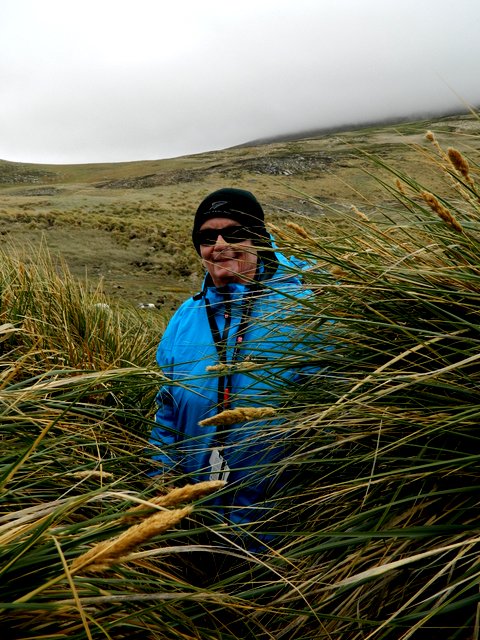
| Kathy in the tussock grass. |
We watch,
photograph, try to avoid stepping on penguins, then head back to the farmhouse
across the island. We’ve been invited
for tea and crumpets at the farmstead of Lily and Roddy Napier, present
landlords of the island.
| The farmhouse of Lily and Roddy Napier. |
| Lily serving tea while Roddy watches. And look at what's on the table! |
| Roddy tidying up. |
| The Napier's farmhouse where we had tea and crumpets. Some of the buildings here are more than 125 years old. Tourism has become another source of income. |
| Kathy amid the flowers. Note the British flag flying. |
| Tools of the trade. |
| This was not a "wet" landing, but on a jetty. The Fram is out of sight. |
| For this landing we are allowed to take off the life vests. |
| The Fram is visible outside the cove. |
| Changing from muck boots to ship shoes. |
| Lining up for lunch. |
| My lunch almost every day. Soup and bread. |
| Today, I stayed away from the desert aisle. |
All of those, just for today's lunch.
| No time for a nap. Saunders Island is just 18 miles away. Wake up! |
Subscribe to:
Posts (Atom)


