
The men are beyond exhausted when they land on Elephant
Island and a more inhospitable place would be hard to find. Uninhabited, rarely if ever frequented by
whalers and sealers, and with treacherous beaches for landing, the island is
exposed to the worst of the ferocious weather for which this area is known.
The next day, they move to a slightly larger beach seven
miles along the coast. Other than
offering a place to get farther away from the waves, it offers nothing more in
the nature of shelter.
All of them understand that had the weather driven them past
this small spot, they would surely have perished in the Drake Passage of the
southern ocean. Many of the men
find themselves incapable of doing anything but lying in their wet sleeping
bags. A blizzard blows up during the
night.
Ernest Shackleton, ever conscious of the well-being of his
men, brings them breakfast in bed the next morning, delivered with cheering
words, as the blizzard rages on. The
next day, he calls the men together and announces that he and five others will
attempt to sail to South Georgia and secure rescue from the whaling stations
there.
Cape Horn and Tierra del Fuego is several hundred miles closer, but that would mean sailing across the westerlies in the Drake Passage. Shackleton chooses to sail with the wind and hopefully find South Georgia.
Cape Horn and Tierra del Fuego is several hundred miles closer, but that would mean sailing across the westerlies in the Drake Passage. Shackleton chooses to sail with the wind and hopefully find South Georgia.
 |
| Dragging the James Caird up the beach on Elephant Island. The figure seated at left most likely is Perce Blackborow, the young stowaway, whose feet are severely frostbitten. |
That energizes the men, and with tasks assigned, they busy
themselves making preparations for the hazardous trip. Chippy McNish, the dour carpenter, puts his
skills to the James Caird,
strengthening and adapting it. He
scrounges what lumber and fasteners he can and builds a framework to enclose
the open boat, over which they stretch a canvas sail, leaving an opening hardly
large enough for three men to stand near the stern.
 |
| Making the James Caird as seaworthy as possible for the impossible sail to South Georgia. |
None of the work is easy.
McNish has frostbitten hands. The
canvas sail is frozen and has to be thawed foot by foot. All of the men are exhausted. The weather is horrid.
Several days later, with 2000 lbs, of rock ballast, the James Caird is stocked with provisions
for four weeks. Even this is difficult
as the supplies must be ferried out beyond the reef to the Caird by the small Stancomb Wills. The bad weather abates and Shackleton decides
this is the day to start their 800 mile journey.
 |
| Launching the James Caird from Elephant Island. |
He chooses his five crew with care, noting their
capabilities as well as their faults:
Capt. Frank Worsley for his exceptional navigation skills and Tom Crean
for his endurance. He added McNish,
despite his rebellion of the ice, for his sailing and carpentry skills, and also
because he does not want to leave him behind to cause trouble with the remaining
men.
John Vincent, boatswain, is selected for the same reason. Timothy McCarthy, able seaman, was the sixth
man. He, along with McNish, Crean, and
Vincent, are some of the several men singled out for commendation during the seven-day
boat voyage.
Shackleton leaves Frank Wild, his right hand man, in charge
during his absence, with instructions that if no rescue appears by the austral
spring, they should make their way to Deception Island where whalers are found frequently. Unspoken is the obvious—the journey ahead for
Shackleton and his men is unprecedented and indescribably dangerous, and the odds
of its success are minimal to nothing.
Eight hundred miles of the most treacherous water in the
world, frequent gales and blizzards, the freezing cold of austral winter, the notorious
Cape Horn rollers some 60 feet high, do not make for a successful sail in a 22
and a half foot, over-loaded boat with slightly more than two feet of
freeboard.
On April 24, 1916, the James
Caird sets sail for South Georgia, trying to get ahead of the advancing ice
pack.
On shore, the 22 remaining men give the departing crew a raucous
send-off until the small boat is out of sight.
Then they turn back to their own plight.
They have little to eat, no shelter, ragged clothing, wind-shredded
tents, wet and rotting sleeping bags, and endless days of boredom ahead of
them. It is a bleak situation, indeed.
 |
| The James Caird departs Elephant Island. |

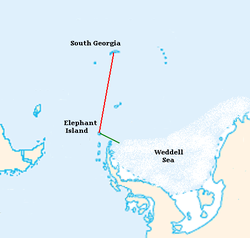 |
| The green line marks the route from the ice pack to Elephant Island. The red line is Shackleton's intended sail to get help. |
Black and white photos by Frank Hurley courtesy of
South with
Endurance: Shackleton's Antarctic Expedition 1914-1917
The
Photographs of Frank Hurley
Book Creation
Services, Ltd., London, 2001
ISBN
1-932302-04-2
***

I’m standing on the deck of a comfortable ship anchored in Halfmoon
Cove, a part of Admiralty Bay on King George Island, part of the Antarctic
Peninsula. I wait my turn for a ride to
shore in the Polarcirkle boats. For now,
I take photos.
 |
| Polish research station of Arctowski. |
Before me is the Polish research station of Arctowski, named
for Henryk Arctowski (1871-1958), a meteorologist who originated the notion of
a wind chill factor, arguing that wind could be as damaging to human flesh as
cold.
It is a glorious and clear afternoon. We arrived here after several days at sea,
fighting gale force winds, 15 foot waves and the incessant westerly wind from
Drake Passage for almost 900 miles.
I thought of Ernest Shackleton and the astonishing voyage he
attempted in a life boat less than 23 feet long, all the way from Elephant
Island to South Georgia some 800 ,miles distant through the same waters we
encountered. It was rough enough int he
comparatively moderate seas we encountered on our 350 foot ship.
I would not have wanted to be in that tiny craft with
Shackleton and five others, no matter how desperate and sick I was of penguin
and seal meat and little else.
 |
| The penguin lookout. |
Soon it’s time for my boat group to go ashore. Under the terms of agreements by tour
operators licensed to bring passengers to the Antarctic, only 100 passengers,
plus guides and necessary crewmen, are allowed on shore at any one time. Thus, when each boatload off-loads, the
passengers are given a specific time to return for transport to the mother ship.


 |
| Waiting to return to the ship. |

Since each Cirkle boat carries only eight tourists, by the
time the number onshore reaches close to a hundred, many are already returning
to the ship.
 |
| What a souvenir tee shirt! |
I wander around a huge rock and find---a gift shop. Cool. I have to borrow money from another passenger to buy a tee shirt I desperately want because I'd left mine on the Fram.
Then it’s off to see the penguins. A rocky point is tough to walk along, but
eventually I reach a snow-covered area where walking is easier. The Adelie penguins try to outwalk me. I hang back, then try to get ahead of them,
but it only makes them waddle faster.
Finally, I veer away and stop to watch three seals slumbering on the
beach.
 |
| Adelie penguins. |
A little farther on, I see the one and only Chinstrap penguin of the trip, mixed in with Gentoo and Adelie. The three are related, both genetically and in crime. They build a nest with stones, then line it with grasses. They are not averse to stealing stones from each other’s nests, either.
 |
| This Chinstrap penguin is standing in front of another penguin. |
 |
| Gentoo penguin. |
Some passengers visit the station
itself, welcomed by the Polish staff there.
Somehow the penguins take up all my time and soon it’s too late for me
to trudge over to the buildings.


Back on board, I watch the sunset as the Fram pulls out of Admiralty
Bay headed south to the British station of Port Lockroy, 220 miles away. It will be an overnight sail for us, but in
the shelter of the peninsula islands, a quiet one.


