"I'm going to speak my mind because I have nothing to lose."--S.I. Hayakawa
_______________________________________________________
Showing posts with label Churchill. Show all posts

Sunday, February 5, 2012

The Polar Bear Journals, Ch. 15, The Big Dog


When Dave Daley told his wife he wanted a team of sled dogs, she said, “You better figure out how to pay for them.”

So he did.

One of those ways resulted in the busing of a couple dozen of us to his dog lot outside of Churchill, Manitoba.  We were on a Road Scholar trip called Lords of the North and had spent the four previous days spotting and watching three dozen wild polar bears.

Now, on our last full day in Churchill, we were greeted by a pack of howling dogs.  And the Big Dog himself—the inimitable Dave.  With a line of blarney that belies his Metis (French and Cree) heritage, Dave entertains tourists with a humorous and educational spiel before giving them rides on either sleds or a carriage, depending on snow conditions, or the lack thereof.
The One and Only Big Dog, Dave Daley.

I was looking forward to this, being a retired dog musher myself.  I was curious about advances in equipment, feeding methods, and training styles.  And the dogs.  Very much interested in the dogs.

Then I met Dave and suddenly I was in my own dog lot twenty years ago, stuffing straw in dog houses, cleaning up their deposits, and giving lots and lots of hugs.  Dave talked  for quite a time before we went outside to actually meet his dogs and to be introduced to the various equipment involved in running dogs.

Harnesses ready to go.
Before that, however, the inevitable subject of what happens with dogs that can no run with a team, or who are terminally sick or injured, in a land where the nearest veterinarian might be hundreds of miles away.

 That’s when Dave won my heart.  And made me cry.

He spoke of spending time with the ailing dog, telling the animal how much it was loved and appreciated, and how much it will be missed.  Then, Dave said, he asks the dog to return in spirit to the dog lot, to be with them always, either in spirit or in another dog.

That’s when the tears ran down my face.  I remembered long ago dogs I loved with all my heart and how much they are missed to this day.
Dave and his sleds.

Big Dog's dog lot.
Dave is the originator of the Hudson Bay Quest race, patterned after the Iditarod and the Yukon Quest races in Alaska, which he would very much like to enter some day.   His race involved travel on the ice of Hudson Bay and the likelihood of polar bear encounters, so when they blazed a completely on land routes, he breathed a sigh of relief.  While there remains a chance of a bear encounter, the odds are now far against it.

Donna and Kathy.

For those snowless times.

That evening, Dave came to the Churchill Northern Studies Centre and spoke to our group.

Dave and his bear gun.
 His family has lived in Churchill for several generations, and has known the bias against descendants of the First Nation peoples.

When he was a child, his mother kept telling him he was descended from the French voyageurs and he was not allowed to learn the traditional language and practices of his Aboriginal people.  Now, however, Dave is considered a community leader and teaches the town children in the old ways.
Yes!  Boy, do I miss this view.

He has received many awards for his volunteers efforts. A couple years ago Dave ran hid dogs from Churchill to Winnipeg, a distance of about 750 miles, all in the interest of promoting Manitoba.

With his wife Valerie, he owns and operates Wapusk General Store  in downtown Churchill.


Wapusk General Store, owned and operated by Dave and his wife.


Painted boulder outside the store.


But Dave wasn't done with us just yet. 

The next morning, most of us would board a Calm Air turboprop plane, bound for Winnipeg and our connections from there.  Dave has worked for Calm Air for many years as an aircraft mechanic.  Dave would be on our minds for a long time to come, as would the staff at Churchill Northern Studies Centre, the town and people of Churchill, and those magnificent polar bears of Hudson Bay.


Our ride to Winnipeg.

Sunday, January 29, 2012

The Polar Bear Journals, Ch. 13, Living with Bears

Mike looked at the bedside clock and wondered what had awakened him at 3 AM.  Usually he slept through the night, so this was odd.  He lay in bed, listening for any clue, anything out of the ordinary noises in his home.

All seemed well.  No sirens, no smoke alarm, nothing.  He rolled over, facing the window, to go back to sleep.

Staring at him through thin, breakable glass was a huge polar bear.

Such is life in Churchill, Manitoba, on the western shore of Hudson Bay, where some 900 polar bears are known to live.  Changing weather has brought change for the great white bears.  The ice goes out sooner in summer and forms later in winter, leaving the bears increasingly shore-bound and without access to the ringed seals that are their primary diet.

It also gives them more opportunities to wander into town in search of food, which is not a good thing for the people who live in Churchill as the polar bear is the largest land-dwelling carnivore known to stalk humans.  Adult male bears can weigh three-quarters of a ton.

Mike’s story didn’t end with the bear strolling away from his bedroom window.  As does everyone in Churchill who encounters a bear, Mike immediately phoned the 24-hour hot line and reported a bear in town.  After convincing the responding officer that there really was a bear outside his house, Mike eventually went back to sleep, confident the patrol would chase the bear back onto to the tundra.

The next morning Mike stopped by the local café.

“Seen any more pink bears?” someone asked.  At first Mike thought they were teasing him about seeing “pink bears,” a Churchill equivalent to pink elephants.  Then he heard the rest of the story.

When the peeping bear left Mike’s, it wandered across town near the grain terminal.  Along the way, it wrenched a fire extinguisher off its wall mount, puncturing the hose in the process.  When conservation officers tracked the bear’s path, they came across the result—the wall where the extinguisher had been mounted was covered in the pink contents of the extinguisher, perfectly outlining the polar bear.

And pink tracks led revealed the bear’s route out of town.

“Mike” is Mike Goodyear, the executive director of the Churchill Northern Studies Centre located a few miles out of Churchill proper.  He is also a fine ambassador on behalf of the bears.  When asked if he isn’t concerned about running into bears when he jogs or bikes out of town, which is patrolled constantly for bears, Mike responds, “I’m more concerned about stroke and heart attack being the number one cause of death in men over 35.”

And so it is with people who live in bear country.  They are always aware of the possibility of sudden bear encounters.  They go about their lives as normally as anyone else, but always aware, always adapted to living with bears.


The last fatal bear encounter in Churchill was more than 25 years ago when a man walking home one night rummaged through the ruins of a hotel that had recently burned.  He found still edible meat in the restaurant’s freezers, and loaded up his pockets.

Shortly afterwards, his cries were heard and residents rushed out and killed the polar bear that was savaging the victim.  It was, unfortunately, not in time to save the man who had filled his pockets with meat.  The bear’s tracks showed it had stalked the man through town and then attacked.


For now, the people of Churchill have a tenuous working relationship with the bears.  They are, after all, what brings the influx of tourism to that part of the country, and tourism means jobs.  During the summer, the mouth of the Churchill River can be filled with thousands of beluga whales gathering there to calve, and the tundra is covered with wildflowers.

While spotting polar bears in the summer is “iffy” because they tend to roam far inland, it isn’t impossible to encounter the occasional bear.  It’s during late October and early to mid-November that the animals gather along the shore of Hudson Bay near Churchill, the place where ice usually forms first.

Arctic fox.

At these times, the tundra in the Wapusk National Park can seem like a vast wildlife theme park.  Snowy owls, white Arctic fox, caribou, game birds and birds of prey also live on the sparsely-treed land.  These creatures are perfectly suited for the harsh conditions of subsisting in the north, as are the bears.

Polar bear print cast.
Bear's hind foot.
Huge feet act like snowshoes, spreading the bear’s weight and enabling it to walk on barely frozen ice, the same ice that Mike attempted to walk on and found himself in cold water up to his knees.  Small ears prevent freezing, and the bears’ profiles are perfect for reaching into a seal’s breathing hole in thick ice and grabbing it.  


Powerful jaws kill the seal immediately and enable it to pull the fat, rotund seal through the small breathing hole.  So well insulating is the bear’s thick fur that infra-red monitoring of a bear picks up only the heat transferred to the surface where the bear stepped.  It cannot detect heat escaping from the rest of the bear.

This is fine when the bear is on the Arctic ice, yet with warming conditions forcing the bears onto land for longer periods, further stresses the animals.

But it takes only one look into the eyes of a hungry white bear to dispel any notions of Disneyland.  Cute, white, and fuzzy aside, these are hungry predators, with tourists and residents alike below them on the food chain.


Sunday, December 4, 2011

The Polar Bear Journals, Ch. 11, The Troubling Incident


 The Troubling Incident
Part One

It is our second and last day on the tundra in the huge Tundra Buggies.  Marcus is our driver once again.  He says he and the other drivers have noticed increased activity in the polar bears the past couple days.

The weather is colder and slush ice is forming in the more protected places along the shoreline of Hudson Bay.   More bears have moved into the area, anticipating the long-awaited freeze-up.  

They have not eaten for several months, other than berries and grasses that do not make a satisfying meal.  The bears have used up their stores of fat.  Their energy levels are low and they become over-heated quickly.

We spot our first bear shortly after leaving the Tundra Buggy loading site, and several more along the way to the remote Tundra Buggy Lodge.  Marcus takes us by a different route on the WWII military roads into the Wapusk National Park, a few miles south of Churchill, and we approach the remote camp from its far side.  


That's unfrozen Hudson Bay behind the bear.

A polar bear is walking towards the stationary buggies that make up the camp.   


We reach the gravel pad and Marcus backs the buggy into position.  I feel the rear end of the buggy drop a couple inches on the uneven pad as he backs up.  By this time, the bear is underneath one of the camp cars, sniffing at moisture dripping from the gray water tank fastened beneath the sleeping unit.


It paws at the wet ice below the tank and sniffs the liquid.  It turns and walks directly towards our buggy, then walks beneath the two front wheels.  I take one last picture before it disappears and then I head for the rear viewing deck.


Just as I exit onto the rear deck, I hear a sound like a sledge hammer hitting the side corner of the deck.  I know what caused it, but my mind refuses to believe a bear can make that noise.

A moment later, I hear the same loud bang from the far corner of the deck.  There are many people on the deck crowding the rail.  Just as I make my way to the rail, Marcus bursts through the door.  He is highly agitated and commands everyone not to lean over the rail.

“No scarves, no camera straps, no elbows!”  he demands, moving through the group and checking that all are obeying.  “No lens caps,” he says as he points to mine.  I briefly think this is erring on the side of extreme caution, but I grab the dangling lens cap and hold it.


Another bear, another time, but posted here to show the bears' interest in the buggies.

I am still trying to wrap my head around those two noises as I watch the bear lying on its belly behind the buggy.  I’ve seen these bears looking up at the people in the buggies, and I’ve seen pictures of them standing on their hind legs and leaning against the buggy side.


I always thought it was done out of curiosity.  Now as I watch the bear, I see it isn’t lying down at all.  It is crouched with those massive and powerful hind quarters ready to leap if it spots an opportunity.  I think about how fast it must be able to move to catch a seal that pops its head above water through a breathing hole in the ice.


The bear appears to be completely uninterested in us, but then I see it roll its eyes upward without moving its huge head.  It’s waiting, waiting for someone to make the wrong move, judging the distance.  


Notice the nose is turned towards the side.  It is sniffing and watching, waiting for the right moment.


“It’s crouched there, ready to pounce,” I whisper to whomever is standing beside me. 

I think about those two loud bangs and what a powerful lunge the bear must have made.   I consider how patient the bears must be to crouch before a seal's breathing hole in the ice, and I begin to feel like prey.

At my feet, just two yards away, is the largest land-dwelling carnivore, the only predator mammal known to stalk humans.


With that, my perception of these bears and of my place in their world changes.  It is a very uncomfortable change.


(to be continued--The Aftermath)

(To enlarge any photo:  Click on the photo.  That will bring up the photo above a line of thumbnails.  RIGHT click on the photo you want to enlarge and select VIEW IMAGE.  When it appears by itself, left click to enlarge to full screen.  Then look at the bear's eyes and tell me it isn't stalking us.)

Monday, November 28, 2011

The Polar Bear Journals, Ch. 10, What's a Hungry, Bored Bear to Do?


You’re a polar bear.  You’re hungry.  You’re bored.  You’re too hot.

The ice went out early in July and now there’s nothing to do.  You snuffle around in the lines of seaweed and kelp the tide washes ashore a couple times a day, but there aren’t any big fat ringed seals lurking in there.   You scarf up some grass but it doesn’t even amount to a mouthful, much less a tummy full.

What to do, what to do… 


You wander along the shoreline, looking for ice.  Nothing as far as you can see.  There’s a bear over there.  Maybe he wants to wrestle.


Okay, that was fun for a couple minutes, but it’s way too hot out here for that.  And you’re still hungry.  Still bored.


Oh, no, here come those big white things  with the appetizers on the back.   They smell good, but you can’t reach them.   Tricky things.  Someday, though, someday you’ll catch one.  You’re a lot more patient than they are.  They’re always clicking at you, like they’re nervous.  Pointing those things at you and clicking.


Maybe there’s ice farther north.  Maybe you’ll just mosey on up that way.  


The farther you walk, smells fill the air.  Mmmm….   Fresh bread from Gypsy’s….   and something else.   Mmmmm  bacon…bacon-cheeseburger.  Yeah, that’ll be nice.

No, wait.  You remember the last time you went into town?  That loud noise?  Better stay away from there.  Go check for ice.  


Hmmm…  Nothing at Cape Merry.   No picnickers.   


Oh, for a seal.  The smell of seal.  Seal, seal, seal,  gonna find me some seal.  I smell SEAL!!!


There it is.   Can’t get at it.  Better check for its breathing hole. 


Ah, ha.  Now I can get it.


(CRASH)

MMMMAAAAAAAA!!!   What?  What happened?  I can’t get out of here.   And that wasn’t a seal, either.  Just a rag soaked in seal oil.


***


And so, another polar bear winds up in polar bear jail, or, more appropriately, the Polar Bear Holding Facility located   by the airport in Churchill. 


Capable of holding 23 troublesome bears, the facility is in a double-wide Quonset shaped building by the airport.  Bears caught in the live trap are transported here, the trap backed up to a cell, and the escape hatch raised.  The conservation officer pounds on one end and the bear scampers out into the holding cell.


The pickup and culvert trap leave the building and the exterior doors are closed.  Dim lighting.  Other bears.  Sows and cubs in larger cells at one end.

There’s controversy about this program.  Some claim it’s cruel.  The bears aren’t fed, but then, they don’t eat if they’re loose on the tundra either.  They’re given water and snow when it’s available.  When the ice forms, the bears are released and urged towards it with cracker shells if necessary.


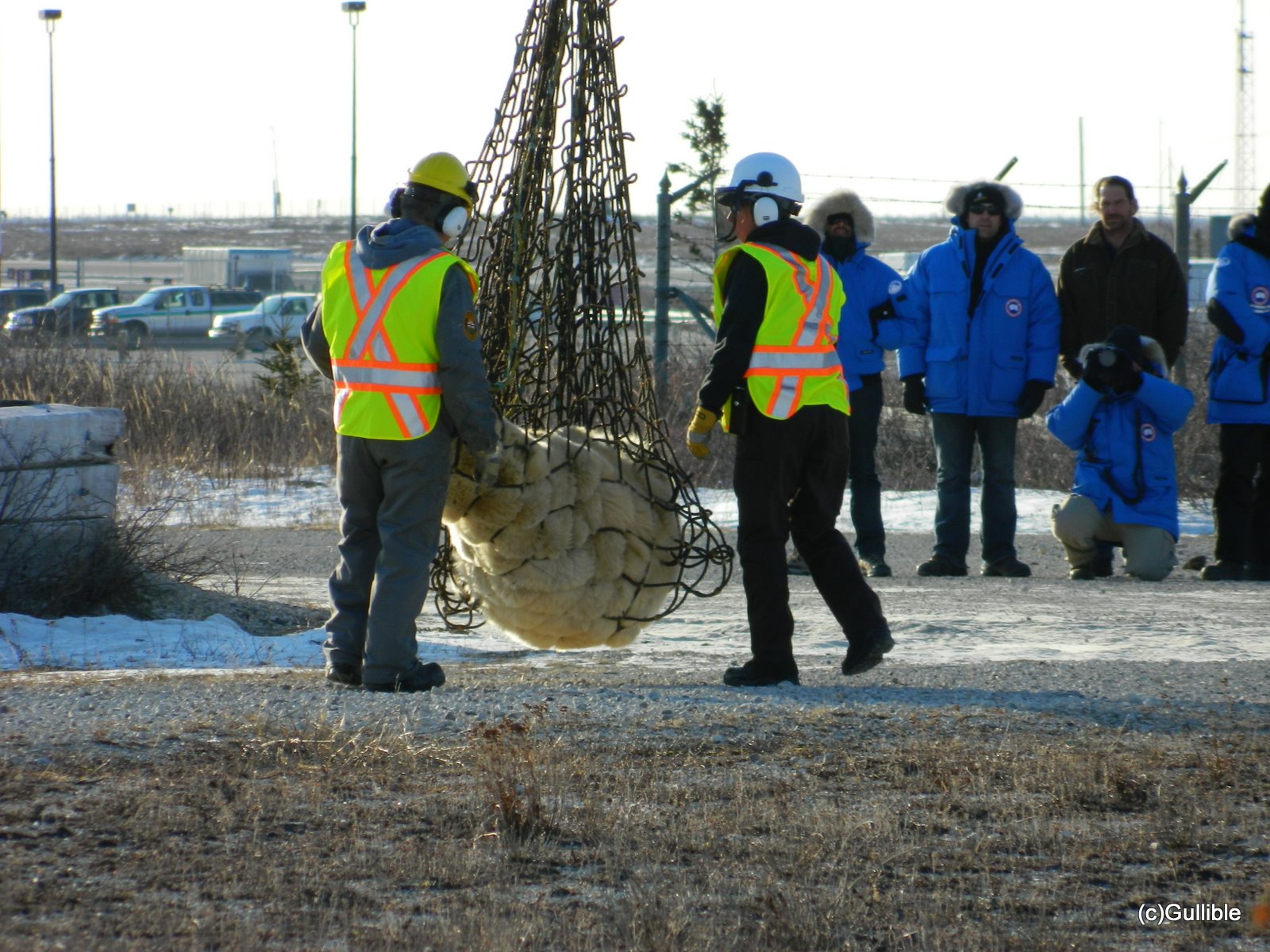
Occasionally, if the facility nears capacity, bears gain early release and are slung beneath a helicopter for a 40 mile journey north—far away from humans.


Bears are sedated and their eyes covered while being transported.


Polar bear jail is only for bears that make repeated forays into Churchill or otherwise cause trouble.


In 2009, there were more than 300 “incidences” involving polar bears near human habitats.  There is a 24-hour a day patrol around Churchill and all residents know the phone number to report a bear sighting. 


Conservation officers in Churchill can have as many as a dozen bear encounters before noon each day, according to one officer.  Most of the bears are scared away with cracker shells fired from .12 gauge shotguns.  The live traps have replaced leg snares, which required sedating the animal so it could be moved. 


No longer used leg snare.  Bait would be placed in the narrow end of the timbers.

I suppose when compared with a life roaming the shoreline, being held in a cell for a few months can be considered cruel.  The facility isn’t meant to be a bed and breakfast for polar bears.

But, the alternative also is cruel—and fatal.  Polar bear jail gives the carnivores a chance to continue living.