Continuing with dates that are important to my generation, we arrive at:
June 6, 1944—Allied Invasion of Normandy, France, Europe.
This was the beginning of the end for the Axis armies. It took until May of 1945, VE Day, to reach victory in Europe and August 1945 , VJ Day, for Japan to surrender.
Again, it impacted the entire world. We were still too young to appreciate the meanings of the dates, but eventually could look back and understand why they should be important to us.
Many of my generation had parents or other relatives who fought and/or died for the Allies. That meant for many of us kids, dads and uncles and brothers returned home from war and a process of re-acquainting began.
Some of us were affected by post-war economic factors and the lack of employment.
Those economic factors became the main reason why my parents decided to move to the territory of Alaska in June of 1948. And, for me, that began a life-long love affair with this wild land.
My brother Jim in front of the Quonset hut (Jamesway) that was our first home.
This is called a Spirit Stone and it is an excellent example of such. See the round thing in the center and knob at the bottom?
Spirit stones are said to be formed as mineral laden water runs through sandy ground and forms around a grain of sand or small object.
From a web site: "The stones are concretions, rocks that form in layers around some object, like a grain of sand. The stones are over 10,000 years old . from quaternary sediments, which means less than 2 million years old."
Rather like pearls, a beauty formed around a grain on sand. In this case, it might be a grain of volcanic or glacial origin.
This particular stone was found on an Alaskan beach. Sorry, but that's all the information as to location that I will give because I have seen photos of people removing buckets full of them.
I was so deep into my reclusive winter hibernation that I almost declined when my birding pal Leilani Devries called to suggest we make a trip to Homer to find the first recorded sighting of an Evening Grosbeak on the Kenai Peninsula. I didn't even set aside the winter doldrums, but packed them up in the small container with my travel laptop and assorted paraphernalia required to go on a photo trip.
(You have to read this story to appreciate the photo I'm posting with it.)
It was only by the graciousness of others that we were given permission to seek out the bird on private property. First, we drove a long way to the end of a particular road and parked at the top of a long, semi-icy driveway because there wasn't room to turn around at the bottom, we were told.
Pine Siskin
Once at the cabin where the evening grosbeak was said to be visiting the bird feeder, we had to negotiate a treacherous trail around to the far side of the house. Treacherous for two seniors on a trail packed only by a dog! Leilani fell knee-deep into snow and I had to help her get out.
We chose a spot where the light was best and waited. Very soon the birds returned to the feeder--chickadees, siskin, pine grosbeaks, crossbills, redpolls, and a Downy woodpecker.
Then we spotted it --the bright yellow and black of an evening grosbeak. I aimed my heavy camera and lens, all while trying not to fall into the dog house that was a couple feet downhill and under the house. There would be no escaping that trap.
I got a bunch of shots, but almost all of them have the bird facing me and its large pink bill is most prominent.
Here, however, is one that's okay. After all, it's the first one seen on the peninsula.
Evening Grosbeak
And then it was negotiating the dog trail back to semi-solid ground and the long 1/3rd of a mile hike back uphill, all while lugging heavy cameras and lenses!
Common Redpoll
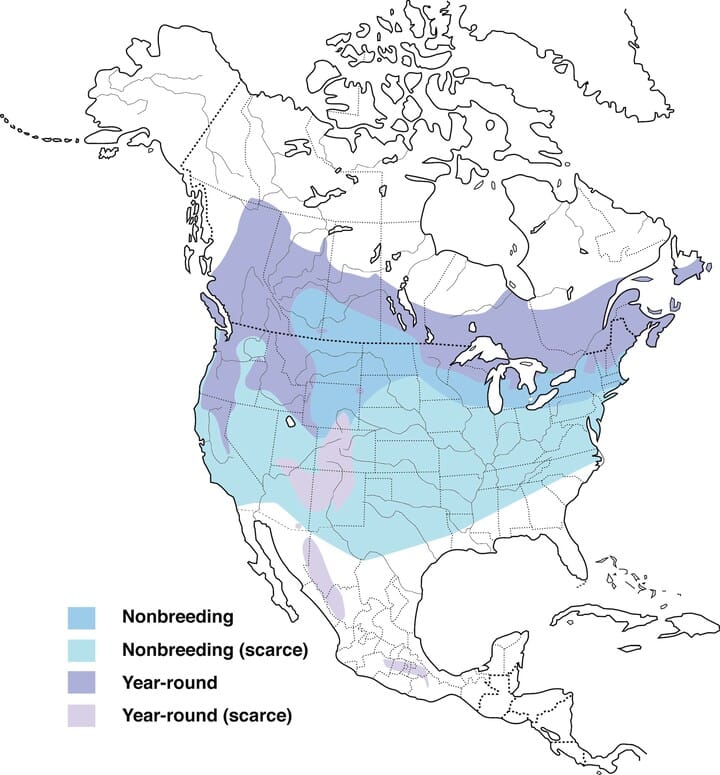
The range of the Evening Grosbeak. Cornell Labs diagram
Forget Grauman’s Chinese Theater; give me the Liberty Theater in Seward, Alaska, any old time.It’s my favorite theater in the whole world, at least until the Spanish Riding School in Vienna starts showing flicks.
Even then, I think I’d prefer the Liberty.
When the muse yanked me out of my truck last Wednesday as I was leaving to go to the Liberty, it was more than just wanting to see a movie.A couple weeks before that, I’d received a well-circulated e-mail suggesting a variation on flash mobs, only called a “cash mob.”Let’s all go to the Liberty on February 20 and given Skip and Marie a shot of cash.Incidentally, we could see Steven Spielberg’s “War Horse.”Not a bad idea.
The challenging weather we’ve been having all winter has been keeping a lot of folks indoors, or outdoors shoveling snow.Perhaps business at the Liberty was off, suggested the e-mail.Well, as a former small business owner who tried to keep a restaurant and motel open all winter, I know exactly what that’s like.
I fell in love with the Liberty the first time I walked in the front glass door, and that must have been thirty years ago.No big glaring marquee, just a tasteful sign above the entrance. Outside the door, a vending machine and a movie poster. Inside somewhere, an automated machine that answers a phone number I've had memorized for thirty years, and when t clicks on, Skip tells you all about the movie that day, and what's coming up next week.
Once inside, you climb the carpeted stairs to the tiny ticket booth, usually manned by Skip, who with his wife Marie, is the owner, and also the projectionist.General admission, $7; kids and seniors, $5.For this night, I lopped twenty years off my real age, and paid as a “general admission.”
I continued through the small lobby, paneled all around with African ribbon stripe mahogany.
The line at the concession stand was long, so I went into the auditorium.The first time I was here, I was amazed that they were selling Green River.
One night Marie set my husband's popcorn on top of the cash register. When he reached for it, he accidentally knocked it over, filling the cash drawer with buttered popcorn. He was forever after embarrassed to order popcorn from her, so I had to do it and hand it to him..
Once inside I was struck again by the resemblance to a humongous Quonset hut, a building with which I am very familiar.I lived in one for several years after I first came to Alaska in 1948, and have a bit of a special affinity for them.
The choice of seats is another thing I love about the Liberty.No fancy-dancy stadium seating with cup holders and such.No, but the Liberty has several seats available for your selection:
There are the cushy plush seats:
The wooden back seats:
The Naugahyde seats:
More plush seats:
My favorites are the plush seats that lean back.
There are five or six different kinds of seats here, as if the original builder bought seats-on-sale wherever he could find them.What a kick.No false pretense here, but simple down to earth small business.
Plus, there’s a real stage that is used occasionally for special events.
Skip isn’t sure how many seats are in the auditorium.He thinks there are between 250 and 260.On this special night, almost all were filled.
Marie and her helper at the concession stand dispensed popcorn and sodas and candy bars long after the movie had started.“Great night,” I said to Marie.She started to reply, then teared up and clamped her mouth shut.
Skip, on the other hand, was smiling and quite talkative.He’s been in the movie business since the 1930s, beginning in Kodiak where his father owned a theater, and here at the Liberty since 1957.He met Marie in Kodiak, when she worked at the theater for his dad.
I can tell you this for sure:Skip and Marie are two of the most loved folks in Seward.Remember that popular TV show called “Cheers?”And the theme song with the words, “where everybody knows your name?”
Actually, not me after all. My dad. My dad worked on the railroad from June of 1948 until he retired thirty years later. I came close. In the late winter of 1976, I was standing in the employment office of the Alaska Railroad, handing in my sure-thing application to be a cook on the railroad for the summer extra gangs.
Then came a phone call from my mother. The dispatcher at the Operating Engineers Union hall in Fairbanks had called and offered me a job on the construction of the Trans Alaska Pipeline. And that simple phone call changed my life.But, that's another story. Today's story is about a small part of the Alaska Railroad, and a continuation of my trip to Fairbanks over last weekend.
There have been almost 500 wildfires in Alaska this year, and many of them are still active. The largest, the Railbelt Complex fire south of Fairbanks, has burned more than a half million acres and remains out of control.
As I neared the town of Nenana, sixty-five miles from Fairbanks, I saw what looked like a large black rain cloud, so my hopes rose about avoiding the smoke I’d heard was limiting visibility.If it was raining, I thought the rain would lessen the smoke.
Eventually, I realized the black cloud was smoke. A temperature inversion layer was holding the smoke close to the ground, and I entered the smoky area before I reached Nenana.
With the discovery of gold in the Fairbanks area in 1902, miners rushed to the Interior. A trading post/roadhouse was established in 1903 at what became the town of Nenana. St. Mark's Episcopal Mission and school was built in 1905.
I want to tell you something about Nenana.
There is a town called Nenana, pronounced Nee–NAN-uh.There is a town called Tanana, pronounced TAN-uh-naw.
There is a river called Nenana.There is a river called Tanana.The TananaRiver runs through Nenana and empties into the NenanaRiver.
Nenana sponsors the annual Nenana Ice Classic, a game of guessing when the ice will go out on the TananaRiver.Go figure.
Legend says two bored railroad workers in 1915 started the whole thing by starting a pool on when the ice would go out.Actually, with the winner getting more than $300,000 in prize money,who cares what the town and river are called? My mother, along with a number of other people, won one time with a guess on her May 5 birthday.She said she got enough to pay her Anchorage property taxes for that year.
Each winter a huge tripod is placed on the ice, frozen into place, and a wire attached to a clock mechanism.Once the tripod has moved a hundred feet with the out-going ice, the ice is declared “out” and spring is here. So, for two bucks a ticket, you place your guess and you takes your chances.Wanting to get a photo of the tripod, I pulled off the highway, drove down the main street of Nenana, and parked next to the RailroadMuseum that’s located on the banks of the TananaRiver.
Then I visited the Railroad Musuem.The Alaska Railroad played a prominent part in the history of Alaska. From its inception in Seward in 1903 as the Alaska Central Railroad, it was owned and operated by the federal government, eventually becoming the Alaska Railroad.With crews working north from Fairbanks and also from the south, the golden spike was driven at Nenana in 1923 with President Warren Harding attending the ceremony.
The president left Alaska, and died of food poisoning in San Francisco.Just thought I’d throw in that little tidbit.
In the Great Alaskan Earthquake of 1964, damage to the railroad was estimated at $30 million, with a substantial portion of that in Seward where the rail terminal was hit by a tsunami. The railroad was up and running within two weeks.
Ownership of the railroad was ceded to the state in 1985. Since then, it has become a symbol of pride for the state. It hauls a tremendous amount of freight, and has been declared one of the best passenger railroads in the country. Recently I heard on the news that the ride between Seward and Portage has been named the premier train excursion in the U.S.I took that ride some years ago, and though I am almost jaded by the incredible scenery around me, I found that to be a jaw-dropping excursion.
The railroad has been important to the town of Nenana also, so it is fitting that the museum is located in the old station house there.
I found a number of interesting things inside, including a framed newspaper front pagebearing the tragic news of the plane crash that killed Will Rogers and Wiley Post in northern Alaska in 1935.
In a glass display case, there are two old concertinas. I took pictures of them and e-mailed the photos to my friend Polka Dan as soon as I could.
A tiny cook stove that probably burned coal or wood.
There was also a newspaper with a photo of a white moose.
And a “telephone” that looks like a character in a Pixar movie.
With a last look around Nenana, I pointed the truck and trailer north and headed out of town, over the bridge spanning the TananaRiver that runs through Nenana. That's the old station house, to the right of the crane, which houses the museum. Click on this photo to enlarge it to full screen and you'll see St. Mark's church left of the crane, and the top of the black and white tripod left of that.
The smoke from wildfires became more pronounced, looking like a thin, low-lying ground fog, but smelling of burning wood.Once I reached the top of a ridge that runs towards Fairbanks, I glanced over my left shoulder and saw this:
And into the Valley of Death rode the Five Hun.... No, it was just Pablo and me, actually.