"I'm going to speak my mind because I have nothing to lose."--S.I. Hayakawa
_______________________________________________________
Showing posts with label hyenas. Show all posts

Sunday, March 26, 2023

The 2022 Africa Journals, Chapter 30: Those Impossible Hyenas and a Photo Dump (PT. 3 of A Great Day)

 (Note: to see photos in a larger format, click on one to open a film strip at the bottom, then scroll through it.)


    Chapter 30:

Those Impossible Hyenas plus a Photo Dump

Part Three of a Great Day for Everything.


Integrity's a neutral value. Hyenas have integrity too.   They're pure hyena.

-Jonathan Franzen


"It's a male," I say in reference to a hyena cub we're photographing.

"How do you know?" asks my driver /guide.    I show him the photograph.   

"I can neither confirm nor deny," he says cryptically and reaches for his canvas-covered mammal book on the Land Cruiser's dashboard.


He hands the book to me and points to a specific paragraph. He gives me a few moments to read it.   Then he says, "I can neither confirm nor deny."

And I sit there utterly astonished--mouth open, jaw dropped, eyes wife open.

Recently, I posted the photo and the above conversation on Facebook, but noted that I would probably go to Facebook jail for a lifetime  for "violating their community standards" if I repeated the information in the following link.

I don't fear Facebook here, but nonetheless I'd rather not copy and paste  it.   I will simply furnish the link and you can read if you, too, want to be educated and astonished as to why it's darned near impossible to sex hyenas.

The link is complete with explanation, photos, and diagrams.   And what a diagram!!!


https://wholeeartheducation.com/hermaphrodite-hyenas/?fbclid=IwAR0KofsLhL9dDQkQ_A_5iVThtdt6TdJovdhKaOiO0ChP4gY0fl8gmUKK8n0


As for  hyenas, sometimes they're cute, most times they aren't.


Hyenas with with what's left of a wildebeest head.


Hyenas are a necessary part of the African ecosystem, often cleaning up carcasses left by larger predators or stealing carcasses themselves from whatever animal brought it down.   They are also quite capable of taking down antelope and wildebeest themselves.

There are three kinds hyenas--the spotted, which is the most prevalent, the brown, and the striped.   The Maasai Mara is over-run with spotted hyenas, in my opinion.

Standing three feet or less at the shoulder, the sloping back of the hyena gives it a sneaky appearance but its short compact frame can reach speeds of 40mph.   They also have the unpleasant habit of drooling.

With a biting force of a bone-crunching 1100psi, there are not many animals willing to chance a broken leg by challenging a hyena.


Hyena spa.   They can often be found relaxing in cooling water or mud.


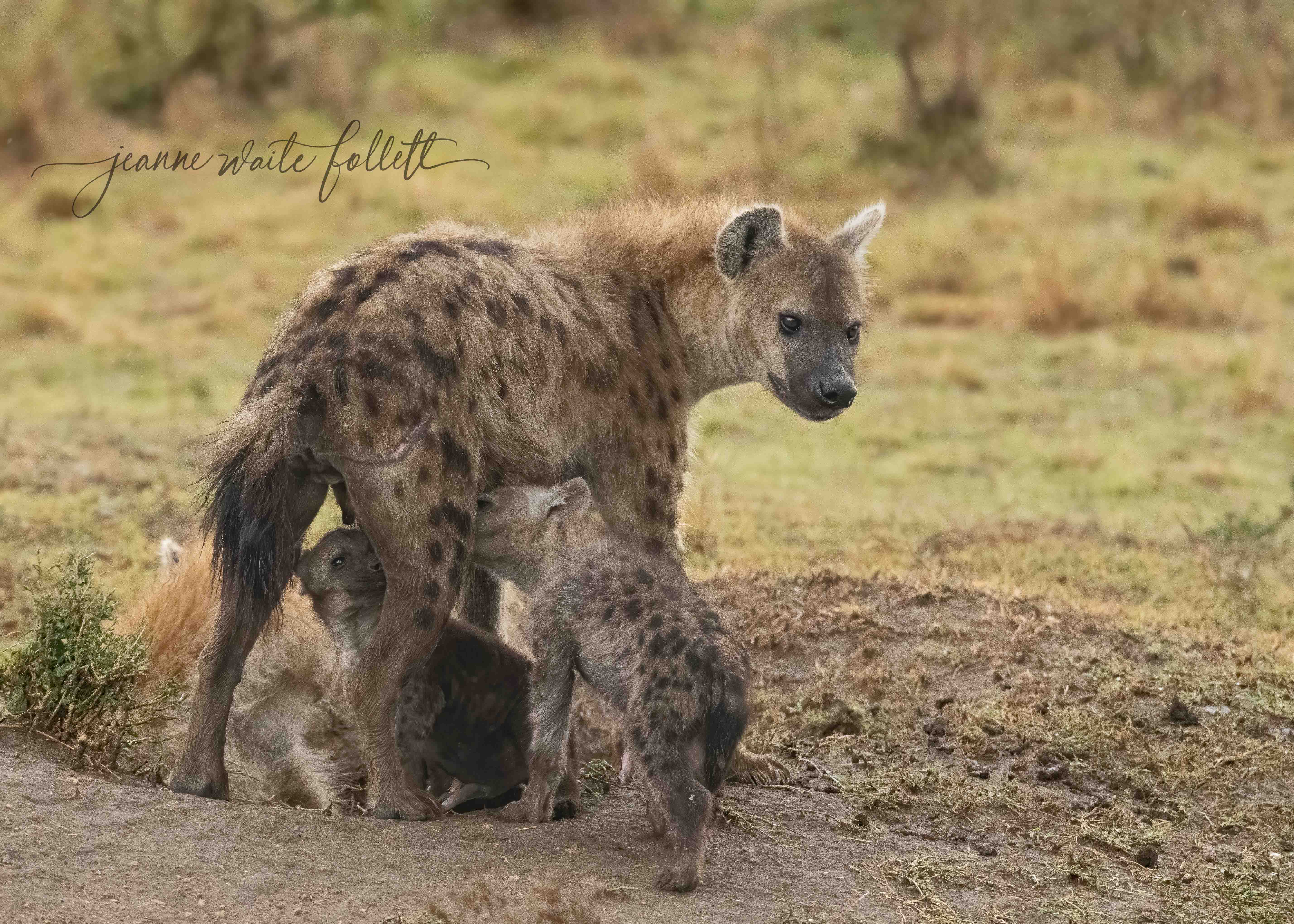
Hyena and cub.


Peeking out of an underground den.


The black blob on the right side is a much younger cub.   They are all black when born.


From Safari Africana: Hyenas are witty, courageous, and smart animals, and have no apologies to make. They are also incredibly caring and nurture their cubs better than many other animals. Many people assume that they are closely related to dogs, but in the real sense, hyenas are more alike to cats than they are to dogs.


Hyenas sleeping on the road.   The dirt is often warmer and dryer than the surrounding grasslands.


From National Geographic:  Although hyenas appear similar to dogs, they are actually more closely related to cats.


My disdain for these animals would be substantially less if they didn't steal food from cheetahs or kill the cubs of the endangered cheetahs.   Or lion and leopard cubs, too.  But then, those cats also kill hyena cubs.

There are two hyena dens close to camp and we visited them several times.

***


Now it's time for a photo dump, those photos that didn't get posted yet because there were too many to fit in a different post.


A yellow winged bat sleeping in a tree next to my tent.   These bats have wingspans of  12 inches!


Here;s an image of the bat that I borrowed from Pinterest:


NOT MY PHOTO


Gray-headed kingfisher.


Rufous-naped lark.


Slender mongoose.   These cute little mongoose are 12 to 15 inches long plus a tail that's 9 to 13 inches long.


White-crowned shrike.


This is a bushbaby nest in a tree next to SHelly'stent.


And this is the best shot I could get of the small animals.   The camera wanted to focus on limbs, not eyes and ears.   Bushbabies are primates with large eyes, long rear legs, and furry bodies.


A crop of the photo above to show the little fingers of a bushbaby.   We had a lot of fun watching these little creatures leap from tree to tree at night.


This is a young bushbaby I am holding at a rescue place in Botswana a couple years ago.


The stunning violet-backed starling.   Also called a plum-colored starling.


Water thick-knee.   Note the large eye.


Female gray woodpecker.


The always magnificent gray crowned crane.


Dark blue pansy butterfly


A Thompson's gazelle with a bent horn and flies all over its head.


Warthog sow with a piglet.


At Great Plains Expedition camp.   A kitchen to die for.


Sunday, March 12, 2023

The 2022 Africa Journals, Chapter 27: Leaving Our Home away from Home


(Note:  To view photos in a larger format, click on one.   A film strip will open at the bottom of the page and you can click through them there.) 


Chapter 27:

Leaving our Home away from Home


“It is always sad when someone leaves home, unless they are simply going around the corner and will return in a few minutes with ice cream sandwiches.”--Lemony Snicket


It’s moving day and we have a long drive to make.  After six nights at Enkewa camp, our home away from home, we are heading north to meet up with the drivers from Great Plains Expedition camp, our fourth and final camp of this safari.


I will also miss the wonderful food at Enkewa.


I’m not at all ready to leave.   Oh, my luggage is packed and waiting by the front flap of the tent—inside so the vervets don’t mess with it.   I simply love this camp and its staff and don’t want to leave.    Its relative isolation  provides us with many wildlife sighting with few, if any, other safari vehicles around.


However, off we go at the appointed time.   Marg, Virginia, and I are in Dominick’s truck.   


Our first sighting is a lion have breakfast, although from the condition of the wildebeest carcass, I think he might be having fourths or fifths.


He walks away, and a lioness approaches for her multiple serving.   Both of their bellies are huge, indicating they have been eating for a while.


And, yes, the rumors are true.    The males will eat first even though the females might have brought down the animal.   If the males aren't around, the adult females are first, and then the cubs.


Lions are very social and affectionate with each other, though a male might growl at little cubs climbing all over him.   They make a number of vocalizations to communicate.   The loudest, of course, is the roar which can be heard, they say, up to five miles away.


The roar is usually made to locate another lion in the pride.   Contrary to the song about the lion sleeping in the jungle, lions prefer the savannah grasslands.  They spend most of their days lolling about and sleeping.  Most hunting tends to occur at night, though there are exceptions.


Then we find Luluka, the leopard who has two cubs tucked away somewhere.  She has a small antelope down and is moving it.   


She is soon surrounded by safari vehicles.    The trucks are supposed to stay on the established trails unless the occupants have purchased an off road permit.  Some of the vehicles on the right mat or may not have the permit, which must be displayed on the vehicle.


Luluka is to the right of the tree.   Just a little spot.


We watch Luluka for a long time, hoping she will carry the carcass up  into the small tree.   


Then, as we have a timeline to follow,  we’re off and moving again.


Eventually, we stop for breakfast.


Under the shade tree.


L-R:   One Ten, Virginia, Sylvia, Peter, Marg, me, Ben, Pere, Shelly is hiding in the back, Cory, Randy, and Johnson.


Dominick


There was a lot more to start with.


Still heading north, we meet the Great Plains guys and transfer into different vehicles.   Frank is driving and Alex is the spotter.


It’s overcast and raining lightly for most of the trip.  


These are the sightings during the journey to camp:


Lark


Gray-headed kingfisher


Sacred ibis.


This variety of ibis got its name from ancient Egyptians, who consider the bird to be the god Thoth, who protected the country from plagues and serpents.   The Sacred Ibis is an ancient species with fossil records going back 60 million years.


A fig tree with its roots exposed by erosion.


Little bee-eater.


Female agama lizard.


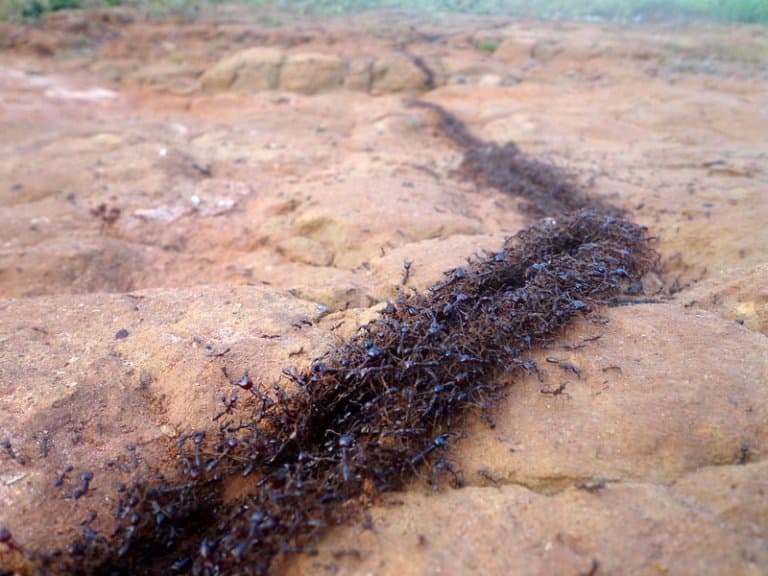
Safari ant trail.


The below photo from Fact Animal shows safari ants, also known as army ants and driver ants, on one of their trails.    They are voracious predators and will attack anything with protein.   Their colonies can number up to 50 million ants.


NOT MY PHOTO.


Spurwing lapwing on a nest.


Blue-eared starling.


Topi with her calf.   I love the hair patterns inside their ears.


Two topi calves.   The one on the left is starting to grow horns.


Warthogs and a Thompsons gazelle.


This bird is called a water thick-knee.   Look at the huge eyes.


Great Plains Expedition camp is lovely.   It’s located on a parcel of privately-owned land, surrounded on one side by the Maasai Mara, the private conservancy Naboisho, and another conservancy called Olare Motorola, or OMG for short.


Remembered to take a photo before I messed it up.


Where all the photo-editing gets done, batteries charged, etc.


The main dining room and lounge tent.   We occasionally had lunch on the deck.


Just for starters.   There was lunch after this.


And a zebra joined us for entertainment.    Expedition camp is fenced, but only to keep out the elephants that can be so destructive.   Anything else can wander through the front gate if it can fit under the overhead cross bar.


After lunch, we were treated to a wee bit of rain (she says facetiously).


  Click on the arrow to watch the short video.


This jackal is gobbling the termites that came up from the wet ground.


Hadada birds.


To top off the day, we visited a hyena den to see the pups.   Hyena pups have black hair that slowly turns to the usual black-spotted ginger color.


We had dinner back in camp and then roamed the grounds watching bushbabies leap from acacia tree to acacia tree.

Bed time.   It was a long, thoroughly enjoyable day.