"I'm going to speak my mind because I have nothing to lose."--S.I. Hayakawa
_______________________________________________________
Showing posts with label Zimanga Private Game Reserve. Show all posts

Friday, December 21, 2018

The 2018 Africa Journals, Ch. 23: The Last Time We Hide


Darkness comes quickly during winter and June is winter in South Africa.   We can already see the early signs of sunset as Margarite drives us to the Lagoon hide at Zimanga Private Game Reserve.

We photographed birds here at sunrise three days ago, so being here now at sunset seems a fitting way to close out our last day at Zimanga..

Once again, we enter the pole stockade that hides our approach from the birds, walk down the long tunnel, slip off our shoes, and take our places before the window that overlooks a small pond at water level.


I'm watching the reed grass above because there's a malachite kingfisher hopping around in there.


 Only five inches long, this kingfisher is sought out by photographers for its colors and its practice of flipping prey in the air and catching it so the head goes down the gullet first.


A black crake, with its red eyes and comical appearance, is quickly becoming one of my favorite birds to photograph.   They are between 7.5 to 9 inches long, and subsist on a variety of invertebrates such as frogs and fish, and also seeds.    They can be seen perching on warthogs and hippos to search for parasites.


Look at the size of those feet!


Who is the photobomber here?   The crake or the Egyptian goose?


The great egret parades around, looking all regal and stuff.


I see some black-headed herons in nearby trees and hope they come down to the pond.


And here is one, fluffing up, flapping its wings, and strutting its stuff.   Photo-bombed by a sacred ibis in the background.


Now you can see that dusk is nigh.


Back at the lodge, Margarite joins us for dinner and we have a chance to discuss "things" with her.  Our position is that having three or four different parties is a great burden on her and thus she cannot spend time with her guests.   She tells us of the other chores she takes care of while her charges are in the various hides.

Everything she says makes perfect sense from the viewpoint of management, i.e., making the best use of  an employee's time.   It is also true that there is no point in her sitting with us in a hide (which she did not).

On the other side, we felt rushed.   In the one game drive we went on, two other parties were with us.   That meant all the seats were taken, including one by a non-photographer.   Trying to shoot over or around another person in your row might be okay for some, but not for photographers.  Having a row to yourself is why they often pay extra.

However, as I kept reminding myself, we came here for the hides, which are well-worth the money and time.  We can take game drives elsewhere.


After dinner, it's time to pack as we leave early in the morning for King Shaka airport in Durban, for our flight to Johannesburg.   Bags are to be set outside our doors while it's still dark--but not the night before in case the baboons get curious about what's in them.


A few bird photos I found while going through more than 20,000shots taken on the whole trip.


This bird is a greater honeyguide.   It leads humans to bee nests by various means of attracting attention to itself, hoping the humans will open the nest, take the honey, and leave some for the bird.

African pied wagtail.   The wagtail eats mainly insects, but also invertebrates like tadpoles and small fish.   It also eats grass seeds and human food scraps.


This little bird in a hurry is a white-fronted canary.

Sunday, December 16, 2018

The 2018 Africa Journals, Ch. 22: The Scavengers


"What's at the Scavenger Hide?" I asked Marg.

"Eagles," she replied.

"Anything else?" I persisted, though eagles were fine with me.

"Probably."

Probably indeed!

So, once again at 0-Dark-Thirty we walked down a stone pathway into a photo hide at Zimanga Private Game Reserve carrying our cameras and big lenses.   I had two cameras, one with a 150-600mm lens and one with an 18-400 lenses.    I figured I had the distances covered well.

We locked our cameras onto the provided tripods with their gimbal heads and settled in to wait until it was light enough to see something.   I would hand-hold the camera with the smaller lens.

We could see Margarite check a depression in the ground  and she signaled that it had been "baited."

Our first visitor was a black-backed jackel.   It entered stage left and went immediately to the depression, selected an item, and left.

There was scarcely enough light for shooting photos with my big lens and they came out dark.   I lightened them considerably to make the jackel visible.


Next, a Marabou stork arrived.   Yes, these storks are scavengers and I frequently saw them on carcasses right in the middle of a mess of vultures.

The lack of feathers on their necks and face is ideal, in that it prevents blood and offal from clotting on them, is they had them.


The stork selects a tasty item from the supply and swallows it.


A tawny eagle arrives to the picnic.


Then, a Cape vulture joins the fun.


This photo is from inside the hide.   The visor aids in keeping the sun from shining directly inside, thus revealing the photographers sitting there.


A  batch of Pied crows arrives in scene.

This crow is quite suspicious and approaches the hide.


It's pretty sure there's something inside the rocks and glass.


The eagle makes an attempt at getting to the pile of goodies.


It retreats to a limb buried in the ground for a perch.


The stork apparently doesn't care much for the eagle, but shows no problem with the vultures.


I took hundreds of photos from this hide, and with a couple exceptions, there is no particular sequence of events.   In the photo below, the stork, eagle, and vulture are joined by a greater blue-eared starling.


The stork became the center of attention.   I don't know if it knew we were inside or if it could see its reflection in the glass.

Several times it came close, looked at the glass, hopped on the roof where it clomped around on a piece of metal, then startled us by jumping down right in front of it.


I know you're in there....


The vultures didn't care much for the eagle either.   I wondered if eagles snatched baby vultures and storks from nests, thereby earning the enmity of those species.


Another Marabou stork arrived and ate breakfast.


The eagle is not happy that the vulture has taken the prime spot on the limb.


A different tawny eagle on a different limb.


Now the stork decides it doesn't want the new eagle on the branch.


So, the smaller eagle departs.


This vulture must have heard our smothered laughter.


Look at those beautiful breast feathers.


A greater blue-eared starling


I took these photos after Margarite came to fetch us.


In the photo below you cam see the two branch perches, one on either side of the feeding grounds.


And, back to the lodge we go for breakfast.

This afternoon, we return to the lagoon hide for our final shoot at Zimanga.    We will stay the night, then depart for King Shaka Airport in Durban the next morning and flights to Johannesburg.

Laura and Holly will fly home from Johannesburg while Marg and I head to Kenya and two tented camps.


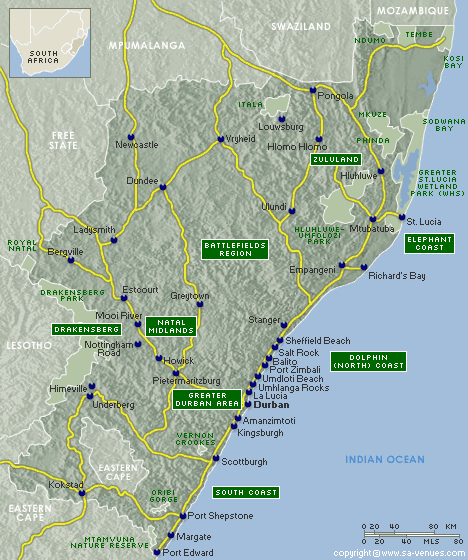
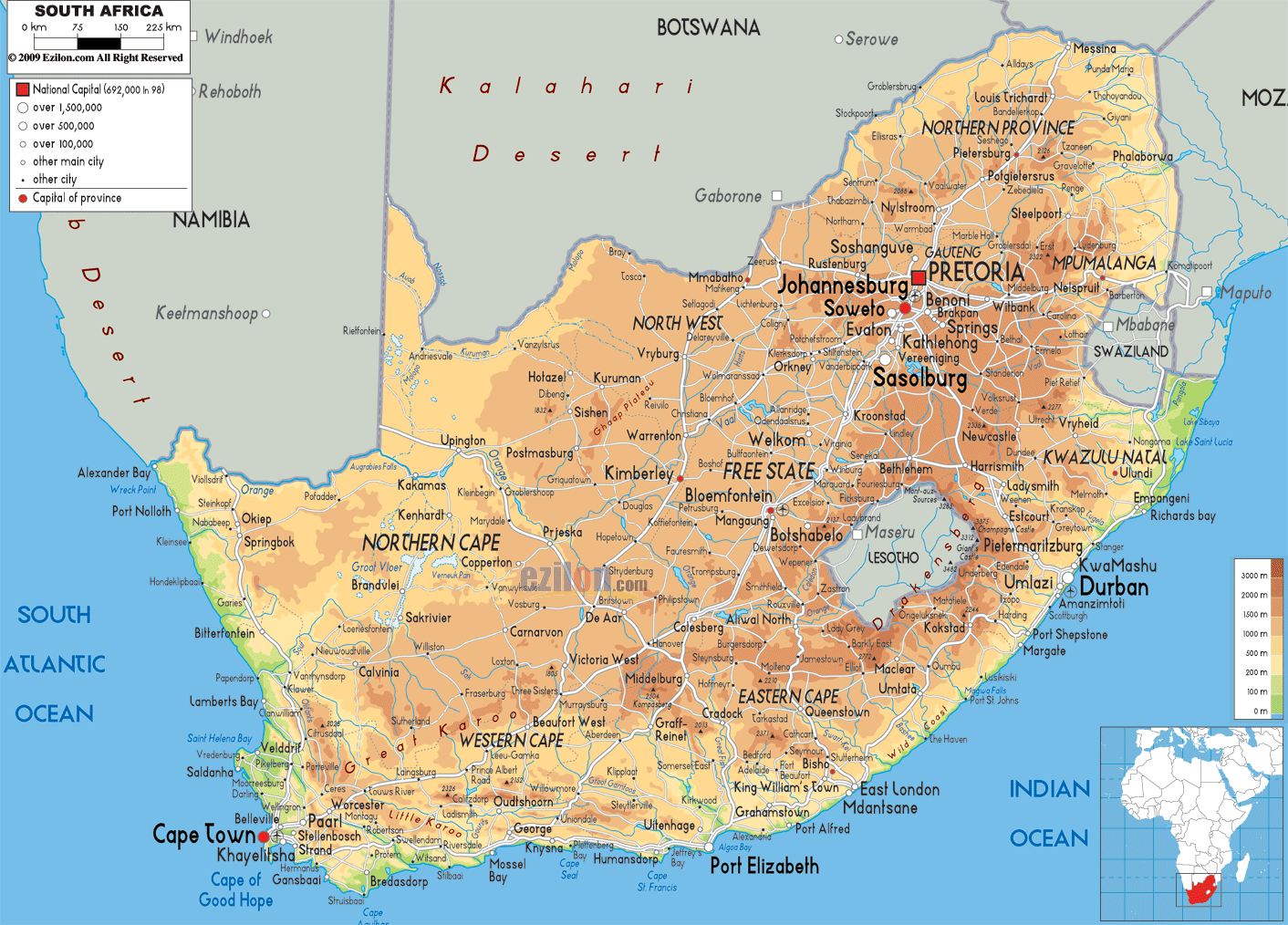
I haven't had any luck finding Zimanga near the town of Mkuza on a map.   From Richard's Bay on the Elephant Coast, we are inland.


Durban is in bold face print on the east coast