"I'm going to speak my mind because I have nothing to lose."--S.I. Hayakawa
_______________________________________________________
Showing posts with label Livingstone. Show all posts

Monday, May 5, 2014

The Africa Journals, Ch. 42, Dr. Livingstone, I Presume? Part 4


The Africa Journals

Chapter 42
Dr. Livingstone, I Presume?


Henry Stanley, dispatched by the New York Tribune on a secret mission to find the missing hero Dr. David Livingstone, was finding that everything in Africa bites, stings, or scratches.  He had malaria, suffered dysentery from drinking the water, and even came down with smallpox.   An early morning hunt in his favorite pajamas resulted in Stanley making the acquaintance of barbs and cactus spines when he tripped and fell.


Crossing the dreadful swamp of the Makata Plain.   This journey took more than two days.  Photo from Princeton.edu files


When he was well enough to travel, or be carried on a gurney, his trek pressed onwards towards Ujiji on the eastern shore of Lake Tanganyika, hoping that he would find the missing man or at least hear of his whereabouts.
***

Livingstone wasn’t missing.   He knew exactly where he was all the time and he wasn’t happy about it.   He was many miles from Ujiji, now stuck in a small village occupied by the hated Arab slavers and dependent on them for his very existence.

Porters had absconded, taking with them his precious medical chest that contained the medicines he could have treated his malaria, chronic dysentery, pneumonia, and the bone-eating tropical ulcers on his feet that were now infested with maggots.

Eventually, Livingstone recuperated enough to make his way to Ujiji, traveling through country inhabited by cannibals and warring tribes.  Upon his arrival, he was crushed to find the Arabs had plundered his supplies, and he was now destitute and again dependent on the slavers for his welfare.

No, Livingstone hadn’t known he was missing, so he was pleasantly surprised to learn that a white man had entered the village.   Then he saw the man, who doffed his hat and said, “Dr. Livingston, I presume?”   But Livingstone politely assured the newcomer of his identity and then learned the man was Henry Stanley, sent by an America newspaper to find him.  “I thank God, Doctor, that I have been permitted to see you,” said Stanley.

“I feel thankful that I am here to welcome you,” replied Livingstone. 


***

Stanley remained with Livingstone for some time, and the two explored together long enough to determine that Livingstone’s quest to find the source of the Nile would require even further treks.  Stanley returned to civilization, and a year later, still seeking the source, Livingstone died while kneeling to pray at his bedside on May 1, 1873 at the age of 60.  

He faithful attendants, Chuma and Susi, decided that Livingstone’s heart should be buried in Africa, the country in which he spent his life spreading the Christian religion.   They removed Livingstone’s heart and other internal organs, placed them in a metal box, and buried it under a tree in what is now Zambia. 
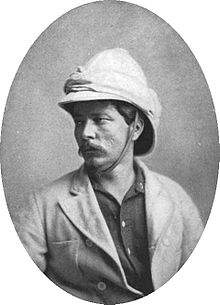
Henry Stanley
Then, in an incredible act of love and devotion, Susi and Chuma prepared the body for travel by salting it and exposing it to the African sun for a month.   They then wrapped it in sailcloth and mats, disguising it to look like trade goods, and carried it 1500 miles to the coast.  Their nine-month trek was made longer than necessary to avoid hostile tribes, and where local superstition made natives afraid of dead bodies and would prohibit transport through their territories.

The preserved body of Livingstone was returned to Great Britain and buries at Westminster Abbey. 

Stanley, his fame assured by finding Livingstone, went on to explore even more of Africa.   He died in 1904 in 1904.


***

As Russell Gammon concluded his talk about Dr. Livingstone, our river boat was nearing its dock on the Zambezi River.  His final words about Chuma and Susi transporting the body had brought tears to Gammon’s eyes.  

At least, I think they did.  Hard to tell because I was looking at him through my own tears.


Russell Gammon


Map of Livingstone's journey to Ujiji and Stanley's trek to find him.


We are to leave Victoria Falls in the morning, but we have a couple more adventures before that departure, so off we go.

Monday, April 21, 2014

The Africa Journals, Ch. 40, Dr. Livingstone, I Presume? Part Two


The Africa Journals

Chapter 40
Dr. Livingstone, I Presume?
Part 2

A little learning is a dangerous thing ;
Drink deep, or taste not the Pierian spring :
There shallow draughts intoxicate the brain…
—Alexander Pope, A Little Learning


Time has erased how and when I first heard the story of Stanley and Livingstone meeting up in the dense jungles of Africa.   I suspect it was reading The White Nile by Alan Moorehead, but I’m not sure. 

Whatever its delivery system, I know it was not accompanied with photographs, film, or television, because the image that’s been in my head for at least a half century was created entirely by my imagination.  It involves two men, wearing pith hats, using machetes to whack their way through a bamboo forest, and then suddenly coming upon each other in mid-whack.  

Whereupon Stanley doffs his pith hat and says, “Dr. Livingstone, I presume?”

Except, that isn’t the way it happened.   Not at all, not at all, not at all.

That old image involving pith hats, machetes, and a bamboo forest still lurks in my head.   Now, thanks to Russell Gammon and Martin Dugard, it has been pushed aside by a new image, one burnished by the African sun, painted with the vibrant colors of that country, and populated with its great beasts.


Russell Gammon
http://www.michaeljwindsordesign.com/wp-content/uploads/2009/11/30-Into-Africa-666x1024.jpg 


***


Livingstone was missing.   He’d not been heard from for several years.  Apparently the Dark Continent had swallowed him and stories ran rampant.  He was rumored to be held captive; he was reported to be dead by porters who claimed they saw him struck in the spine with an axe.


His many admirers in England were anxious for any news of the medical missionary who had captured their imaginations with his exploits in Africa.   They pressed the government to send a rescue caravan to find him.

Livingstone, that is Dr. David Livingstone, was a national hero in England and highly regarded for his exploration of the unknown interior of Africa.  He was on his third trip, this time to find the source of the Nile River, the longest river on earth.  This was the paramount goal in the mid- 1800s, the grail of exploration.

Born into poverty in 1813 in Glasgow, Scotland, he was the second of seven children.  While still a child, he worked 14 hour shifts in cotton mills.  He put himself through medical school, then entered the London Missionary Society seminary.  Sent to southern Africa in 1840 to set up missions, dispense religion and medicine, he found exploring much to his liking.


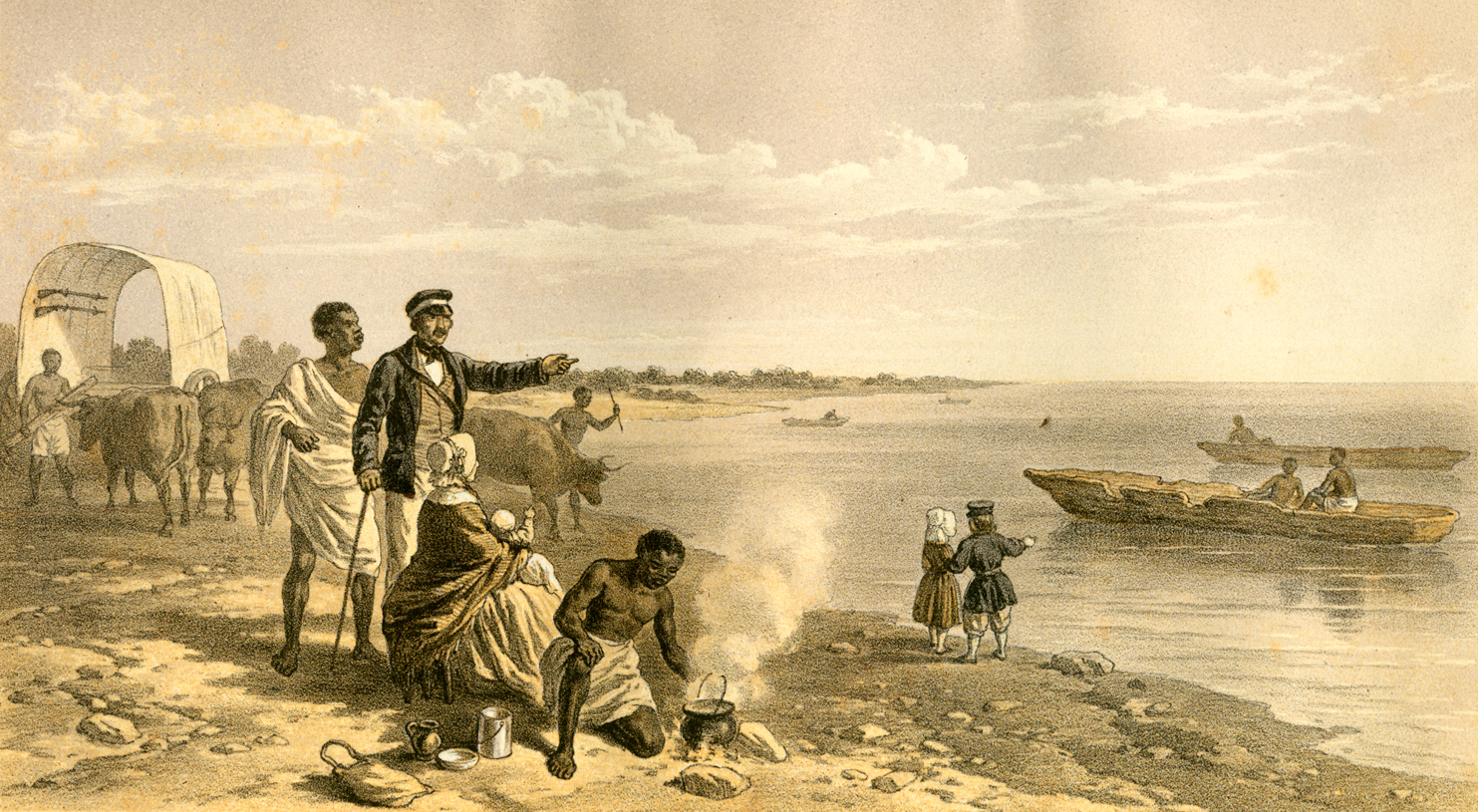
Discovering Lake Nagami, 1849.     From Princeton's Livnigstone collection.


Already, he’d walked across the unmapped interior of Africa from east to west, surviving the diseases, warrior tribes, and predatory animals in the country.  An attack by a lion had broken his arm.   He set it and stitched up the wounds himself, without anesthesia, but it left him with a crooked arm.   Now in his mid-fifties, Livingstone suffered from malaria and dysentery.   He was traveling in areas known to be inhabited by cannibals.   All this, and more, in a country where the average life expectancy of a white man was six months.


Sketch from Uncommon Christian Ministries.


It was during these travels that he witnessed the horrors of the slave trade in the country. 


Africans captured by Africans to be sold as slaves.


Arab slavers raided village after village, capturing men, women, and children and selling them into slavery.   The Portuguese purchased captives from Africans who had captured other Africans, and  sent them to northern Arabia, India, Persia and China.   The Arabs also purchased Africa-captured slaves and sold them in northern Africa and Turkey.   Slaves from eastern Africa went to India, Persia, and Arabia.


Arabs raiding village for slaves.   Based on drawing by H.H. Johnson for a London newspaper.


From the Portuguese stronghold in eastern Africa, slaves went to England, Denmark, Holland, Sweden, and France.  Those captured in western Africa went to America, the Caribbean, South America, Mexico, and Europe.   A cholera epidemic in Zanzibar decimated the population, including the cheap labor slaves, and now, during Livingstone’s trek, slaving was a lucrative trade. 


Massive Arab slaving caravans numbering into the hundreds roamed the continent and they were well aware of Dr. David Livingstone.   They came across him regularly, occasionally carrying his letters to the coast for shipment to England.   Sometimes, they destroyed his missives, knowing they contained his written evidence of their slave practices.

Slavery appalled Livingstone.   While he was still in England, he had mounted a campaign to stop slavery, speaking publicly and often.

Now, the great explorer was missing.