"I'm going to speak my mind because I have nothing to lose."--S.I. Hayakawa
_______________________________________________________
Showing posts with label Russell Gammon. Show all posts

Monday, May 5, 2014

The Africa Journals, Ch. 42, Dr. Livingstone, I Presume? Part 4


The Africa Journals

Chapter 42
Dr. Livingstone, I Presume?


Henry Stanley, dispatched by the New York Tribune on a secret mission to find the missing hero Dr. David Livingstone, was finding that everything in Africa bites, stings, or scratches.  He had malaria, suffered dysentery from drinking the water, and even came down with smallpox.   An early morning hunt in his favorite pajamas resulted in Stanley making the acquaintance of barbs and cactus spines when he tripped and fell.


Crossing the dreadful swamp of the Makata Plain.   This journey took more than two days.  Photo from Princeton.edu files


When he was well enough to travel, or be carried on a gurney, his trek pressed onwards towards Ujiji on the eastern shore of Lake Tanganyika, hoping that he would find the missing man or at least hear of his whereabouts.
***

Livingstone wasn’t missing.   He knew exactly where he was all the time and he wasn’t happy about it.   He was many miles from Ujiji, now stuck in a small village occupied by the hated Arab slavers and dependent on them for his very existence.

Porters had absconded, taking with them his precious medical chest that contained the medicines he could have treated his malaria, chronic dysentery, pneumonia, and the bone-eating tropical ulcers on his feet that were now infested with maggots.

Eventually, Livingstone recuperated enough to make his way to Ujiji, traveling through country inhabited by cannibals and warring tribes.  Upon his arrival, he was crushed to find the Arabs had plundered his supplies, and he was now destitute and again dependent on the slavers for his welfare.

No, Livingstone hadn’t known he was missing, so he was pleasantly surprised to learn that a white man had entered the village.   Then he saw the man, who doffed his hat and said, “Dr. Livingston, I presume?”   But Livingstone politely assured the newcomer of his identity and then learned the man was Henry Stanley, sent by an America newspaper to find him.  “I thank God, Doctor, that I have been permitted to see you,” said Stanley.

“I feel thankful that I am here to welcome you,” replied Livingstone. 


***

Stanley remained with Livingstone for some time, and the two explored together long enough to determine that Livingstone’s quest to find the source of the Nile would require even further treks.  Stanley returned to civilization, and a year later, still seeking the source, Livingstone died while kneeling to pray at his bedside on May 1, 1873 at the age of 60.  

He faithful attendants, Chuma and Susi, decided that Livingstone’s heart should be buried in Africa, the country in which he spent his life spreading the Christian religion.   They removed Livingstone’s heart and other internal organs, placed them in a metal box, and buried it under a tree in what is now Zambia. 
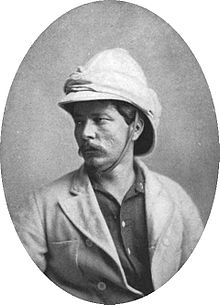
Henry Stanley
Then, in an incredible act of love and devotion, Susi and Chuma prepared the body for travel by salting it and exposing it to the African sun for a month.   They then wrapped it in sailcloth and mats, disguising it to look like trade goods, and carried it 1500 miles to the coast.  Their nine-month trek was made longer than necessary to avoid hostile tribes, and where local superstition made natives afraid of dead bodies and would prohibit transport through their territories.

The preserved body of Livingstone was returned to Great Britain and buries at Westminster Abbey. 

Stanley, his fame assured by finding Livingstone, went on to explore even more of Africa.   He died in 1904 in 1904.


***

As Russell Gammon concluded his talk about Dr. Livingstone, our river boat was nearing its dock on the Zambezi River.  His final words about Chuma and Susi transporting the body had brought tears to Gammon’s eyes.  

At least, I think they did.  Hard to tell because I was looking at him through my own tears.


Russell Gammon


Map of Livingstone's journey to Ujiji and Stanley's trek to find him.


We are to leave Victoria Falls in the morning, but we have a couple more adventures before that departure, so off we go.

Saturday, April 19, 2014

The Africa Journals, Ch. 39, Dr. Livingstone, I Presume?


The Africa Journals

Chapter 39

Dr. Livingstone, I Presume?


Life is either a great adventure or nothing.
--Helen Keller


Russell Gammon is the kind of fellow you’d love to have dinner with, preferably when neither of you has any time constraints and the postprandial conversation is free to wander where it may, because you know Gammon is a storyteller par excellence, and thus the evening holds promise of being both entertaining and educational.


I can imagine him setting down his lager and telling me how to find the big cats of Africa during the rainy season.  They don't like getting wet and since the heavy undergrowth is laden with dew in the morning they walk down the roads, making them easier to track and find. 


Leopard tracks after a night rain.


Gammon looks like he belongs in Africa—to Africa, and he does.   He’s a third generation resident of Zimbabwe, the result of an ancestor coming to Zimbabwe from Scotland in the early 1890s.

He is a big man and his ruddy complexion, exacerbated by the intense African sun, tends to disguise the redness of his beard.   


My introduction to Gammon comes in the late afternoon of a day filled with activities.   Elephant rides, cheetah petting, a visit to a tribal healer, all were spinning around in my head in an orgy of exotic encounters.  When Brian tells our driver to take a different road to wherever we are going, I sit right up and pay attention, ready for the next adventure.

The “different road” takes us through the village of Victoria Falls, then turns back alongside the Zambezi River through brush and trees.   A seemingly deserted road suddenly comes alive with hawkers coming out of the brush as we slow to see another baobab tree.   Thankfully, we are protected within the coach and escape with our dollars intact.  


Hawkers in front of the coach.


A short distance away, we disembark and board a river boat with chairs and tables lining the outside of the deck.  Seated at one of those tables was Gammon, dressed in a gray shirt and khaki shorts.  Once the hors de oeuvres are set out and we have our beverages of choice, Gammon goes to the bow and begins to speak about his hero:  Dr. David Livingstone, the first European to see the “Smoke that Thunders,” who promptly named it Victoria Falls after the queen of England.


Front CoverLike Livingstone, Gammon is Scottish.   He has been a guide for most of his adult life and is now considered the foremost expert in the life of Dr. Livingstone.   He frequently gives talks at Victoria Falls Hotel and other venues, and has worked with the Smithsonian Institute, National Geographic, the BBC, and Discovery Channel regarding Livingstone.   Further, he has traveled much of Livingstone's routes.


I had read Martin Dugard’s Into Africa: The Epic Adventures of Stanley and Livingstone before I came to Africa and I was anxious to hear Gammon flesh out the story of the Scottish medical missionary and Africa explorer.


So, I join fellow travelers from Nevada at a front table and settle back with a Coke Zero and a few hors de oeuvres, pen in hand and notebook at the ready.   
I suggest you order a tray full of gin and tonics.   We're in malaria country and you'll need the anti-malarial qualities in the tonic, you see.


The boat pulls away from the dock, passes some women fishing along the shore,  and Gammon begins to speak.   We are literally on the same river at the same place that Livingstone explored in the mid 1800s.

Now, settle back and listen as we learn about Livingstone and Stanley during an era when the average life span of a European in Africa was an astonishing six months.