"I'm going to speak my mind because I have nothing to lose."--S.I. Hayakawa
_______________________________________________________
Showing posts with label jackals. Show all posts

Sunday, March 12, 2023

The 2022 Africa Journals, Chapter 27: Leaving Our Home away from Home


(Note:  To view photos in a larger format, click on one.   A film strip will open at the bottom of the page and you can click through them there.) 


Chapter 27:

Leaving our Home away from Home


“It is always sad when someone leaves home, unless they are simply going around the corner and will return in a few minutes with ice cream sandwiches.”--Lemony Snicket


It’s moving day and we have a long drive to make.  After six nights at Enkewa camp, our home away from home, we are heading north to meet up with the drivers from Great Plains Expedition camp, our fourth and final camp of this safari.


I will also miss the wonderful food at Enkewa.


I’m not at all ready to leave.   Oh, my luggage is packed and waiting by the front flap of the tent—inside so the vervets don’t mess with it.   I simply love this camp and its staff and don’t want to leave.    Its relative isolation  provides us with many wildlife sighting with few, if any, other safari vehicles around.


However, off we go at the appointed time.   Marg, Virginia, and I are in Dominick’s truck.   


Our first sighting is a lion have breakfast, although from the condition of the wildebeest carcass, I think he might be having fourths or fifths.


He walks away, and a lioness approaches for her multiple serving.   Both of their bellies are huge, indicating they have been eating for a while.


And, yes, the rumors are true.    The males will eat first even though the females might have brought down the animal.   If the males aren't around, the adult females are first, and then the cubs.


Lions are very social and affectionate with each other, though a male might growl at little cubs climbing all over him.   They make a number of vocalizations to communicate.   The loudest, of course, is the roar which can be heard, they say, up to five miles away.


The roar is usually made to locate another lion in the pride.   Contrary to the song about the lion sleeping in the jungle, lions prefer the savannah grasslands.  They spend most of their days lolling about and sleeping.  Most hunting tends to occur at night, though there are exceptions.


Then we find Luluka, the leopard who has two cubs tucked away somewhere.  She has a small antelope down and is moving it.   


She is soon surrounded by safari vehicles.    The trucks are supposed to stay on the established trails unless the occupants have purchased an off road permit.  Some of the vehicles on the right mat or may not have the permit, which must be displayed on the vehicle.


Luluka is to the right of the tree.   Just a little spot.


We watch Luluka for a long time, hoping she will carry the carcass up  into the small tree.   


Then, as we have a timeline to follow,  we’re off and moving again.


Eventually, we stop for breakfast.


Under the shade tree.


L-R:   One Ten, Virginia, Sylvia, Peter, Marg, me, Ben, Pere, Shelly is hiding in the back, Cory, Randy, and Johnson.


Dominick


There was a lot more to start with.


Still heading north, we meet the Great Plains guys and transfer into different vehicles.   Frank is driving and Alex is the spotter.


It’s overcast and raining lightly for most of the trip.  


These are the sightings during the journey to camp:


Lark


Gray-headed kingfisher


Sacred ibis.


This variety of ibis got its name from ancient Egyptians, who consider the bird to be the god Thoth, who protected the country from plagues and serpents.   The Sacred Ibis is an ancient species with fossil records going back 60 million years.


A fig tree with its roots exposed by erosion.


Little bee-eater.


Female agama lizard.


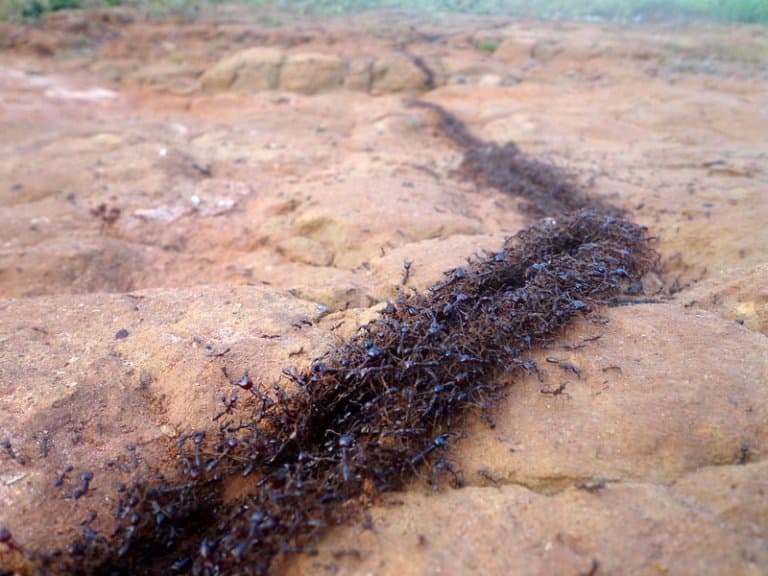
Safari ant trail.


The below photo from Fact Animal shows safari ants, also known as army ants and driver ants, on one of their trails.    They are voracious predators and will attack anything with protein.   Their colonies can number up to 50 million ants.


NOT MY PHOTO.


Spurwing lapwing on a nest.


Blue-eared starling.


Topi with her calf.   I love the hair patterns inside their ears.


Two topi calves.   The one on the left is starting to grow horns.


Warthogs and a Thompsons gazelle.


This bird is called a water thick-knee.   Look at the huge eyes.


Great Plains Expedition camp is lovely.   It’s located on a parcel of privately-owned land, surrounded on one side by the Maasai Mara, the private conservancy Naboisho, and another conservancy called Olare Motorola, or OMG for short.


Remembered to take a photo before I messed it up.


Where all the photo-editing gets done, batteries charged, etc.


The main dining room and lounge tent.   We occasionally had lunch on the deck.


Just for starters.   There was lunch after this.


And a zebra joined us for entertainment.    Expedition camp is fenced, but only to keep out the elephants that can be so destructive.   Anything else can wander through the front gate if it can fit under the overhead cross bar.


After lunch, we were treated to a wee bit of rain (she says facetiously).


  Click on the arrow to watch the short video.


This jackal is gobbling the termites that came up from the wet ground.


Hadada birds.


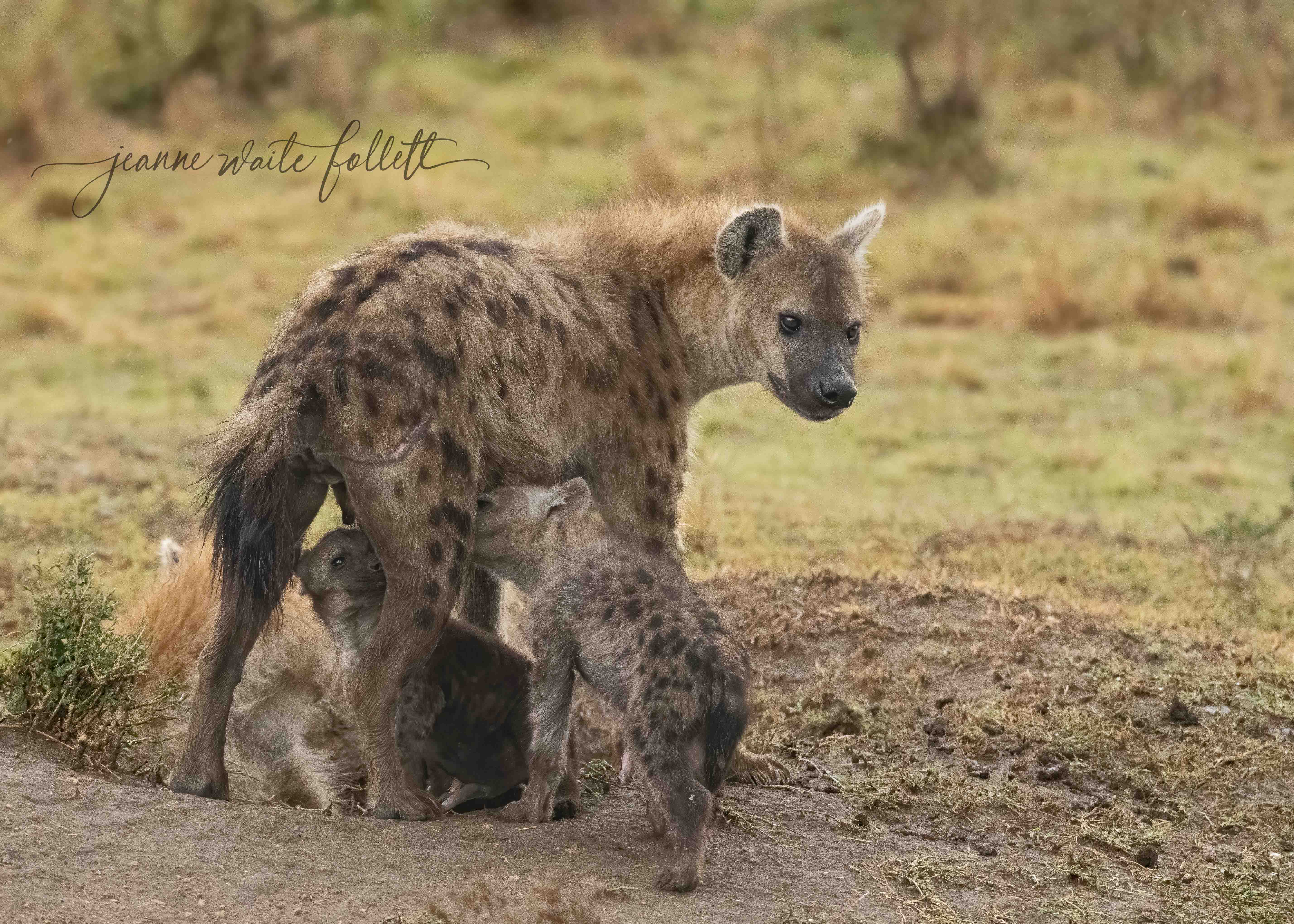
To top off the day, we visited a hyena den to see the pups.   Hyena pups have black hair that slowly turns to the usual black-spotted ginger color.


We had dinner back in camp and then roamed the grounds watching bushbabies leap from acacia tree to acacia tree.

Bed time.   It was a long, thoroughly enjoyable day.

Monday, March 6, 2023

The 2022 Africa Journals, Chapter 26: Sleepless on the Mara

 Chapter 26:

Sleepless on the Mara


(Note:   If you want to view the photos in a larger format, click on one.   A film strip will open at the bottom of the page and you can click through it.)


It’s funny, but you never really think much about breathing. Until it’s all you ever think about. – Tim Winton


I can't sleep.

I can't sleep because I can't breathe.

I can't breathe because when I lie down, I'm short of breath.

And thus it goes, awake and concentrating on breathing.   The longer I'm awake, the more anxious I become which serves only to exacerbate the problem.  I'm trying not to toss and turn so that I don't disturb Marg in the next bed, who may or may not be sleeping.

I notice, however, that my persistent cough has disappeared now that we are in the less dry area of Kenya.

I must have finally drifted off because I wake up and Marg has already gone to the dining tent for coffee.   (How does she unzip and zip the tent flap without waking me?)


My bed is left, Marg's is right.   At night, mosquito netting shrouds both beds.


I lie in bed for a while, thinking and worrying.  I finally decide what to do near wake-upon call time and it's a tough decision because this is our last full day at Enkewa camp.   Tomorrow we head for our fourth and final camp.

I get up, get dressed, and wave a flashlight out the tent flap to summon a security guard to escort me in the dark to the dining tent.   Marg is the only one there and I sit down beside her and tell her I am going to stay in camp this morning because I din't sleep much and am exhausted.

She wants to know why I didn't sleep well.    I hesitate because Marg is a veterinarian and reluctant to say too much, but she dismisses my initial middle-of-the-night delusional self-diagnosis.   


Virginia walks into the dining room.   Virginia is a surgeon (people, not animals) and can ethically advise medical info.  She immediately wants to know what's wrong.   She checks my (nice, steady, and not too rapid) pulse and pokes a finger at my shin.   A dimple remains:  I'm retaining water.

I look at my leg and think that it doesn't look like my legs usually look.   It's bigger.  And puffy.

This gives me another avenue to research for my self-diagnosis and I return to the tent. I dig into my tea and cookies, then take my morning prescription meds which includes a pill that lowers blood pressure and reduces the risk of strokes, and a diuretic.

Then I go back to bed.

Two hours later, I wake up and feel fine.   I'm no longer short of breath.   I turn on the computer and Google "elevation of the Maasai Mara National Reserve" and there's my answer--it's 4900 to 7000 feet above sea level.   I am having a bit of a high altitude problem.   After all, I've lived within 700 feet of sea level almost all my life.

I should have recognized the symptoms as they have plagued me in the past in high elevations--in Tibet and in Wyoming.    They are the reason I can't go to Machu Picchu

This is the first time I'm in camp during the morning, so I wander around to see what I can see, hoping for birds.   I strike out on that, but I finally get a decent photo of the dining room.


In the next couple hours, two different people (Solomon the dining room waiter and Jason our tour organizer) come to check on me.   They assure me they can get me to a hospital if I need.   I'm embarrassed for all the attention, but assure them I'm fine.

Later, Dominick, the head guide, also checks on me.  


I'm ready for the late afternoon game drive.   This time, I'm with Marg and Dominick is driving.   He has a spotter also.

First off, we find a black-backed jackal den in a huge termite mound.   A pup is curious about the vehicles with people pointing those huge black circles at him.

These charming little canids are among the bravest animals I've seen in Africa.   They think nothing of getting close to and barking at lions, trying to make the big cats move away from a carcass so they can eat their share.

This is from Go Africa, a tourist web site written as a blog:

"...(N)ow lack-backed jackals are one of the most ancient canids of all –the ancestors of modern wolves and dogs. They have not survived the past two million years by only getting in the ring at their own bantam-fighting weight. In fact, these little fellows – literally the smallest of all jackals - are considered the most aggressive. I’ve seen an individual jackal hunt and kill a young impala – an antelope larger than itself - with clinical efficiency."


Monogamous, cunning, and shy around humans, they are always a favorite sighting.


A Cape buffalo with a headdress of two yellow-billed oxpeckers.


A black-bellied bustard, displaying for a lady bustard.


Little bee-eater

Little bee-eater


On the way back to camp, I request a short stop to take a scenic photo.   It's raining slightly and it's slightly hazy, but I love this terrain.


Then, one last stop for an immature martial eagle.   This is Africa's largest eagle.   As you can see, it's crop is full and it causes a large lump on the breast.

Adult martial eagles are incredible strong, enough to carry off small antelope, baby warthogs, etc., but their favorite prey are poisonous snakes, chickens and the wild species of francolins, grouse, young bustards, and young goats and lambs, which makes them the enemy of pastoralists.

They are considered endangered.


Maybe.   Maybe it's something else.   With immature birds, it's often hard to tell.


I go to bed this night and sleep much better, even with the itching termite bites.