"I'm going to speak my mind because I have nothing to lose."--S.I. Hayakawa
_______________________________________________________
Showing posts with label maps. Show all posts

Monday, November 24, 2025

The 2025 Botswana Journals, Ch. 2: The Airlines Agony Continues

Savvy traveler that she is, Marg Wood planned for our group to spend two days in Johannesburg at City Lodge before going on to Botswana, our primary destination.  It’s a nice hotel attached to the airport, and that makes it wonderfully convenient.   As it turned out, we would be a day late, but still on track for our connections to Botswana from South Africa.


I neglected to mention a couple of things about the beginning of this trip.   I make it a practice to spend the night before a trip in Anchorage.   That’s because there is only one road to Anchorage (and its international airport) from where I live, and if there’s an accident, avalanche, or any other issue, the road might be closed, causing me to miss a flight.  Sure enough, it happened.   While I was blissfully unaware of a wreck that closed the highway near Anchorage the morning of my flight, I boarded my flight to Seattle.

And, while we were winging our way south to that port city, the Alaska Airlines computer systems went down. It didn’t affect my flight or my connection to Edmonton.


That was all before hell broke loose a few hours before the flight to Amsterdam, connecting to Johannesburg.  I told you about that morning as Marg made arrangements, including long phone calls, gathering everyone’s passport numbers, and utilizing her Platinum status with KLM.    I’m glad I was with Marg in her home when this happened, because my email from KLM said my flight was cancelled!


This is the hotel attached to the airport in Johannesburg, South Africa.


We got to Amsterdam and even made up some time in the air.   So much time, in fact, that as we deboarded, we saw our original flight to Joburg being boarded a couple of gates down!   We could have made it, but there were great odds that our checked baggage wouldn’t have.

We had about nine hours to wait until our new flight via Swiss Air left.  Once again, Marg and her Platinum status, and Marshel came to the rescue.   They paid for temporary passes for all to the KLM lounge, something KLM does not usually allow.   Free food, drinks, and a comfortable place to wait!  I took a nap.

I then spent the next ten hours miserable in seat 31A  as we flew to Zurich and then on before finally landing in Joburg and checking into a room at City Lodge, meeting as a group for dinner, and then getting a good night’s sleep before catching a morning flight to Kasane, Botswana, and our first safari outing.  


City Lodge reception desk

Outdoor eating, pool area

Part of the dining room

Name dropping here with no shame:   I once saw Jane Goodall walk past the dining room!!!


In the lobby


Let's get on with it!!!


 I had now been travelling for six days, but I had the next five days to enjoy the Chobe River while staying at one of my favorite places:   the Pangolin Chobe Hotel.   I think this was my third visit here, and I love it.


I was hoping to see Guts and Janine, the owner-operators, but they were away guiding a photo group.   I was pleased to see that their beloved business survived the 15-month COVID lockdown in Botswana!

It was built by photographers FOR photographers and is the only place I’ve stayed in Africa where an experienced photographer is with you on every outing to offer photo advice.


The lowly pangolin is the most trafficked animal in the world.   Its scales, made of keratin like human fingernails, are used in "traditional medicine" in parts of Africa and in Asia.   


As for blaming the pangolin for Covid, "While the pangolin is a likely intermediate host, the original source of SARS-CoV-2 is believed to be from a bat, as seen in other coronaviruses. "


The World's Most Trafficked Mammal Just Got Desperately Needed Help |  National Geographic
I've never seen one, so I borrowed this image from the Internet.


This is the second-floor lounge.   The colored glass evokes the shape of the pangolin with its golden scales, which are much treasured.   Unfortunately, those scales have crested a crisis for the small mammal.


Creativeness is apparent throughout the lodge, as shown by these empty liquor bottles adapted to hold electric lights and the copper tubing formed as a base.


The room I shared with Sylvia.


Large bathroom with exposed copper plumbing.


Two large beds.   The windows offer a view of the Chobe River.


Plumbing in the bathroom.


This is where you can tell the lodge was designed by photographers--the long counter for setting up computers and photo gear and lots of outlets.


We had a couple of hours to unpack and unwind before our first outing on the specially designed river boats.   Here’s a teaser for the next chapter:


A beautiful flowering tree right where we load onto the boats.


First bird of the trip:   the elusive giant kingfisher and it has a fish in its mouth.   The giant, or Goliath,  kingfisher is 42–46 cm (16.5–18 in) long, with a large shaggy crest, a large black bill and fine white spots on black upperparts. The male has a chestnut breast band and otherwise white underparts with dark flank barring. The female has a white-spotted black breast band and a chestnut belly.


The pied (having two or more colors) kingfisher is prevalent across Africa.   From the Internet:  The pied kingfisher is apparently unique amongst kingfishers, having a bony plate that slides across their eyes when the bird hits the water. The kingfishers are fairly distinctive as a group. They have large heads, long, pointed bills, short legs, small feet, and short tails.


The freshwater Nile crocodile.   These highly aggressive ambush predators are responsible for about 1,000 human deaths every year.  Some of the largest specimens were 20 ft. long and weighed more than a ton.


Ah, crocs and birds and what else awaits us?


Photos from a previous trip to the Pangolin hotel:


Even the roof trusses evoke the curved shape of the pangolin.

The lounge.


The sunken fire pit.


The outdoor eternal pool and the fire pit.


Dining room.


Room for eight photographers.


The Chobe River can be seen from my hotel room.   Borrowed photo.


We are located along the river, quite near the border with Zimbabwe.   As you can see, the river forms Botswana's northern border with Namibia, and also a point where the borders of four countries meet--Botswana, Namibia, Zimbabwe, and Zambia.


Tuesday, January 31, 2023

The 2022 Africa Journals, Chapter 19: There are Game Drives and then there are GAME DRIVES!

 Chapter 19:

There are Game Drives and then there are GAME DRIVES!


"But African time was not the same as American time…As African time passed, I surmised that the pace of Western countries was insane, that the speed of modern technology accomplished nothing, and that because Africa was going its own way at its own pace for its own reasons, it was a refuge and a resting place.”-Paul Theroux


We landed at Keekorok airstrip around 11 A.M. and walked into the welcoming arms of our African guides.   It felt like we were being welcomed home, even this is only my second time lodging at Enkewa camp.


Map of the Masai Mara
Keekorok is located near where all the roads come together in the lower right.    Enkewa camp is in the area southwest of the airstrip.


The guys load all our luggage  except cameras into one vehicle and it heads immediately to camp.   

The camp Land Rovers appear to be brand new and I recall the owner, Jose, telling us he had ordered new vehicles just before the COVID pandemic hit and closed down so many camps in Kenya.

I climb into a three-row truck with Peter driving and I expect he will follow the luggage truck.  Pretty soon I realize we aren't passing any familiar landmarks.   We are also on a Ferrari Safari, which is what we call driving far too fast for scanning the landscape for animals


Peter has the two-way radio on high volume.   This is unusual because almost all the guides are now using cell phones for communicating privately with each other.

I lean back, hold on, and imagine that Peter is a young man with his first hot car and loud radio blasting across the savannah.   I'm not far off.


We come upon a herd of zebras and wildebeest and Peter slows down to let the animals cross the track.


First stop:   some beautiful Coke's hartebeest, so-called because the shape of their horns resembles a heart.


A large antelope at  46 inches at the shoulder, these animals weigh a little over 300  lbs.    They prefer dry savannah and forested woodlands, and will often move to more arid regions after rainfalls.    They have been spotted at the 13,000 ft. elevation on Mt. Kenya.

Hartebeest share similar traits with wildebeest, topi, and blesbok in that they have elongated heads with forequarter sloping to hind quarters.    There are several varieties of hartebeest, with a couple having become extinct.

Next, I ask Peter to stop ("Oh, look! A calf!") so we can photograph two eland with a calf.    Can't miss calves, no matter what species.


The common eland is the largest antelope at up to 6 ft. at the shoulder and males weighing up to 2200 lbs.   While they are the slowest antelope at 25 mph, they can jump 10 feet from a standing start.   Males have a large dewlap and are really impressive animals.


This is an interesting item from Seaword.com:   When walking, tendon or joints in the eland's foreleg produce a sharp clicking sound, the cause of which has not been widely investigated. The sound carries some distance and is a good indication of an approaching herd. Some scientists believe it may be a form of communication; if a male is walking through his territory, the clicking which can be heard for up to a mile away, may alert another eland about this territory.


We leave the elands and soon slow again for a herd of zebra and wildebeest.   The zebra are blocking the track, so Peter moves forward slowly.


Then, the reason for the rush appears.   A leopard was spotted earlier and the guides are taking us to see it.   

I laugh to myself at something Marg said a few years ago:  "These guys are hard-wired to find leopards."    She and I were once lined up to take photos of elephants against the horizon at sunset.   Suddenly the guide yelled at us to get back in the truck.  

Then they raced down into a gully--and there was a famous female leopard known as Fig, who was walking through a scrum of safari vehicles.    It was too dark for photos.

We missed the elephants on the horizon.


Our first look at this leopard.


She moves into a ditch where she is partially concealed and carefully scans for game.    Then she moves back into the depression and walks along it, closer to the main herd.


Leopards are beautiful and impressive cats.


Leopards are about 6 feet in length and females weigh up to 88 lbs, with males weighing 130 lbs.   They are powerfully built cats that can carry their prey up a tree to protect ion from other animals that might steal it.


Leopards are primarily nocturnal so seeing one out in the daylight at noon is exceptional.   No wonder we were in such a rush.


It is remarkable how close the herd animals are as the leopard watches for the right one--a calf, or a sick or wounded animal.   Some even wander closer to her, apparently unaware of her presence.


Apparently she doesn't see a likely catch, so she lies down in the grass.   That's where we leave her to continue our drive.


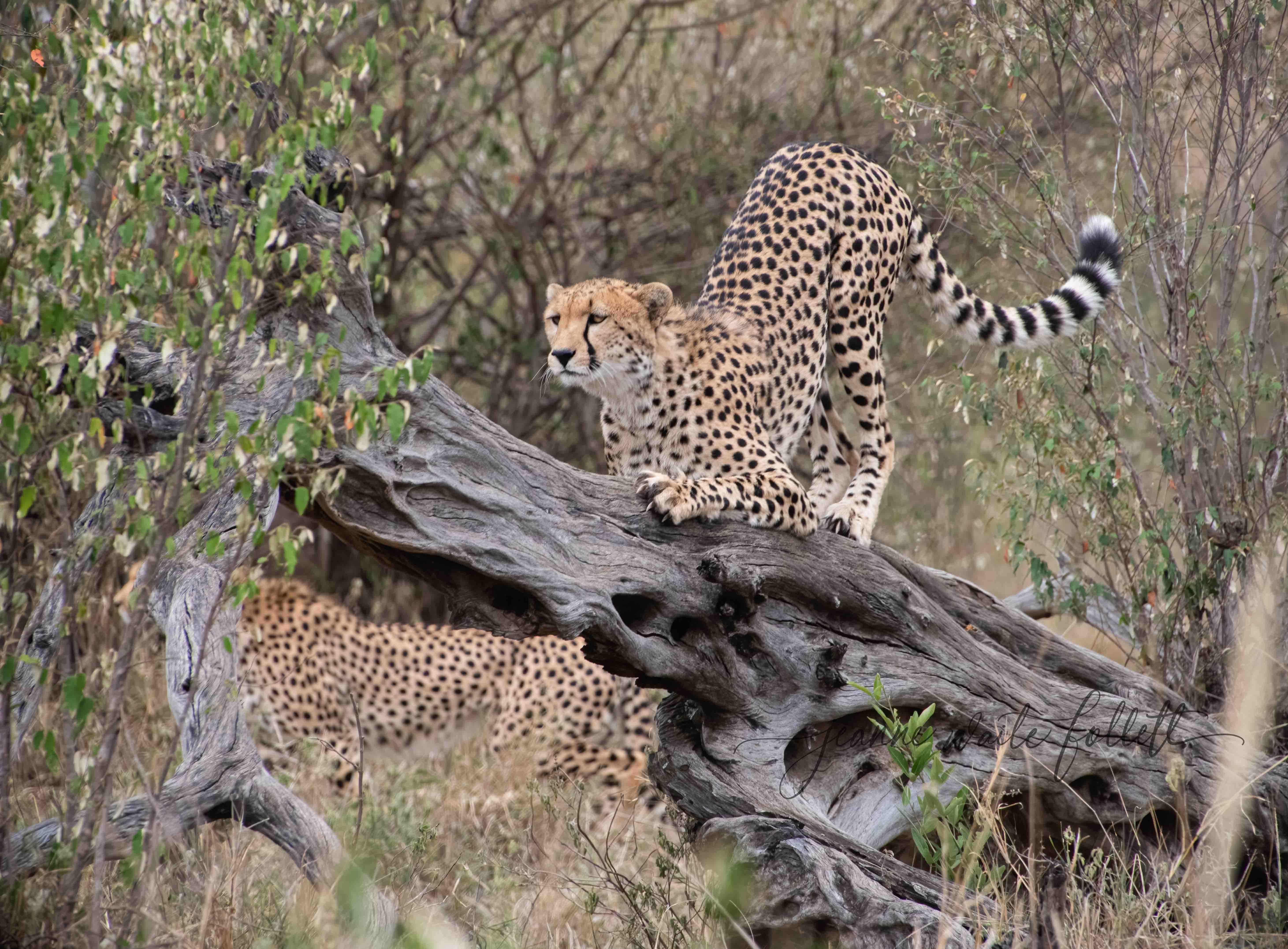
Fifteen minutes later, the guides find two female cheetahs roaming through the grasslands and brush.   They are sisters, out one their own though they still have mantles on the back of their necks.   A mantle is a long patch of hair that helps camouflage cheetah cubs.


Cheetahs have long bodies--four feet plus another two or three feet of tail.   They weigh from 75 to 120 lbs.


Their sprint speed has been measured at 71 mph, though they can exceed that when pursuing game.


When big cats are spoken of, cheetahs are generally included.   Some internet sites claim that they aren't true cats because they can't roar.


A video for you.   Our guide, Dominick, suggested the names Napi (Brave) and Nanyorri (Beloved).   The names were adopted.   This was a first sighting of these two out on their own.


It's a video!   Play it!


Some information from Britannica on what makes cheetahs are so special:


Cheetahs have evolved many adaptations that enhance their ability to sprint. Their legs are proportionally longer than those of other big cats; an elongated spine increases stride length at high speeds; they have unretractable claws, special paw pads for extra traction, and a long tail for balance. Internally, the liver, adrenal glands, lungs, bronchi, nasal passages, and heart are all large to allow intense physiological activity. During a chase, cheetahs take about 31/2 strides per second and 60 to 150 breaths per minute. 


Like most cats, cheetahs are very affectionate with each other and will often groom each other, as this one is doing to her sister.


Do you see the longish hair on the back of the neck and shoulder?   That is called a mantle and is a form of camouflage for young cubs.   Note the long tail.   That acts like a rudder and also stabilizes the cat at high speed.


We spend a lot of time with the cheetah sisters and leave when they seem to be ready for a nap.


We are heading in the direction of camp now and come across some elephants with very young calves.


This calf is so young you wonder how it can reach high enough to suckle.


Finally I recognize the scenery and realize we are close to "home."


But, before we get there, we see the third and last members of the Big Cats of Africa-- lioness with her two cubs.


All three of the Big Cats in one drive--leopard, cheetahs, and lions!    And we haven't even reached camp from the airstrip.. Phenomenal!


KUDOS to our guides!!!


Can't forget the jackal pup we see.


And then, we roll into camp.   Happy with the drive, happy with the camp and happy, happy with lunch that featured broiled chicken and salad, topped off my personal favorite--the Chocolate Amarula Mug.


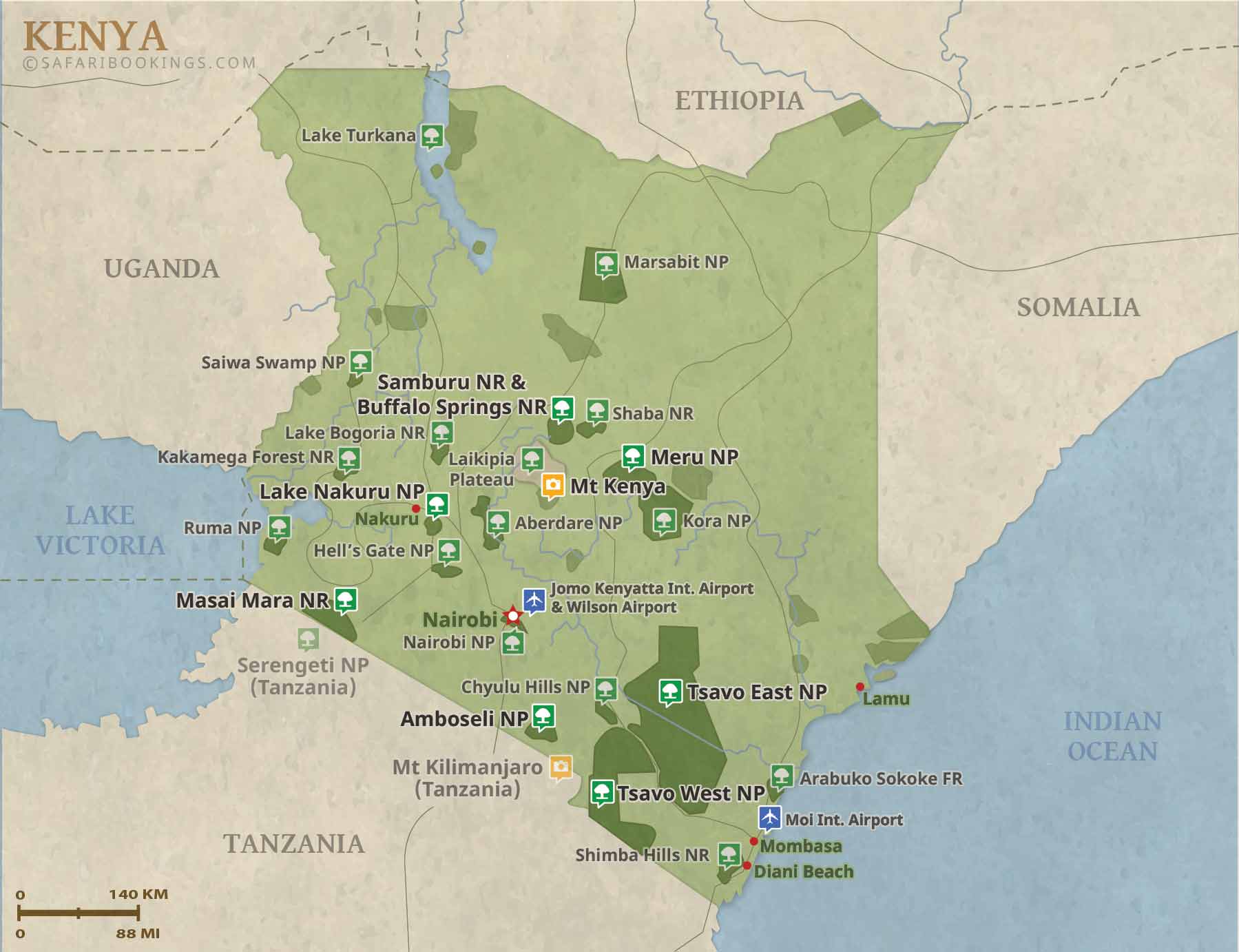
Detailed Map of Kenya National Parks
The Maasai Mara National Reserve, where we are now, is the tiny dark green spot at left, on the border with Tanzania.   It covers 580 square miles.   It is unfenced and conservancies along its upper borders increase the habitat for animals.


Map of Africa
This map shows Kenya on the east coast of the continent at the equator.