"I'm going to speak my mind because I have nothing to lose."--S.I. Hayakawa
_______________________________________________________
Showing posts with label Eva Peron. Show all posts

Monday, December 10, 2012

The Antarctic Journals, Chapter Seven


You Can't Escape Politics

Ernest Shackleton uses his considerable talents to raise funds for his third expedition to Antarctica.  Though largely financed by private donations, even the British government kicks in £10,000.

He receives more than 5,000 applications from people wanting to be part of this venture.  He is sometimes eccentric in his hiring methods, often hiring men because he likes the cut of their jib, so to speak.

He also continues with a trait that contributed much to his problems with Robert Falcon Scott on Shackleton’s first polar expedition, that of considering all the crew equal and expecting even the scientists to pull their weight in the ship’s chores.  It is a trait that endears Shackleton to his men and will pay dividends in the future.

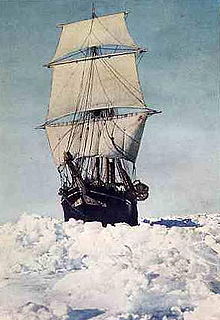
Finally, two crews are selected, one for each of the two ships employed.  Shackleton’s ship will proceed to the Weddell Sea south of South America.  The second ship, the Aurora, will go south from New Zealand and lay in inland chaches of supplies for the latter part for the 1800 mile trek across the mile continent.

In addition to scientists, Shackleton also acquires 70 sled dogs, a veterinarian, and a dog handler.  And a photographer named Frank Hurley becomes part of the crew.


Shackleton finds his ship in Norway.  It is a ship built for tourism and is called Polaris.

***


Long after I signed up and paid for this trip, I realized that I would be gone during the November election and that on election day, in particular, we would be far at sea.  Surely, I thought, news would somehow reach the ship and we would at least know the results of the presidential election.

I was ambivalent about this but finally decided that it would be for the best for me.  I would avoid those final days of campaign ads and I wouldn’t have to suffer the interminable election night vote counts. 

Freedom from politics after all the nastiness and dire predictions sounded pretty good by the time I left for Argentina.

Yes, escape from politics sounded good indeed.
 
It was not to be.


Day Three, there’s a bus tour around the city.  There are six buses to handle the lot of us, all pre-assigned.  While Kathy and I are on Bus Four, my friends Jim and Jan are on Bus Six.

Wall of the Recoleta Cemetery


Our local guide for the day is a young Argentine woman with excellent English skills who also was our guide on the trip from the airport into the city.  The hotel is in the Recoleta area of the city, so after a spin around that part of Buenos Aires, a trip to the Recoleta Cemetery is next.

Lonely planet has a great piece online about the cemetery:  For a much better read about the cemetery than I could give:


Thus, I’ll just show you photos.

Some of the mausoleums have fallen into disrepair.
Some are mini-palaces.
Our local guide, standing in front of the Duarte family mausoleum where Evita's remains are interred.


On the drive to the cemetery, our guide speaks about Eva Peron, the young woman who captivated the married Colonel Juan Peron, who eventually became the president of Argentina.  They married amid much gossip, especially from the upper classes who considered the actress a fallen woman.


She was born the illegitimate daughter of Juan Duarte, later a president of the country, who refused to allow her to use his name.

Her cause as Peron’s second wife became that of the workers and the poor, the so-called "shirtless," who idolized her and called her Evita.  She did many things to benefit them.  Most of what she did was at the expense of the upper classes, who had to pay for her causes.   


She would, according to anecdotal evidence, suggest to a baker that a thousand cakes should be given the poor at Christmas.  The baker understood the “suggestion” and Eva took credit.  A shoe store owner “voluntarily gave” a hundred pairs of shoes and again the Perons took credit.

She died of cancer at the age of 33 in 1952, and the lower classes’ obsession with her became even stronger.  Eva’s body eventually was entombed in the Duarte family crypt in the Recoleta Cemetery. 

As one of our program managers later said, Evita never said, "Don't cry for me, Argentina."  That's a song written for the movie.  Rather, she is quoted as saying, “My biggest fear in life is to be forgotten.” 

 Sixty years have passed since her death and she remains a visible icon in Argentina.  Monuments of various types abound in the city.  Every day, those in the city are reminded of Evita, for in the middle of the green strip on Ninth of July Avenue, the main drag so to speak, a steel image of Evita is welded to the sides of the Ministry of Health.


Visible from the north, where the upper classes live, the image is of Evita with a microphone.  Locals say she is  haranguing the wealthy and the government to do more for the workers.  On the south side of the building, she is smiling to the workers and the poor.


The Ministry of Health building in the distance.
The view of the Ministry of Health from the north side.  I was never able to get a photo of the south side.

She is still admired for her many works to benefit the poor, such as a beach resort for the working class, a home for unwed mothers, and an amusement park for children.  There are reminders of her everywhere in this city.

On the other side, she is reviled as a profligate and irresponsible spender out for her own glory.


The government building.  The balcony from which Evita gave her last speech is the small balcont to the left of center with the white shutters.  This is not the balcony shown in the movie.


Three different speakers on this trip make it abundantly clear that the subject of Evita and Peronism still cause a powerful rift in Argentina among the political and economic classes.  They criticize the continuing concept of Peronism, which draws its support from the working classes and unions, financed by the upper classes.  

Among many, many things, social justice is a prominent tenet in Peronism.  The lower classes become more and more dependent on government handouts, claim the anti-Peronists, thus destroying self-responsibility and self-initiative.  Further, they claim Peronism encourages class warfare.

Evita's balcony.


To me, it sounded a lot like politics at home.

Thursday, December 6, 2012

The Antarctic Journals, Chapter Five

Triumph, Tragedy, and Try Again


Ernest Shackleton, now Sir Shackleton, hopes to reap riches upon his return to England after the Nimrod Expedition, during which he and three of his team reach the farthest south point yet for man, a mere 112 (or perhaps 93—estimates differ)  miles from his goal.  Things don’t work out that way for Shackleton, whose successes lie on the ocean and not on land.

Now, while he tries various business ventures which all fail to some degree, he waits to hear the results of his rival Robert Falcon Scott’s latest expedition in quest of the South Pole.  Unknown to many until it is well underway, a Norwegian explorer named Roald Amundsen has pulled a fast one on his financial backers and on Scott as well.


Roald Amundsen

Amundsen raises funds for an expedition to the North Pole, during which he hope to drift across the northern pole in the ship Fram.   (Remember that name? Fram? This is the quiz I promised in Chapter One.)

While still in the fund-raising and planning stages, Amundsen gets word that American explorers Frederick Cook and Robert E. Peary each claim to have reached the North Pole.  Amundsen secretly changes his plans and sets his aim at the South Pole during the northern summer of 1910. 


He doesn’t tell his crew until they are out to sea.

He doesn’t tell Scott, either, and Scott, thinking the two were heading in opposite directions, sent instruments to Amundsen that would enable the two parties to make comparative readings at each pole.

Instead, Amundsen heads for Antarctica, to the Bay of Whales on he Ross Ice Shelf.  The Norwegians’ skill with skis and sledge dogs, as well as their fur clothing and specially designed equipment of all types, makes the difference.  They spend the rest of the austral summer laying depots of supplies inland, in advance of the push to the pole.  Then, they settle in to wait out the winter.


The Antarctic continent with the Ross Ice Shelf in red where the Bay of Whales was located until a 99 mile chunk of the ice shelf broke off in 1989.


Three weeks after Amundsen’s Fram anchored to the ice shelf, Scott also arrives.  He also sets up chaches of supplies inland, and then waits for spring.


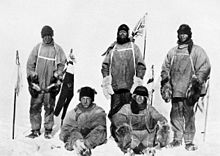
Scott's group, after reaching the South Pole and finding Amundsen's Norwegian flag planted there.


On Oct. 20, 1911, Amundesen makes his push, starting from his base camp which is 60 miles closer to the pole.  He replies mostly on sled dogs.

On Nov. 1, Scott’s party begins its trek, using ponies and dogs.

Amundsen, with meticulous and successful planning and execution, arrives at the South Pole on Dec. 14, 1911 after 55 days.  He returns to base camp in 41 days with no casualties.

Scott, after many mistakes in planning and execution, arrives at the pole on Jan. 17, 1913, and finds the Norwegian flag planted by Amundsen 34 days previously.  Scott is devastated, writing in his diary, “The worst has happened"; "All the day dreams must go"; "Great God!  This is an awful place". 

Scott and his party perish during the return trek to the base camp.

This map is inverse to those previous.  You are at the South Pole looking north.  Amundsen's party began at the Bay of Whales, his path marked in red.  Scott's group was on Ross Island, his path shown in green.


Back in England, word of Scott reaching the pole and then dying reaches England first.   Later comes news of Amundsen’s triumph.  Shackleton devises yet another plan to visit the pole, this time intending to transverse the entire continent from the Weddell Sea below South America to the Ross Sea south of Australia.

And thus begins one of the most famous adventure stories ever lived.  


***  

(While Shackleton gets his third act together in England, we’ll wait for him in Buenos Aires.   Maybe.)


Vantage Travel has organized everything.  The problem is that none of us new arrivals are aware of their organizational plans.  Therefore, when we exit the controlled immigration and customs area of the Buenos Aires airport, we are shuttled right into chaos.

Everywhere there are people holding signs with the names of the people they are awaiting.  I see at least four Vantage signs, each a different color and I don’t know what the colors mean.   I trudge from one Vantage sign to another, finally finding a spot where baggage handlers are gathering suitcases for Vantage clients.


This is 9 de Julio Avenida (Ninth of July Avenue), billed as the widest avenue in the world at 110 meters, or something like 330 feet.  That might not be correct anymore, but they still call it that.  It honors Argentina's independence from Spain.

Then I join the nearest Vantage guide and wait with others.   We are escorted outside onto a narrow sidewalk and walk towards a bus in the distance.  Then we turn around and walk back in the direction from which we came, pursuing the same bus.  The sidewalk is crowded and blocked by structural pillars in sequence that greatly interfere with passage.  However, I suppose the airport terminal would fall down were it not for those pillars.

The 9th of July Avenue
The front of the group (which used to be the back of the group when we were chasing the bus in the other direction) has trapped the bus and carry-ons are handed off to a crush of men surrounding the baggage bay of the bus.  

Soon, it’s my turn.  A hand reaches out for my wheeled bag at the same time his other hand reaches out for a tip.  I give him a couple dollars and as I board the bus a man behind me says to his wife, “I asked him how much and he said 'twenty.' ”
“You didn’t give it to him, did you?” she asks.

“No, I gave him five.”  I wonder if tips are the only income those handlers receive.  There were far too many of them to be employees of the bus line Vantage has chartered for our local transportation.

And then we’re off, into the city-wide traffic jam that is Buenos Aires.  We are headed for the Sheraton Buenos Aires Hotel and Convention Center in the Recoleta area, on the northern side of the city where the richer residents live.  

 This is a little hold over (actually a massive hold-over) from long ago when the wealthy lived on the south side and had summer homes (read ‘mansions’) on the north side.  When yellow fever struck, the rich moved into their summer homes up north and stayed.

This is not what makes the Recoleta famous though.  That is for its graveyard, which holds the remains of many Argentine rulers and military.

Oh, but let's not forget its most famous crypt--for tourists anyway--the mausoleum that holds the mortal remains of a woman called Evita.


Front of the Duarte family mausoleum.
Some tourist in front of Eva Peron's mausoleum.
Wall surrounding the Recoleta Cemetery

This is where I usually sit in all tour buses--in the back row.  This time, however, the rear row was raised, so I still couldn't see.

For a great read about the Recoleta cemetery: http://www.lonelyplanet.com/argentina/travel-tips-and-articles/75881