"I'm going to speak my mind because I have nothing to lose."--S.I. Hayakawa
_______________________________________________________
Showing posts with label Argentina. Show all posts

Thursday, December 13, 2012

The Antarctic Journals, Chapter Nine


Who Says Crime Doesn't Pay?


Two shipwrecked friends make their way to Buenos Aires in 1914.  They are looking for employment.

One, William Bakewell, is hired on as an able seaman by Ernest Shackleton.  The second, Perce Blackborow, is not, perhaps because he is only 18 years old.

Endurance is re-provisioned.  Frank Hurley, expedition photographer, also  boards the ship.

Then, Endurance sails down the sediment-filled waters of the Rio de la Plata (River of Silver), which mark the border between Argentina and Uruguay.  One hundred and eighty miles east southeast, the estuary is more than 140 miles wide at its mouth where it empties into the Atlantic Ocean. 

Looking east to the mouth of the Rio de la Plata.  Argentina is on the right (south) and Uruguay is on the left (north) side.  Buenos Aires is the gray area, lower right.

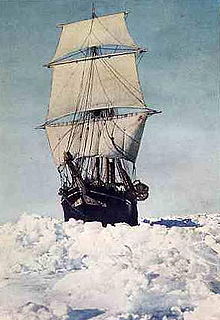
Endurance clears the mouth and Capt. Worsley sets a southeast course for South Georgia Island, and the Norwegian whaling station of Grytviken.
Frank Hurley photo
Three days after setting sail, a stowaway is discovered.  It is young Perce Blackborow. 

Shackleton, in an apparent fit of rage, roundly berates the stowaway in front of the crew.  The reactions of two crewmen, Bakewell and another, expose their complicity in helping the stowaway.  Much of the crew feels the ship is under-manned and are relieved to have Blackborow. 

Shackleton tells the young man, “Do you know that on these expeditions we often get very hungry, and if there is a stowaway available, he is the first to be eaten?”

“They’d get a lot more meat off you, sir,” Blackborrow replies.


Shackleton's route is to sail to South Georgia Island and then to the Weddell Sea (the red line).  A second ship, the Aurora, leaves New Zealand (pink line) to lay a line of supply caches inland on Antarctica.


***


The Penguin Caper

Don't worry.  This is not a recipe for penguin steaks with a succulent piccata sauce, garnished with capers.   Read on safely.

"This isn’t a cruise ship; it’s an expedition ship."   We are repeatedly reminded of that by the Three Gauchos.  Fine with me.  Too many people on a cruise ship for me.

So, what to do when we’re at sea, far from land, naps accomplished, and no lectures to lure us?

Crime comes to mind.

I suggest to Kathy that we kidnap the penguin, hide it, and write a ransom note.  She loves the idea and off we go to Deck Three and the Vantage hospitality desk.  The Magellanic penguin sits there in full view, along with the list of suggestions entered in the contest to name it.  Winning name wins the stuffed toy.

There’s a security camera hidden in a black plastic half-dome on the ceiling.


Scene of the crime--the Vantage hospitality desk on Deck Three.

I’ve brought a plastic shopping bag, so I amble over to the desk with my back to the camera, pretend I’m writing my name on a slip for the daily drawing, and stuff the stuffed penguin in the bag.

Leaving another note from the penguin-nappers.

We go back to the cabin and Kathy writes the ransom note.   She writes a masterpiece--if you're looking for a master's degree in creative writing.  I tell her she has to write like she's a crook, you know, misspellings and so on.   It's hard for her, but she finally gets it done.

Then she dons her Hurtigruten parka and goes back to the desk on Three, hood up in case they check the surveillance camera.  She will look like every other passenger on the ship in that blue parka.

 The next morning:


Soon, an envelope is left for the penguin-nappers, purportedly containing the demanded ransom.


We leave it.  No sense drawing suspicion.  The ransom envelope disappears.   Has someone stolen the ransom???


And the day after, our note is taped to the bulletin board with a hard-nosed response written underneath..  “We do not negotiate with terrorist!”  

Hmmph.


The winning name is selected:  Hurti-Gurti, a clever play on Hurtigruten, the company that owns and operates the MS Fram.   Sadly, the winner cannot be awarded the penguin.   I'd twirl my handlebar mustachio if I had one.


We hoped they would suspect these two, who are NOT Gully and Kathy.


We let a couple days pass in silence.  Then another note appears on the desk.


"Cabin 314" is a red herring, pardon the pun.  We have no idea who is in that cabin.


More silence and we surrender, leaving a big clue about the penguin’s hiding place in the main dining room.


More time passes before another passenger comes strolling out of the dining room with the purloined penguin.   Kathy and I happen to be sitting in the lounge outside the dining hall and I innocently ask her where she found it.


We are now in the clear.  This uncaring brigand has re-kidnapped the kidnapped penguin.

"Under the lavender and blue table where the menu is posted."  Each day, at least three times a day, every passenger and crew person passed by the missing penguin.

Every passenger passes this table at the front of the dining room every day.  The kidnapped penguin is stashed under it.

When asked, she says she’s going to hide it in her room, at least until it recovers from sea sickness.   I could have told a sea sick penguin is nothing to have in your room, what with it barfing up imaginary herring and Styrofoam all the time.  Besides they moult their feathers.

She eventually gives the penguin to its new owner.


The night before we disembark the ship forever, Kathy goes down to the Vantage desk and confesses.  All three Gauchos jump up in disbelief.  “We never suspected you!  The misspelled words!  We never knew!”


You never fooled us!  You looked suspicious from the start.

Kathy modestly places all the blame on me.  Well, what are friends for if they won’t spend the night in the brig with you?

Cohorts in crime.

One of the Gauchos orders her to wait right there.  In a couple minutes he returns with two smaller stuffed Magellanic penguins for us.


Who says crime doesn’t pay?


The Three Gauchos have preserved all the forensic evidence, though following her confession, Kathy carefully retrieves all of the notes.   Just in case, you understand.

Monday, December 10, 2012

The Antarctic Journals, Chapter Seven


You Can't Escape Politics

Ernest Shackleton uses his considerable talents to raise funds for his third expedition to Antarctica.  Though largely financed by private donations, even the British government kicks in £10,000.

He receives more than 5,000 applications from people wanting to be part of this venture.  He is sometimes eccentric in his hiring methods, often hiring men because he likes the cut of their jib, so to speak.

He also continues with a trait that contributed much to his problems with Robert Falcon Scott on Shackleton’s first polar expedition, that of considering all the crew equal and expecting even the scientists to pull their weight in the ship’s chores.  It is a trait that endears Shackleton to his men and will pay dividends in the future.

Finally, two crews are selected, one for each of the two ships employed.  Shackleton’s ship will proceed to the Weddell Sea south of South America.  The second ship, the Aurora, will go south from New Zealand and lay in inland chaches of supplies for the latter part for the 1800 mile trek across the mile continent.

In addition to scientists, Shackleton also acquires 70 sled dogs, a veterinarian, and a dog handler.  And a photographer named Frank Hurley becomes part of the crew.


Shackleton finds his ship in Norway.  It is a ship built for tourism and is called Polaris.


***


Long after I signed up and paid for this trip, I realized that I would be gone during the November election and that on election day, in particular, we would be far at sea.  Surely, I thought, news would somehow reach the ship and we would at least know the results of the presidential election.

I was ambivalent about this but finally decided that it would be for the best for me.  I would avoid those final days of campaign ads and I wouldn’t have to suffer the interminable election night vote counts. 

Freedom from politics after all the nastiness and dire predictions sounded pretty good by the time I left for Argentina.

Yes, escape from politics sounded good indeed.
 
It was not to be.


Day Three, there’s a bus tour around the city.  There are six buses to handle the lot of us, all pre-assigned.  While Kathy and I are on Bus Four, my friends Jim and Jan are on Bus Six.

Wall of the Recoleta Cemetery


Our local guide for the day is a young Argentine woman with excellent English skills who also was our guide on the trip from the airport into the city.  The hotel is in the Recoleta area of the city, so after a spin around that part of Buenos Aires, a trip to the Recoleta Cemetery is next.

Lonely planet has a great piece online about the cemetery:  For a much better read about the cemetery than I could give:


Thus, I’ll just show you photos.

Some of the mausoleums have fallen into disrepair.
Some are mini-palaces.
Our local guide, standing in front of the Duarte family mausoleum where Evita's remains are interred.


On the drive to the cemetery, our guide speaks about Eva Peron, the young woman who captivated the married Colonel Juan Peron, who eventually became the president of Argentina.  They married amid much gossip, especially from the upper classes who considered the actress a fallen woman.


She was born the illegitimate daughter of Juan Duarte, later a president of the country, who refused to allow her to use his name.

Her cause as Peron’s second wife became that of the workers and the poor, the so-called "shirtless," who idolized her and called her Evita.  She did many things to benefit them.  Most of what she did was at the expense of the upper classes, who had to pay for her causes.   


She would, according to anecdotal evidence, suggest to a baker that a thousand cakes should be given the poor at Christmas.  The baker understood the “suggestion” and Eva took credit.  A shoe store owner “voluntarily gave” a hundred pairs of shoes and again the Perons took credit.

She died of cancer at the age of 33 in 1952, and the lower classes’ obsession with her became even stronger.  Eva’s body eventually was entombed in the Duarte family crypt in the Recoleta Cemetery. 

As one of our program managers later said, Evita never said, "Don't cry for me, Argentina."  That's a song written for the movie.  Rather, she is quoted as saying, “My biggest fear in life is to be forgotten.” 

 Sixty years have passed since her death and she remains a visible icon in Argentina.  Monuments of various types abound in the city.  Every day, those in the city are reminded of Evita, for in the middle of the green strip on Ninth of July Avenue, the main drag so to speak, a steel image of Evita is welded to the sides of the Ministry of Health.


Visible from the north, where the upper classes live, the image is of Evita with a microphone.  Locals say she is  haranguing the wealthy and the government to do more for the workers.  On the south side of the building, she is smiling to the workers and the poor.


The Ministry of Health building in the distance.
The view of the Ministry of Health from the north side.  I was never able to get a photo of the south side.

She is still admired for her many works to benefit the poor, such as a beach resort for the working class, a home for unwed mothers, and an amusement park for children.  There are reminders of her everywhere in this city.

On the other side, she is reviled as a profligate and irresponsible spender out for her own glory.


The government building.  The balcony from which Evita gave her last speech is the small balcont to the left of center with the white shutters.  This is not the balcony shown in the movie.


Three different speakers on this trip make it abundantly clear that the subject of Evita and Peronism still cause a powerful rift in Argentina among the political and economic classes.  They criticize the continuing concept of Peronism, which draws its support from the working classes and unions, financed by the upper classes.  

Among many, many things, social justice is a prominent tenet in Peronism.  The lower classes become more and more dependent on government handouts, claim the anti-Peronists, thus destroying self-responsibility and self-initiative.  Further, they claim Peronism encourages class warfare.

Evita's balcony.


To me, it sounded a lot like politics at home.