"I'm going to speak my mind because I have nothing to lose."--S.I. Hayakawa
_______________________________________________________

Tuesday, December 4, 2012

The Antarctic Journals, Chapter Four

Leaving Your Mark, or Not


 To say that Shackleton’s second expedition to Antarctica sailed from New Zealand in 1908 would be both correct and incorrect.  Shackleton is the leader for this expedition and he chooses to have his ship, the Nimrod, towed 1650 miles by a steamer ship in order to save coal.

Before leaving England, Shackleton promises Robert Scott that he will not use the McMurdo base camp set up by Scott on their previous expedition. 

 This promise will be broken, of necessity.
Therefore, Shackleton heads for the eastern sector of the Great Ice Barrier (now called the Ross Ice Shelf), but finds ice conditions completely unsuitable and unsafe for landing or establishing a base.  He sails for McMurdo Sound and establishes a base hut about 24 miles from Scott’s former base.  Stores are off-loaded and the Nimrod sails back to New Zealand.
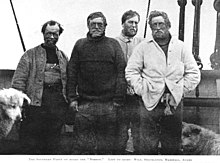
Frank Wild, left, Shackleton, Marshall and Adams
Shackleton and his men wait out the Antarctic winter in a pre-fabricated hut and in January 1908, a four-man party consisting of Shackleton, Petty Officers Frank Wild, surgeon Eric Marshall, and Jameson Adams reach a point only 112 miles (97 nautical miles) from the South Pole.  They also establish the approximate location of the magnetic pole.  For this journey, Shackleton uses Mongolian ponies to carry their supplies.  The cold and conditions are far too difficult for the equines and many die during the long Antarctic winter from eating volcanic sand for its salt content, and more perish on the trek inland.

The trip is arduous and food is rationed as the men trudge southward.  One of the ponies falls into a cravasse, taking with it some of the food supplies. Though they travel farther south than any other expedition and are so close, Shackleton decides to return to the ship, knowing that further travel would most likely cause the death of his teammates and himself.  

Marshall, Adams, Shackleton at their farthest point south.  There is some discrepancy as to the identity of the men in this photo, with some sources claiming Shackleton took the photo and that Adams, Wild, and Marshall are in the picture.

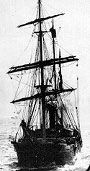
Nimrod

The return trip is plagued with starvation and half rations.  Frank Wild writes in his diary that Shackleton gave him (Wild) his allotted biscuit for the day and adds, “All the money that was ever minted would not have bought that biscuit and the remembrance of that sacrifice will never leave me.”

It is but one measure of Shackleton’s character.

 On arriving back at the base camp, the men find the Nimrod had sailed two days previous.  In desperation, they burn the camp.   It works and the Nimrod returns for the men.

Back in England, Shackleton is knighted and receives many awards but only a grant from the government saves him from defaulting on his loans.


The red line shows the route of  Shackleton's Nimrod Expedition trek to within a hundred miles of the South Pole.  Ignore the green line, because Shackleton did not fly from South America to Antarctica.  This was the only map I could find that showed the route of the Nimrod Expedition.  The red line denotes the air route used by a  group that recently duplicated Shackleton's expedition.


***


Surprisingly, we land in Buenos Aires just about on time.  I say surprisingly because there was some kind of delay in Dallas, one of those things the ticket agents won’t disclose the reason for, but leave your imagination to run wild instead.  

We get off the plane and walk down a long hallway, ride down as escalator, pile up at the bottom, and fall down in a heap. 

Really.  Well, some did.  The escalator continues to deliver more bodies to the heap.

Gold glass-fronted building across from the hotel in Buenos Aires.
Some of us see the heap in time to avoid the escalator.  Turns out, about fifty feet beyond the bottom of the escalator is where we line up in double lines to pay our bribe to get into Argentina. 

They call it “reciprocity,” kind of a turn-about-is-fair-play.  Seems the U.S., Canada, and Australia charge Argentinians a visa fee, so even though Argentina doesn’t require a visa for US citizens, they charge us the fee anyway. 

As I said, a bribe to get into the country.  However, when a 777 full of foreigners de-planes, it requires more than fifty feet to accommodate all those passengers at passport control.  When a herd of sheep is blindly following the sheep in front, it can be difficult to see what happens at the bottom of the escalator, hence the heap.  


Close-up of the reflections in that glass (see above photo).

Someone had the wherewithal to hit the stop control on the escalator, which allowed the poor lady at the bottom to get her feet under her and stand up.  The rest of us take the stairs, not wanting to be part of another heap.


This photo is actually of Kathy trying to get back into the US without fingerprints.
My friend Kathy finally reaches passport control, where an agent inspects her passport, takes her photo, and a digital fingerprint of her right thumb.  It won’t take, so they give her an alcohol swab to clean her thumb.  Still nothing.  They try the left thumb and it, too, won’t print.

Eventually they try a number of fingers, again without success.  A supervisor is called and after a discussion, Kathy is allowed into Argentina without leaving her prints behind.

She thinks the reason for the failure is that she has psoriasis on her hands.  Though she treats it daily, the skin condition has all but eliminated her fingerprints.

And then we encounter the chaos of the terminal where guides holding Vantage signs hope to corral us.
 

Sunday, December 2, 2012

The Antarctic Journals, Chapter Three

Alfajores and Things Argentine


Ernest Shackleton is Anglo-Irish, born in Ireland in 1874, and destined for a life at sea.  At the age of 16, he apprentices “before the mast” on a square rigged sailing ship, and learns his trade on the job. 

By 1896, he is qualified to command a British ship anywhere in the world,  certified as a Master Mariner.  For several years, he regularly sails between England and Cape Town delivering mail and passengers.

Ernest Shackleton
Through the machinations of acquaintance and friendship, the usual “it’s who you know” thing, Shackleton hires on as third officer for an expedition to the South Pole.  Under the auspices of the Royal Geographic Society and commanded by Robert Falcon Scott, the Discovery Expedition sails from London in July of 1901.  The ship arrives along the Antarctic coast in January of 1902, after calling at Cape Town and New Zealand.

Scott chooses Shackleton and another man to accompany him on an exploratory route towards the pole.  Though they reach farther south than any other attempt to date, 82° 17’, the trip seems doomed.  Food for the sled dogs that hauled the supplies is tainted and all 22 dogs die. 

On the return trip, the three men are afflicted with snow blindness, frostbite, and--the bane of sailing men everywhere--scurvy.  

Discovery

Amid rumors of contention between Shackleton and Scott, Scott insists that Shackleton leave for health reasons on a relief ship that arrived in McMurdo Sound, January 1904.  He arrives in New Zealand and stays for a while to recuperate.  He is very disappointed with himself, considering his health problems a personal failing.


***


On the back of the seat in front of me is small television screen.  It features my favorite thing about flying internationally:  the flight path and progress information.  A small airplane icon shows where we are on the flight path, and other information lists air speed, time elapsed, time to destination, and altitude.  It also gives the exterior temperature, which hovers around 50 below Fahrenheit when at altitude.

We are served dinner and most of us settle in to sleep.  Seated beside me is an Argentine man in his late 20s.  For many hours, I don’t think he speaks English, so I remain quiet.  We awake, are served breakfast, and when my seatmate rises for a trip to the restroom, I do so, too.

He is waiting in the aisle when I return.  I say “thanks” and slide into my seat.   “Oh, you’re welcome,” he responds in perfect English.  That opens the floodgates.

Before we land in Buenos Aires, I know that his name is German, his father lives in Spain, his mother in San Diego, and that he is returning home to Buenos Aires after visiting her.  He works in technology.

I learn that beef is the iconic food of Argentina.  I tell him one of my childhood memories is of oddly-shaped cans of corned beef from Argentina, cans that needed a “key” to unwrap the metal seal.*

Canned corned beef, and yes, it's tapered.

He says to be sure to buy Argentine chocolate, not the cheap fakes.

“Try empanadas and milanesas (breaded pan-fried meat),” he says and then tops it all off with a cookie concoction called alfajor.  He even specifies Havanna as the best brand.

Alfajores
 Later in this trip, I encounter two versions of alfajor on the ship.  The first, prepared by the ship’s kitchen, consists of two white cookies filled with caramel filling, then dusted with powdered sugar.  It was tasty.

 The second I find at the Vantage Travel desk (where all things Vantage are dealt with).  The guides have a large, institutional-sized box of the cookies.  Again, two cookies with a sweet filling, but these are coated with a white icing.  I am not impressed.

Near the end of the trip, on LAN Airways flight from Ushuaia to Buenos Aires, we are given a snack pack by the cabin crew.  Among the goodies inside the box is a foil-wrapped Havanna Alfajor.  I eat mine.  It is very, very good and very, very sweet.

Somehow I find myself in possession of two more Havanna Alfajores.  Because they are so sweet, I stuff them in my carry-on bags for later.  I still have them, although by now they are a conglomeration of ingredients mashed into a sweet paste, and the packages look as if it they have been run over by a penguin stampede.  Otherwise, I’d open them and show you what they look like.

Mashed Alfajores packages

The plane lands, taxis to the terminal and the seat belt sign is turned off.  I now have German’s full name, cell phone number, instructions on how to dial his phone number from outside the country, and his e-mail address.  Also, his offer to escort me around town, should I want a guide.  "Anything you need," he says, "you call me."

Before we part, German asks me what is the iconic food of Alaska.  He wants to know how much  two pounds of salmon cost.  I pause, and then say, “I don’t know.  I don’t buy it.  I go out and catch it.”

He is still chuckling and muttering “go out and catch it”  as we struggle down the aisle to disembark in Buenos Aires.

This one's for you, German.   Yes, I caught all those.


*For a fun read about canned corned beef, go here:  http://www.guardian.co.uk/notesandqueries/query/0,5753,-2642,00.html 

Friday, November 30, 2012

The Antarctic Journals, Chapter Two

Manning the Ship


Late winter, 1914.

 An unemployed sailor wanders the docks of Plymouth, England.  He talks to fellow mariners, shopkeeps, and visits the pubs, all in search of employment.  Finally, a barkeep tells him of a ship captain looking for crew.

The barkeep reaches behind the pint glasses on the back bar.  He pulls out a sheet of wrinkled paper and hands it to the sailor who smooths the printed page and scans it.  At the bottom of the page in bold letters, he finds it:

Wanted:

Men wanted for hazardous journey.  Small wages, bitter cold, long months of complete darkness, constant danger, safe return doubtful.  Honour and recognition in event of success.”

__ernest ShAckleton


“Shackleton, aye.  Heerd o’ ‘im.  Where’s ‘e off to now?”

“South Pole, don’t ya know?  Where all them fellas go nowadays.”

“Crikey!  South Pole.  But there’s been fellas there already.  Scott and that Norwegian fella, the one that bamboozled Scott.”

“Aye.  Amundsen.  Wily bastard, he were.  But now this Shackleton, he’s gonna go anyway and walk across it.”

“Walk across the South Pole?”

“Nae, nae, nae.  Not jest the South Pole.  The whole bloody Antarctic!”


(Now, wouldn't it be grand if that advertisement actually had appeared?  Alas, it seems to be part of the legend surrounding Shackleton, because no evidence of such a publication has ever come to light.  Nonetheless, we are dealing in legends and so it remains in this imaginative tale.)

 ***


I wasn’t looking for a job.  I was just cleaning out my spam e-mail account when the words “Shackleton’s Antarctica:  An exclusively charted voyage” caught my eye just before my finger clicked “delete.”

I am a Shackleton junkie, totally in thrall with the legend that surrounds this man of the sea, so I read on.  It was from Vantage Travel, a tour company I knew from a previous voyage through the waterways of Russia from Moscow to St. Petersburg.  

Long story short, I signed up.  As did my frequent travel companion Kathy, who now lives in Palm Springs, California.   She has wanted to go to Antarctica since childhood, and as this itinerary included South Georgia Island, she was in.

That's my friend Kathy, looking at you.

I thought I had everything ready for my trip, but my last week at home was a disaster of one thing after another breaking and confounding me.  It seemed my careful planning was hexed.  A pump went bad on my heating system, the battery in my truck went kaput, my loaded Kindle broke, and my alarm clock wouldn't ring.   

A lot of dollars and frazzled nerves later, I thought I was ready to leave.  I'd have a couple  peaceful days to relax and try to keep Pablo Parrot fooled before I took him to the parrot-sitter's.

My plan was to drive into Anchorage Sunday afternoon, spend the night at a friend's, who would then drop me off at the airport Monday morning.  Before that could happen, though, I spent a frantic Friday afternoon during which I tried to reach my primary care physician for a last minute prescription for that seasick patch and a quick 72 mile drive into Seward to pick up said prescription.  I thought it was an over-the-counter drug I could buy when I got to Anchorage.  It isn't.

I almost fainted when the price of the patches was more than $200.  Surprisingly, my prescription insurance picked up all but an $80 co-pay.   Finally, armed with medication and a handful of receipts for all the last-minute problems, I departed Anchorage and spent the night in Los Angeles.

I met Kathy at the LA airport late  the next morning, and a few hours later, we were sitting in the Dallas-Ft. Worth terminal as the sun went down.   


Sunset, Dallas-Ft. Worth airport.


Then we boarded an American Airlines Boeing 777, and settled in for an over-night flight to Buenos Aires, Argentina.  We were off to follow in the footsteps of Shackleton, or in his wake, to be more precise, because much of this journey would be by sea.


(The photograph of the Endurance reproduced above is one of expedition photographer Frank Hurley's incredible photographs from the Shackleton expedition.)