"I'm going to speak my mind because I have nothing to lose."--S.I. Hayakawa
_______________________________________________________

Saturday, January 19, 2013

The Antarctic Journals, Chapter Thirty, Going Home


The Quest arrives at the whaling station of Grytviken on South Georgia Island on Jan. 4, 1922, six years after all the men of the Endurance were rescued.  Ernest Shackleton is greeted warmly by his friend the station manager and they spend the day revisiting favorite sites around the station.

That evening, Shackleton dines aboard the Quest and goes to bed.  At two in the morning, Shackleton summons his friend Alexander Macklin, a surgeon, to his cabin.  Macklin is concerned about The Boss’s health and notices the cold in the cabin.  He leaves and returns with a heavy blanket which he tucks around Shackleton.

Macklin remains and talks with Shackleton, carefully suggesting that perhaps he should take it easy for a while.

“You are always wanting me to give up something,” replies Shackleton  “What do you want me to give up now?”  Suddenly a massive heart attack hits and he dies shortly before 3 a.m.

He is 47 years old.


Sir Ernest Shackleton


***


 O>
(   )
= =
Ten days previously in this voyage.


The Fram moves slowly into East Cumberland Bay on the eastern coast of South Georgia Island and drops anchor in the pristine water.  Sunlight glints off the frothy wake of a Polarcirkle boat as it takes me to land on a beautiful and peaceful day in this remote place.


I step out of the boat onto a small rocky beach and watch the seals and penguins nearby.   


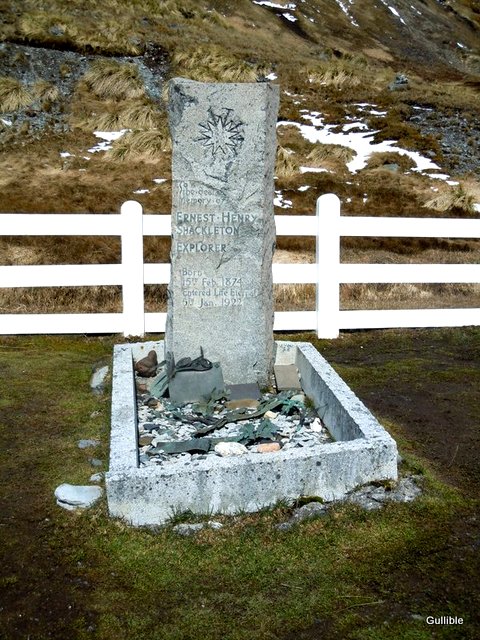
Then I walk up a gentle rise of low grass punctuated with mounds of tussock grass and pass through an opening in an immaculate white fence.  I carefully watch where I’m stepping as I proceed to the far side of this small enclosure and stop at a stone monolith several feet high.

Before me is the final resting place of Ernest Shackleton, explorer, author, and leader extraordinaire of men.  Though most of the graves here are oriented east, Shackleton's is oriented south towards Antarctica.  The remains of Frank Wild, his devoted right hand man in life, are buried at Shackleton’s right.


The Scottish granite marker, topped with the mariner's star.


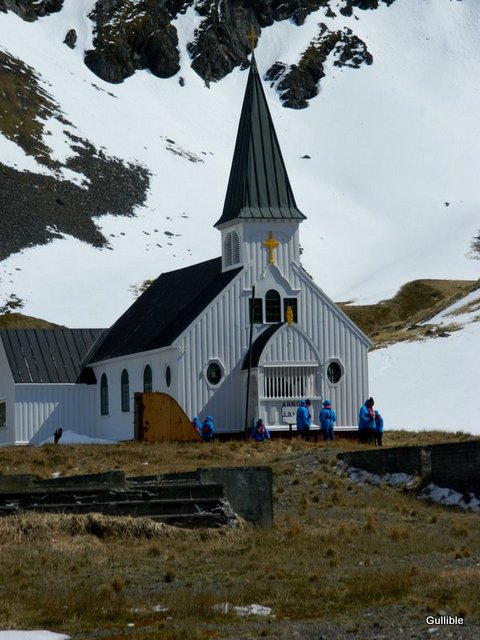
Whaler's church at Grytviken


It is customary for visitors to this remote and stunningly beautiful place to pause here and pay their respects to the man who was arguably the last man of the heroic age of explorers.  It is also customary to dribble a shot of Scotch whisky over Shackleton’s grave, which was his favorite drink.


A few years ago, five cases of Scotch were discovered buried under the hut Shackleton built in Antarctica for his Nimrod expedition.  After great effort by the distiller, the whisky’s flavor  was duplicated and a bottle sold for £100, or about $160 a bottle.  Even the glass maker took pains to make the bottle look as if had been made a century ago.


The whaler's cemetery can be seen to the upper right of the small white building with the red roof.

I turn around and look at Shackleton’s final resting place. Tall mountains, slowly losing their snowy duvets, sparkle in the sunshine of early austral summer.   


Before me, a freshly- painted black and white expedition ship bobs at anchor as little orange boats deliver visitors to the beach.


To my left are the carefully preserved remains of the Grytviken whaling station, a monument to a bygone era.  The seals and whales and penguins that once were slaughtered here for their oil are now protected.  Inside a small museum building is a replica of the James Caird.  


Rising above the vats and conveyors and rusting ruins of whaling boats is the steeple of a white church where a service was held for Shackleton.  After Wild’s grave was located a few years ago, and his remains transported to South Georgia, another service was held in the church for him.


Elephant and fur seals haul out on the beaches and slumber unmolested.   Three King penguins waddle down from a snow patch to peer at the newcomers in blue parkas.


This is a peaceful and lovely place.  It's a fine place for eternal rest.


Friday, January 18, 2013

The Antarctic Journals, Chapter Twenty-nine, Changes


Ernest Shackleton, after seeing his 27-man crew rescued without loss of life, is greeted in Puenta Arenas, Chile,  with crowds cheering loudly for he and his men.   He remains in South America for a few months, trying to raise funds to pay his large debts.  He also arranges for relief of the Ross Sea group that was to lay supply caches inland for Shackleton’s trans-Antarctic trek.  The men were stranded after their ship broke loose from its mooring on the pack ice.
 
He lectures, writes two books, and collaborates with Frank Hurley on a lantern slide presentation, all the while repeatedly offering his services to his country in the war effort.  While he performs a few small commissions, none of them come with wearing the uniform of Britain’s military forces.  One book, “South," is critically acclaimed and sells well, but Shackleton receives no royalties from it as they are taken by one of Shackleton’s benefactors for past debts.

He drifts from one enterprise to another, until 1921 when he is again overcome with the siren song of Antarctica.  Several of his former crew join him and the Quest sails from London in September of 1921, bound for Antarctica and some ill-defined purpose


***


If I thought I was charmed by Port Stanley in the Falklands Islands, this city of Ushuaia (oo-SHWY-ah) utterly captivated me.

I am surprised that we do not have to go through passport control when we dock in Ushuaia.  One of our program managers explains that as far as Argentina is concerned, we had never left Argentina, all due to the country's continuing claim that the Falklands and South Georgia actually belong to Argentina.  Early last year, two major cruise ships sailing under the British flag were refused tie-up at the dock in Ushuaia.  On the other side, it was only last year that people traveling with Argentine passports were allowed to travel to the Falklands and South Georgia.


Be sure to read the last paragraph.


The bustling city is a port of call for many of the world’s cruise operators.  It’s the gateway for tours to the Antarctic Peninsula, as well as the Falklands/Malvinas, and South Georgia. 

Our program managers ask us to respect the feelings of the locals and NOT wear any hats or tee shirts with the word “Falklands" on them.


Note the large, very visible sign "Capital de las Malvinas." 


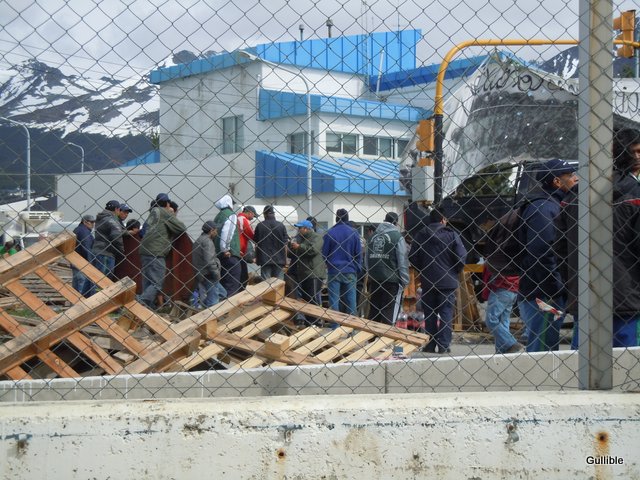
The strikers blockading the pier to any motor vehicles.


On the back of a jacket.
As far as the Argentine transportation strike went, it works out fine for me because I got to spend a full day exploring this city at the "end of the world," as it likes to be billed.  There is a wee problem with that, because an upstart town in Chile, Puerto Williams, on Isla Navarino across the Beagle Channel and farther east from Ushuaia (00-SHWY-ah),  claims it is the southern-most city.


Kathy with part of the town behind her.


That leaves population and which country advertises the most to settle the claim.   Puerto Williams has a population of around 3000, while Ushuaia’s is near 60,000. 

But, Argentina and Chile are always having dustups about one thing or another.  After refusing to accept binding international arbitration over the ownership of three islands located at the strategic eastern end of the Beagle Channel, the whole mess was dumped in the lap of Pope in the Vatican, who decided the islands rightfully belonged to Chile.  (I am not making this stuff up.)

Why was this so important?  The Drake Passage, Beagle Channel, and the Strait of Magellan are the only three ways of maritime passage between the Atlantic and Pacific Oceans in the southern hemisphere.   Drake Passage and Cape Horn are wicked, but the Beagle Channel and Strait of Magellan also have their demons, like katabatic winds and narrow passages.


The main drag,

Back to the strike.  We have to tour Ushuaia on foot, though.  Men and stacks of wooden pallets block vehicle access to the pier and the waiting ships.  Foot passengers are allowed free passage, and I observe many Chinese tourists hauling their own baggage to a ship next to us.


Took me a while to translate the English on this gift shop sign.


The Three Gauchos help those who want to visit the southern-most national park in the world. With bus drivers affected by the strike and not working, the only transportation is by taxi.   I pause to listen as we walk by a line of waiting taxis.  The cost was $120.00 to get to the park (just a few miles away) and $40 an hour after that.  I have no idea why taxi drivers are exempt from the strike.  Perhaps they weren’t union members.

Kathy and I opt for the town and the prison museum.  And lunch off the ship.  I think we hit every gift shop in town, and then have lunch at an Irish Pub.


The Irish pub where we had lunch.  It seems to be a favorite of the cruise ships crews, too.


Pepperoni pizza with unpitted green olives.


Kathy's hamburger.


After that, a visit to the prison museum.

 
The first explorers, followed by missionaries, to reach this place were British.  Though Tierra del Fuego was known to Europeans in the sixteenth century, it was not until Robert FitzRoy, captain of the HMS Beagle, explored the waterway that became the Beagle Channel in 1833, and made the first significant contact with the indigenous peoples.  

The Europeans were astonished to find the Yaghans (also known as Yámana) survived with no clothing, and anecdotal evidence suggests they became ill when wearing clothing.  This is a sub-polar maritime climate, not tropical.   Temperatures average between the mid-twenties and mid-fifties.  Snow and rain are common, as is wind.  Some sources suggest the Yaghans had developed a body temperature a degree higher.  While the Europeans shivered under blankets, the Yaghans slept naked on bare ground with no coverings.


I started out with a jacket, but soon stuffed it in my purple bag.  Temps in the high 40s or low 50s and very windy.  I was comfortable.  Yes, those are tee shirts in that bag.


In 1896 a penal colony was established at Ushuaia, Argentina’s version of Devil’s Island.  Re-offenders, dangerous criminals, and political prisoners were held there.

Forced labor by the inmates built much of the town’s streets, squares, and bridges, as well as a railway which now is a popular tourist attraction known as End of the World Train.  The prison was closed in 1946 by Argentine President Juan Peron, after many reports of abuse and unsafe practices.


Today, the prison is a museum, occupying a prominent place on the edge of downtown Ushuaia.


One row of prison cells.


Portrayals of political prisoner at left, convict at right.


Prisoners in leg irons.


On the second floor of this wing, we found the polar explorers exhibits.

There was, of course, Shackleton.


A replica of the Endurance with the James Caird at left.


The James Caird.


 And, wouldn't you know, I ran into my old friend Capt. James Cook.


Capt. Cook's vessel,  HMS Resolution


If my long-ago high school Spanish serves me correctly, I think this plaque commemorates Cook's circumnavigation of the Antarctic Continent.


And then a stroll through town, back to the ship.


Almost every shop in town displayed one of these things for smart phones--can't remember what they're called.


Restaurant display.  They call them king crab here.  In Alaska, we call these snow crab.  They're smaller than our king crab.


Tomorrow, the first of my five flights in a row to get back to Alaska.  But, first, we will return one more time to Grytviken on South Georgia Island, in this blog, if not in actuality.  We have a ceremony to attend there.

(NOTE:  For excellent reads about Ushuaia and Tierra del Fuego:

Rounding the Horn by Dallas Murphy who sailed in these areas and wrote a delightful book.
Uttermost Part of the World by E. Lucas Bridges, born in Ushuaia in 1874 to missionary parents.)