"I'm going to speak my mind because I have nothing to lose."--S.I. Hayakawa
_______________________________________________________

Thursday, January 18, 2024

The 2023 Brazil Journals, Chapter Twenty-Seven

Chapter Twenty-Seven

The rest of the Next-to-Last Day on the Cuiaba River


They do not see the battles she’s fought, the scars she bears, 

the darkness she holds back, or the warrior within.

Unknown


We are a quiet bunch today, deeply affected by the brutal infanticide of Medrosa’s cub.   We have spent so much time with Marcela, Medrosa’s two-year-old daughter, that we feel part of the family.


We are photographers, yes, but first and foremost we are animal lovers.  Sometimes I put down my camera and just live in the moment with animals and birds, admiring their beauty and strength, fascinated with their behavior.


Though there are an estimated 173,000 jaguars living in the world, they are considered “near threatened” by conservation entities.  


We do see jaguars today, though not as many as usual.


The first, in the morning, we watched climb the river bank and plop down to a siesta.


Later in the day, we come upon another,  though for the life of me I can’t spot it where's it's secluded until Shelly points out a specific rock.


The jaguar is hidden just above the vegetation right in the center.    


Finally, the sub-adult crawls out of the thicket of air roots where it is hidden and climbs up the bank.


And disappears into the jungle.


Houseboats along the river with accommodations for tourists.


Abandoned house.   Octavio said his father knew the former occupants and used to bring him two go fishing and to stay there when he was a child.


Our cottage


Hydration station where we fill our water bottles numerous times a day.


Jabiru stork nestlings


The nest


Kingfisher


Rough-winged swallow.


Black vulture.


Sunday, January 14, 2024

The 2023 Brazil Journals, Chapter Twenty-six

Chapter Twenty-six

Bad Day at Black Rock


The pall of death hovered everywhere,

then slipped into our very souls.

--New York Times


The cockroach is dead.


At least, I think it is.   It no longer has appendages to wave about to indicate otherwise and it looks somewhat shriveled.   The ants are still around it and somehow the cockroach is located about a foot from where it was last night.   Did the ants carry it?


Lingering in the back of my mind is how the roach fell prey to the ants in the first place.   Bug spray?   Will the ants die if they consume the roach?   Will birds die if they consume the ants?   Will rodents and other birds die if they consume the birds?   The possible effects are endless.


I try to put all this out of my mind and think about all the adventures we will have on the river today,


As it turned out, maybe the cockroach was foreshadowing the events of today.


***


We’re off like a rocket on the river today and my hat is now firmly tethered to a belt loop on my safari pants.  


I used a very flexible camera strap to tether my Tilly hat to a belt loop only safari pants.


No one tells us what’s going on.   If they had, I might have asked to vary the agenda.


We make our way through the floating water hyacinth to a scrum of boats shoving as far into the vegetation as they can toward shore.   Before us is a large tree and everyone is staring at it.


I ask what is happening and I’m told that a male jaguar  killed  Medrosa’s young male cub, the very one we were photographing a couple days ago.   I ask Shelly if she can see it and she says she can see the blood.


The male is lingering in the vicinity and I catch a glimpse of his back in the tall grass.


I sit down.   I take no photos and I don’t try to see the blood.


Medrosa's cub Aimee, killed by a male jaguar.


Like lions, leopards, bears and other animals, males will kill the young of females.   The female will then stop lactating and be receptive to mating with the male.


It’s nature.   At its worst, in my opinion.


Suddenly, we leave in a hurry.  “Bees!” says Octavio.   Fine by me.  


We didn't know this until later, but we witnessed history today.   It has always been suspected that male jaguars, like other wild cats and bears, will kill the cubs of  females, but until today it has never been DOCUMENTED.    The film crew is there to record it.


The cub disaster took place in a lagoon and that offers me a chance to photograph some birds.


The morning light was perfect for photography, lending a warmth to colors.

This anhinga is facing away from the sun, it wings spread to allow the sunlight to dry the wings feathers.


Anhingas, along with cormorants, are considered prehistoric birds in that they do not produce oil to spread on their feathers like other water fowl.   They are large birds of 35 inches in length with a wingspan of 37.5 inches.


Also called snakebirds, darters, American darters, or turkey birds, anhingas swim almost totally submerged but for their long neck and head, hence the "snakebird" name.    Another unusual element of the anhinga is their lack of nostrils.   Breathing is done entirely through the epiglottis, a flap in the throat that allows air in and closes to keep water and food out.


Anhinga drying its wings.    


Anhinga


Anhinga


The beautiful striated heron, a smaller type of heron.   Less than 20 inches long with a wingspan of two feet, these herons are common across the globe in warmer climates and are rated as "least concern" by the IUCN (International Union for Conservation of Nature).


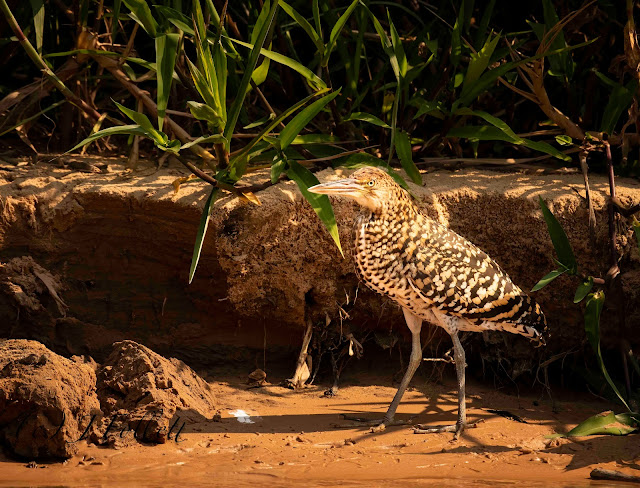
A tiger heron juvenile.


When it's all grown up, the chick will look like the adult below, which measures about 30 inches in length.


Which brings up an interesting question:   how do "they" derive a bird's length.   It's done by laying a dead bird on its back and measuring from the tip of its bill to the tip of its tail.


A female ringed kingfisher.   She was perched and sunning herself when we first saw her.   Here, as the boat approaches, she begins to prepare to fly away.


We move out of the lagoon and into another by-way of the river where we find several caimans sunning themselves.


It was not until I was editing and cropping the photo above that I noticed something and zoomed in to see what was.


There is something on the caiman's snout!


 And it's a butterfly!


There's a jaguar in this photo.   Can you see it?

No, well, maybe after lunch in the next chapter, I'll show it to you.


Thursday, January 11, 2024

The 2023 Brazil Journals, Chapter Twenty-five

(To view photos full screen, click on one.   That will open a slide show that you can scroll through.) 


Chapter Twenty-Five

The River Wolves


Though a family of giant otters can bring down a caiman, the alligator-like reptiles do (infrequently) prey on otters. In fact, they’re about the only thing that does. A family of giant otters is pretty much indestructible, so it’s a good thing they're happy just eating fish.--Wired Website


On the water again after lunch, we spot a toco toucan on some branches far across the river.   It moves down the limbs to take a drink.


And then!!!   A family of giant river otters is moving upstream, fishing and eating as they go.


The adults are adept at catching fish and the juveniles crowd around them hoping they they’ll share.


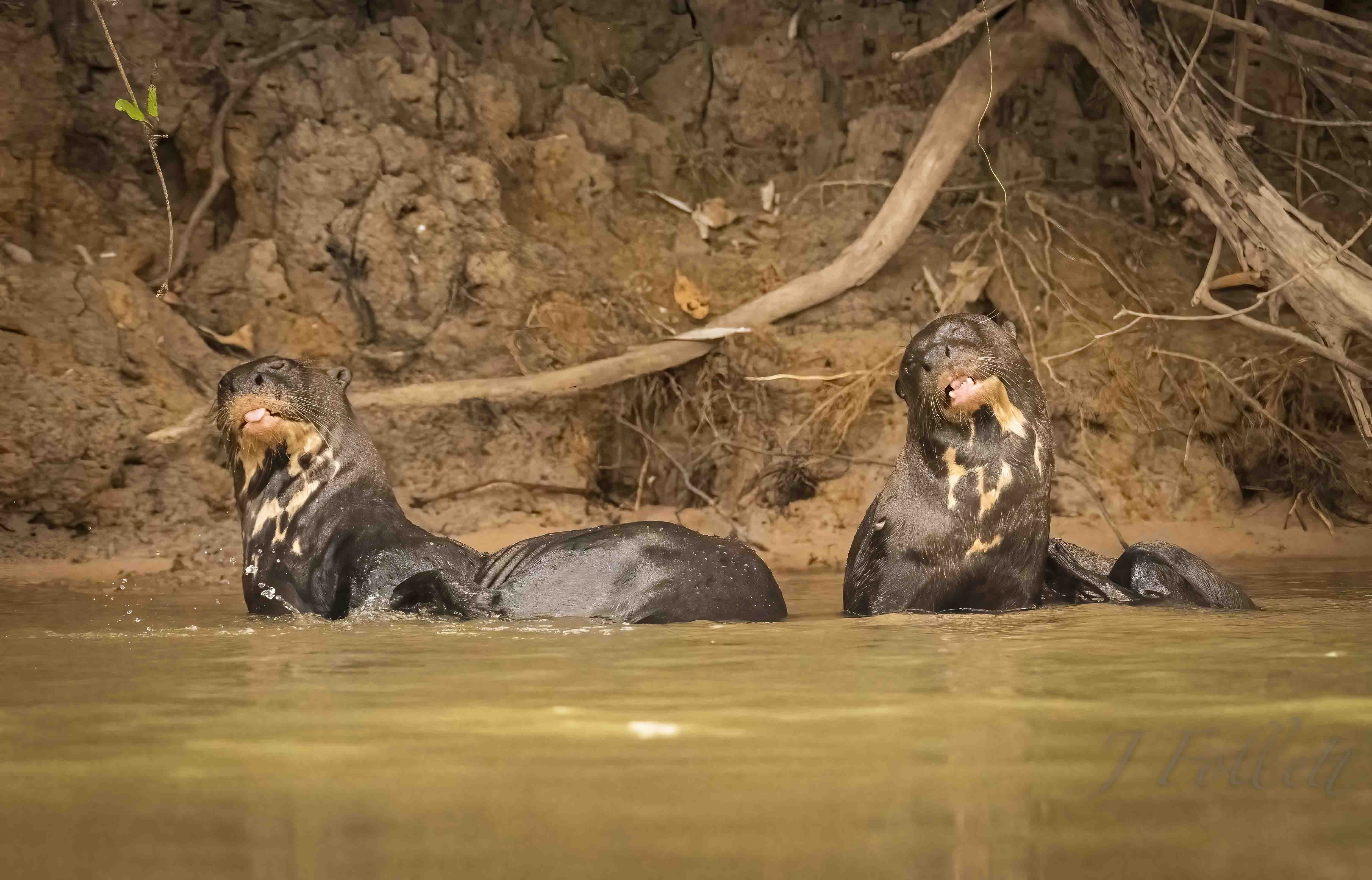
The giant river otter is the largest member of the weasel family with some reaching six feet long.   It competes with the jaguars for food.   Their legs are short and stubby and end in webbed feet with sharp claws.

They live in highly social groups of family members, numbering from two to twenty.    They are monogamous.   Litters number from one to five, and at nine to ten months the juveniles can hunt independently.


The adults create large burrows, up to 50 meters in size, and set aside areas for communal use latrines.


The collective nouns for river otters are romp, bevy, family, raft, and pod.


The giant river otters are a top predator in the waterways, usually eating common fish but also taking on caimans, anacondas and piranhas.


Giant river otters are the noisiest of otters and have a complex repertoire of vocalizations.


Video of the giant river otters moving up the river:


Eventually, the otters reach a slit in the dirt bank.   It’s their den.   We spend more than an hour  watching their behavior, taking photo after photo, more than 400 for me, plus a video.


I find the behavior very interesting—that they hunt and feed as a family and share what must be a very large den in the river bank.   I wonder what they do when the flood season comes and the rivers overflow their banks.


An adult otter calls the family to gather at the den.   The call begins with a whistle and then something of a bark.


From Wikipedia:  Duplaix identified nine distinct sounds, with further subdivisions possible, depending on context. Quick hahbarks or explosive snorts suggest immediate interest and possible danger. A wavering scream may be used in bluff charges against intruders, while a low growl is used for aggressive warning. Hums and coos are more reassuring within the group. Whistles may be used as advance warning of nonhostile intent between groups, although evidence is limited. Newborn pups squeak to elicit attention, while older young whine and wail when they begin to participate in group activities.[35] An analysis published in 2014 cataloged 22 distinct types of vocalization in adults and 11 in neonates.[36] Each family of otters was shown to have its own unique audio signature.[37] 


On the way back to the hotel, we find another jaguar that is unidentified so far.


There is a drama playing out in my bathroom.  


 I see a cockroach on its back, waving a front leg and a rear leg.   Ants are attacking it, though they scattered when I turned on the light.


I take a piece of toilet paper and hold it above the cockroach’s front leg.   It grabs hold and I move it until it is upright.   It tried to get away, but with only a right front leg and a rear left leg, can only go in circles.


I close the bathroom door and leave it to its fate.


***


Some birds to take your mind off the cockroach:


Fork-tailed flycatcher.

Yellow-billed cardinal


Curassow male.


Black-capped Donacobius.


Anhinga female or juvenile.