The Africa Journals
Chapter 64
Brian Tells Stories
After nourishment, shelter and companionship, stories are the thing we
need most in the world.
― Philip Pullman
My time in Africa is coming to an end. There will be no more safari drives to see
wild animals, no more time travels into history, no more dining on exotic
foods. Our coach will now take us to the
final destination on our itinerary, one of the most famous gardens in the
world, known as Kirstenbosch Botanical Gardens.
We leave Hout Bay after our seal-viewing boat returns safely
to the dock and board the coach. As we
leave the town, Brian tells us a story.
There is, he says, a reclusive man who lives along the coast
many, many miles from here. He is called The Seal Man and probably is known by more
seals than humans. Sick and injured
seals often travel vast distances to see him, knowing that he will treat their illnesses
and heal their injuries.

How the seals know to visit the man is unknown, except that healthy seals often escort ill seals to him. There is very little information available
about him, and I’ve searched the internet several times. If I never find a word about the man, I am
happy that he is there tending to the seals.

***
 On a drive through Simon’s Town on the Cape Peninsula, we
pass a small park called Jubilee Square and Brian points it out, though not
soon enough for me to get my camera ready.
Through the autos and tree branches, I catch only a glimpse of a bronzed
statue commemorating Able Seaman Just Nuisance.
On a drive through Simon’s Town on the Cape Peninsula, we
pass a small park called Jubilee Square and Brian points it out, though not
soon enough for me to get my camera ready.
Through the autos and tree branches, I catch only a glimpse of a bronzed
statue commemorating Able Seaman Just Nuisance.
Odd name for a seaman in the British Royal Navy, don’t you
think? What’s even stranger is that the
seaman was a dog—a Great Dane, specifically.
Just Nuisance was whelped in April, 1937, in a suburb of
Cape Town, then sold to Benjamin Chaney, who moved to Simon’s Town to run the
United Services Institute there, which was patronized mostly by British sailors
from the British Naval Base in the town.
Treated to tidbits and affection, the sailors became the dog’s favorite
and it would have nothing to do with men from the other services. He could recognize sailors by their square
collars and bell bottomed trousers.

Just Nuisance took to riding the local electric train with sailors
on liberty heading for Cape Town, and then riding the train without the
sailors. If kicked off by the
conductor, the dog would wait patiently for the next train and board it. Eventually, the Navy bought the dog a season
pass to ride the train, and Just Nuisance began escorting inebriated sailors
back to their bunks at the naval base, sometimes even if they weren’t stationed
there.
The HMS Neptune was one of the dog’s favorite ships and
lying down at the top of the gangplank was his favorite spot. Because of his size, the huge dog was
difficult to get past and “loathe” to move.
His name came from many sailors saying, “You’re just a nuisance, why do
you have to lie here of all places?”
In October of 1939, Just Nuisance was inducted into the
Royal Navy and as a volunteer during wartime, he was allowed to ride the train
for free. Postcards of Just Nuisance
wearing his sailor’s cap were sold to raise money for war bonds.

Just Nuisance was no perfect seaman and his record lists offenses
such as losing his collar, riding the train without his free pass, sleeping on
a bed in the Petty Officers’ dormitory, and refusing ejection from the Sailor’s
and Soldiers’ Home. He would, however,
insert himself between two fighting sailors and thereby end the fisticuffs, thus
saving the men from bodily harm.
Alas, such large dogs live short lives, and Able Seaman Just
Nuisance was put to sleep when it became obvious he was slowly becoming
paralyzed from thrombosis, results of injuries sustained in a motor vehicle accident. In 1944, he was buried in a solemn ceremony complete with a rifle salute by Royal Marines and a lone bugler. A granite gravestone marks his grave.
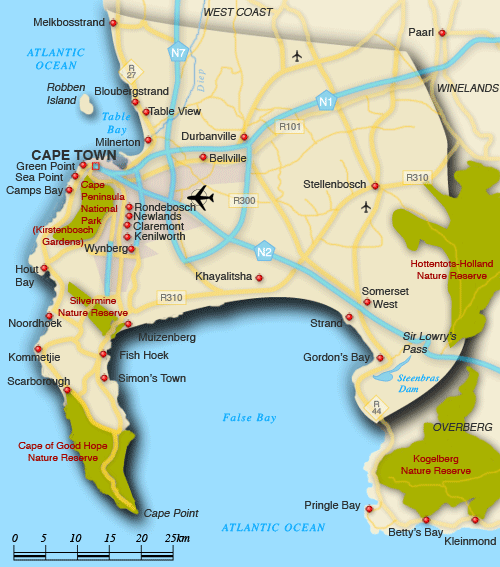 |
| Hout Bay is on the left side of the peninsula and Simon's Town is on the right. We are now heading for Kirstenbosch , shown in parenthesis below Cape Town. |