"I'm going to speak my mind because I have nothing to lose."--S.I. Hayakawa
_______________________________________________________

Thursday, March 16, 2017

The Kenya Journals, Ch. 7: Sleepless on the Masai Mara


Chapter Seven:  Sleepless on the Masai Mara


In wisdom gathered over time I have found that every experience is a form of exploration.
- Ansel Adams


While the lions feast on their kill, my attention is drawn to two cubs staring at something across the river.
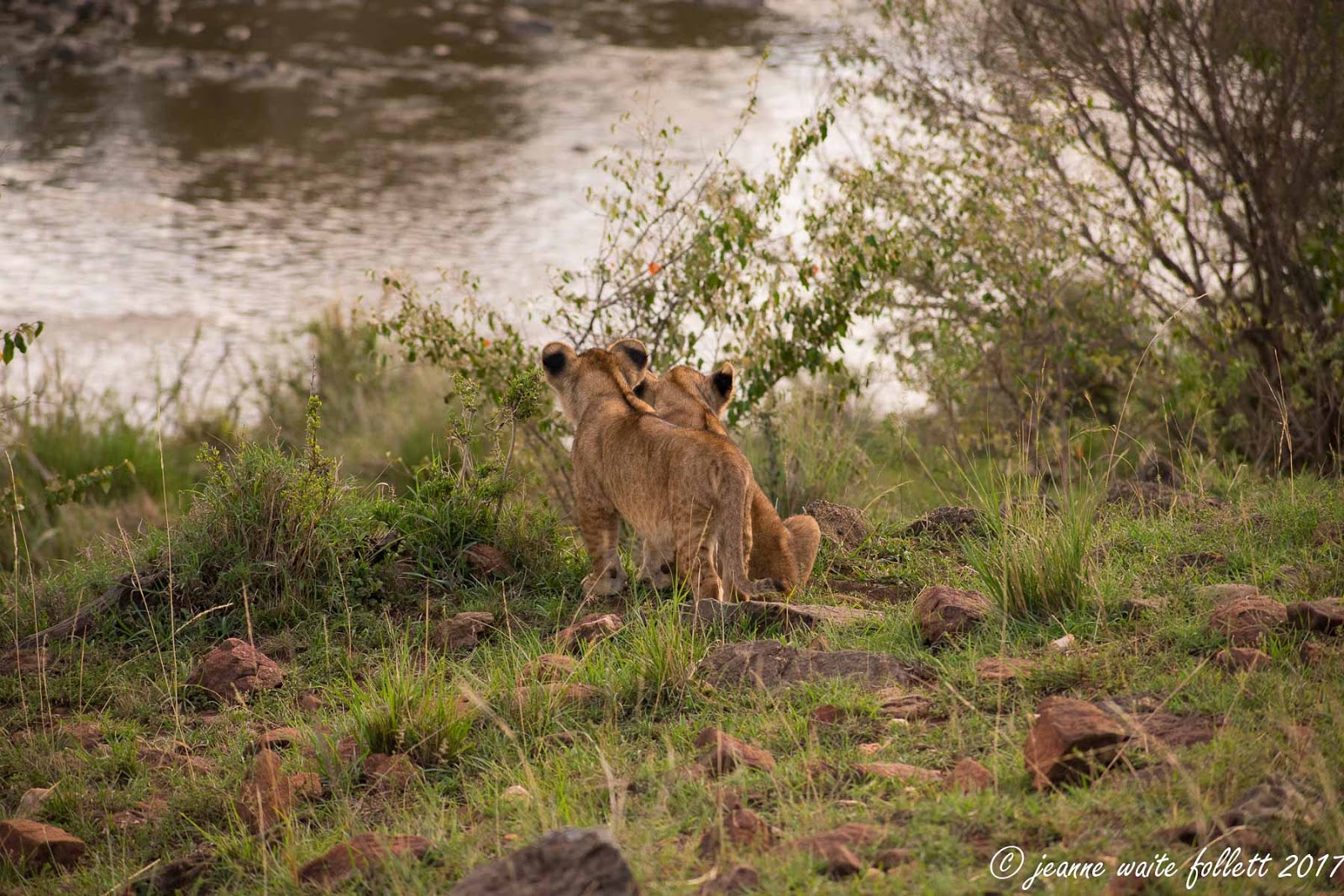


After fleeing back across the river and now safely on the plain, the grazing beasts of the savannah are lined up, watching as the lions consume their prey.  It is almost impossible not to project human emotions upon these animals.   Are they saying to goodbye to one of their own?   Pondering how a simple stream crossing, something they probably have done many hundreds of times, turned so deadly?   


It is a moving tableau, and the last thing I expected.   I thought they would still be running from danger, certainly not stopping.


Several giraffes approach the scene with their slow and fluid gait, seemingly drawn to the drama playing out.  They, too, watch the lions. 


The wildebeest and zebra solemnly walk away, heads hung low.   They move steadily, as if in mourning, not pausing to graze.


Eventually, the giraffes follow the herds and then linger atop a distant ridge.  They are silhouetted in the last light of day as they turn once more and look upon that river of death.

The giraffes are the last animals we see after leaving the lions to their feast.   We pause briefly to take a sunset shot, and then Dennis hurries us back to camp before the government-mandated curfew when all humans must be off the Mara and the animals are left undisturbed.


I lie in bed that night, thinking about those wildebeest lined up on the river bank.    I think about how both lions and wildebeest seemed surprised to see our vehicle and paused just long enough to….

To what?   Did a wildebeest pause long enough for a lion to grab it?   Did the lion hesitate long enough for the wildebeest to escape?

All the action took place in the brush, out of our sight.  Considering where the prey finally fell, it must have gone in that direction, away from us but right into the waiting lions.

No doubt a lion would have caught a wildebeest had we not been there; they had laid their strategy well.  But I can’t escape the feeling that, somehow, we humans intervened, and I am torn between guilt over the wildebeest and satisfaction that the lions had a good meal.


These guides go to school to learn their craft, and many have been plying it for years.  They know the animals and their behavior, know how close they can get, and when to move.   But, they also have clients to satisfy.

Yes, it’s thrilling to get wonderful action shots of predators and prey.    Watching and photographing wild animals, and the circulation of those experiences and photographs,  often lead to new efforts at conservation and protection of these wonder-full creatures.

 Yet, somewhere along the line, that human intervention—active or passive—comes into play, and the ethics of that is what keeps me awake this night.


Tuesday, March 14, 2017

The Kenya Journals, Ch. 6: Gobsmacked on the Masai Mara


Chapter Six:  
Gobsmacked on the Masai Mara

Kenya yetu,
Hakuna matata
(Our Kenya, there is no problem.—
Kenyan pop song lyrics)


Dennis maneuvers our safari vehicle around another one and parks next to a well-worn trench.   I’m new to the ways of the Mara, but even I can see that it is an access trail down the steep bank to the river, worn deep into the soil by generations of hooves.

Across the river, wildebeest and zebra are descending a similar trail and gathering along the river shore.  The wildebeest are moving to my right and my view of them is blocked by our vehicle so I can’t tell if they intend to cross or just to drink.


I notice the zebra on the river shore are bunched up and holding back, acting wary.  They are looking across the river—looking directly at a lioness crouched beside a bush.   She was there when we arrived and hasn't moved.


I lean out the side of the vehicle and see several wildebeest in the water.   It’s an awkward position for me and my camera focuses on the vegetation rather than the animals.   Suddenly, a couple wildebeest reach the top of the trench and stop, apparently surprised that we are parked right next to them, almost close enough to touch.

And then all hell breaks loose!   


The rump and tail of the wildebeest is in the foregound. Note that the original lioness is still lying on the bank.   Where this one came from, I have no idea.   I didn't see it.


There is an explosion of wildebeest and lions!   Predator and prey go in several directions, so fast it’s impossible to keep up with them, especially if you’re watching the action through the viewfinder on your camera.

I had set up take a shot of the wildebeest right next to us but accidentally—and fortuitously—catch a lioness coming right toward me in full charge.  My camera is set to take multiple shots as long as the shutter button is depressed and it is not until later that I realize what I have captured.


Note the head, mane, and shoulder of the wildebeest.   And the lioness looking right at me!


She could be in my lap in one leap.


As quickly as they appeared, predator and prey disappear.   I have a vague sense of a wildebeest disappearing away from us into the brush that covers the hill, but when I said there was an explosion of action, I meant it.

Dennis starts the Land Rover and drives around the base of the hill to the far side.  It takes only a couple minutes and when we arrive we see that the lions have been successful.  The wildebeest is already dead, thank goodness, and one lioness is beginning to work on the soft tissue of its underbelly.


Note the strength of the lion's claw holding the wildebeeste's hide quarters open.


Right next to the wildebeest is the bare rib cage and head of another wildebeest that had fallen to the lions.  It is an eerie scene.

A lioness appears on the hill.   Apparently, her cubs were hidden up there in the brush during the stalk and chase, and she is now bringing them down.   


Only one lioness feeds on the wildebeest.   The others hold back for a long time, perhaps exhausted from the chase, perhaps obeying the hierarchy of the pride.   


Lioness catching her breath.   How close we are.


 One particularly brave cub examines the animal.


Pretty tough hide to get through for a little cub.


There’s not a lot of action to photograph while the lions feed on the carcass, but the cubs give us plenty of photo ops.    


Note the one cub attempting to nurse.


Always play time for the cubs.


Exploring.


Eventually, the other adults appear to recover from their exertions enough to join in feast, and that one brave cub does too, after being shooed away a couple times.


I’m watching and photographing the antics of the other cubs.   They wander down to the river and an adult brings them back.

And then I notice them staring intently across the river.


(to be continued)